
Goldberg Variations

Insightful presentation on this wonderful JS Bach composition

October 2026

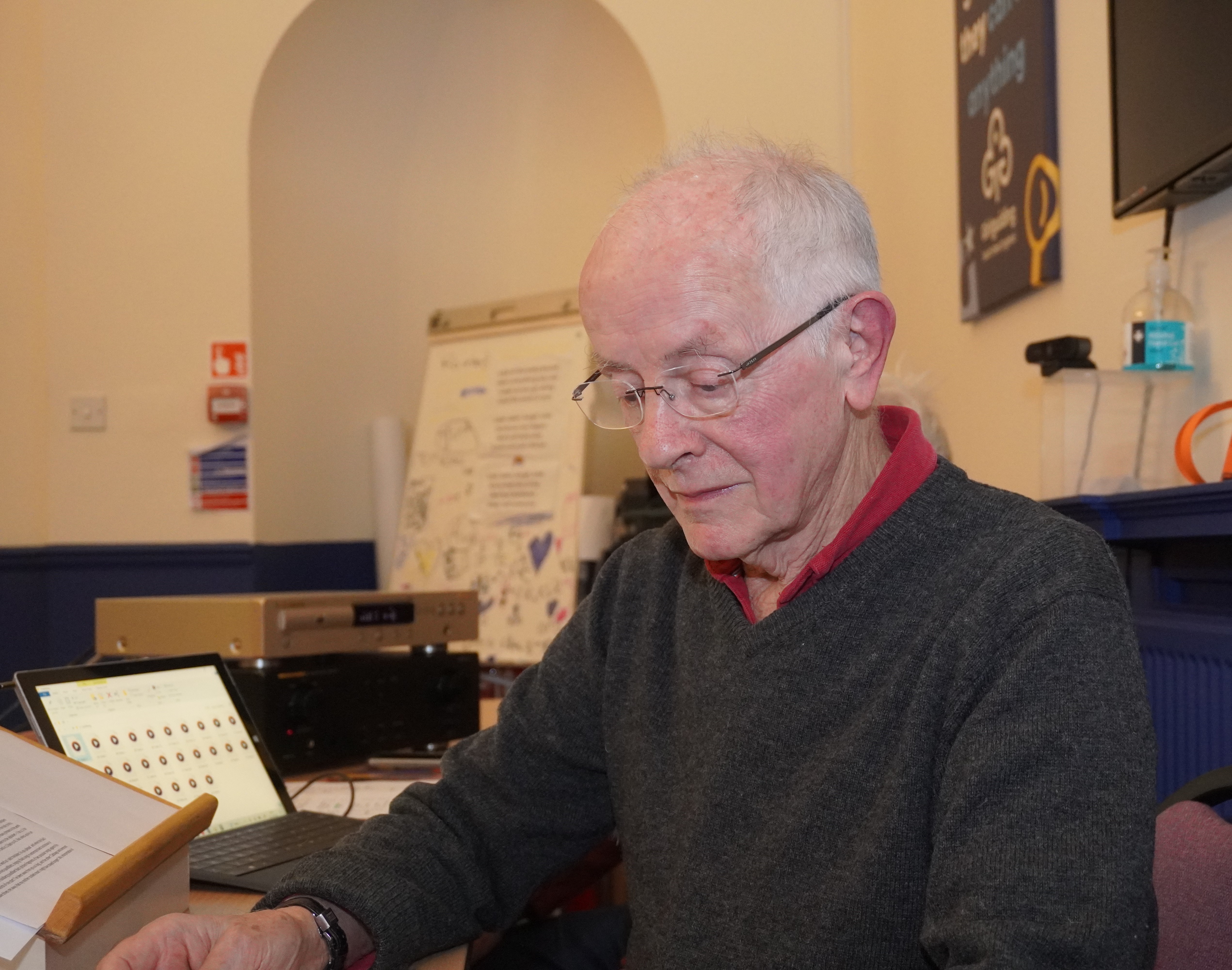
Last evening’s presentation by Jeremy Barlow (pictured) was entitled ‘From Gould to Gold‘ and focused on the many interpretations of the Goldberg Variations by JS Bach, BWV 988. The ‘Gould’ in the title refers of course to the great Canadian pianist Glen Gould who has provided a range of brilliant performances of Bach’s music. As someone in the audience pointed out, he was a bit of a problem for recording engineers because of his habit of singing along to pieces and noisy foot tapping.
There are many myths about the piece, the most famous being it was written for the Russian Ambassador to enable him to sleep. Few believe this today as there is no dedication to the Ambassador and the generous gift of a golden goblet full of gold coins was not found in Bach’s effects when he died.

‘Goldberg’ refers to the harpsichordist said to have played them at the time but there is doubt even about this since he was only 14, although he was a prodigy.

The purpose of Jeremy’s presentation was to explore the many different interpretations of the piece both on a harpsichord (for which it was composed) and on the piano. The two instruments are different in structure he explained: a harpsichord requires the strings to be plucked and a piano by contrast the strings are hit by a hammer. A seemingly small distinction but it means there is no means to vary volume on a harpsichord which requires a different compositional technique to achieve this.

We heard no less than a dozen versions and what was remarkable was the extent of the differences. The metronome had not been invented in Bach’s day so we have no means of knowing the tempi of the composition. The early Gould recording for example was a lot faster than the later ones. This might partly be due to the amount of space on discs after the war, later LPs overcame this.

One performance was by Wanda Landowska from before the war providing a rather delicate version. Jeremy liked Wilhelm Kemp’s treatment which displayed a clear and distinct presentation. One recording was by the Icelandic pianist Vikingur Ólafsson which adopted an almost demonic pace.

The presentation was remarkable, not just the erudition that Jeremy provided, but showing how just one piece can sound so different and invoke different emotions in the listener. This was especially so in the Aria with the slower paced interpretations hitting the mark. We certainly will listen to Bach (and perhaps other composers from that era) rather differently in future. We tend I suppose to hear a piece thinking that’s ‘it’ in terms of authenticity and interpretation, whereas Jeremy’s talk demonstrated that there are many different approaches to the same piece each with its own cluster of feelings.


The next meeting is on 9 November and is a Members’ evening so send in your piece to Robin Lim robert.lim@virginmedia.com please. The meeting will be preceded by a short agm.

Peter Curbishley

Picture: Salisbury RMS
Tonight’s meeting

October 2026

Tonight’s meeting (26th October) is centred around Bach’s Goldberg Variations and presented by Jeremy Barlow. Something of a contrast from the presentation two weeks ago!

It was always believed that the piece was created to help a Russian ambassador to get to sleep and to be performed by a young harpsichordist he employed, one Johann Goldberg.

The story is probably apocryphal and the gold coins and goblet Bach was supposed to have been given were never found in his effects when he died. But it’s a good story.

Today, they are more popular than ever so tonight’s review of the various recordings should be a treat.

7:30 as usual at the rear of the Guide’s Centre.

PC

Steve Reich at 90

Presentation about this American composer

October 2026

Rhythm – memories – unusual sound – experimental – original – repetitive – strangely moving – different – modern – odd combinations – slow build up of harmonies – tedious – chords – exploratory – exciting – polyrhythmic. I suppose one could say all these things about Reich and we spent the evening exploring his music guided by Alan Doel (pictured).

Alan played some interviews of Reich where he explained some of the reasoning behind his compositions, how he takes a chord and varies its combinations in repeated elements. His start in San Francisco was working with various tape machines to create a mix of sound. One of his early influences was Stravinsky’s Right of Spring but also JS Bach – something of a contrast.

A remarkable piece the composer performed with Wolfram Winkel involved rhythmic clapping with everchanging phrases. The strange thing I found is that I was aware of when it was going to end – hard to explain but there you are.

Music for 18 Musicians was played the musicians included wind, strings, xylophone and singers. Typical of his work it was a simple set of themes endlessly repeated with variations. Other works included ‘It’s Gonna Rain‘ and ‘Runners‘.

Another piece featured was music for 4 Organs and maracas which was first performed in Carnegie hall to a less than ecstatic reception. It takes a single 7 note chord and combines them and recombines then to a climax. The use of maracas reminds one of Philip Glass.

There was a moving film of a piece called Different Trains where he contrasts his own train journeys in America in contrast to the terrible train journeys endured by Jews in Germany and how his own life might have turned out differently (he is Jewish).

An accessible piece some of us thought was Music for Eight Pieces of Wood the wood being claves that is, hollowed out tubes each of a different pitch. There was a strong primitive feel to the composition and reflects Reich’s desire to do as much as he can with minimal resources.

Reich claims he is influenced by a French composer from the 12th Century called Pérotin about whom little is known (even his name) who left behind a small body of work the simplicity of which one can see might be appealing to him.

What to make of him as a composer? He is regarded as influential both in the classical world but also in jazz and popular music. Some say he is accessible arising from the lack of complexity in his work. He scorns a base line he says because it tends to dominate the form of a composition. It is argued that the idea of repeated rhythm somehow captures the modern world.

Wittgenstein is sometimes quoted who said ‘how small a thought it takes to fill a whole life’ which seems to sum him up well.

Alan was thanked for the work in putting this presentation together and giving us an insight into an important minimalist composer.

Next meeting on 26 November focuses on the Goldberg Variations by JS Bach.

Peter Curbishley

Picture: Salisbury Recorded Music Society


Next meeting

October 2026

Our next meeting will be on 12th October when Alan Doel will present ‘Steve Reich at 90’ and take us a pulsating journey from Minimalism. Starts at 7:30 and parking is free to the rear of the Guides Centre.