Fascinating presentation on Black musicians

Dual presentation explores the historical role of Black musicians and breaks new ground

April 2026

The title of the presentation was Black musicians in England 1500 – 1800 which might have led you to believe a presentation tending towards the esoteric. Well, not a bit of it and Society members Rosemary Pemberton and Jeremy Barlow broke new ground with a truly interesting presentation on this topic.

What was noteworthy as the evening wore on was the degree of scholarship and research which had gone into it. After all, the subject is a little off the beaten track and the treatment of Black people during the period in question does not show Britain in a favourable light. Black people were considered a lower form of life and the slave trade was at its height by the end of the chosen period.

Rosemary got the idea she said by noticing a piece of Chelsea pottery of a Black musician probably playing an early trombone. Other pictures from that era revealed black musicians often somewhat tucked away. One well known individual was John Blanke (variously spelled) who was a trumpeter in Tudor courts including that of Henry VIII. He was thought to be the first Black musician in Britain.

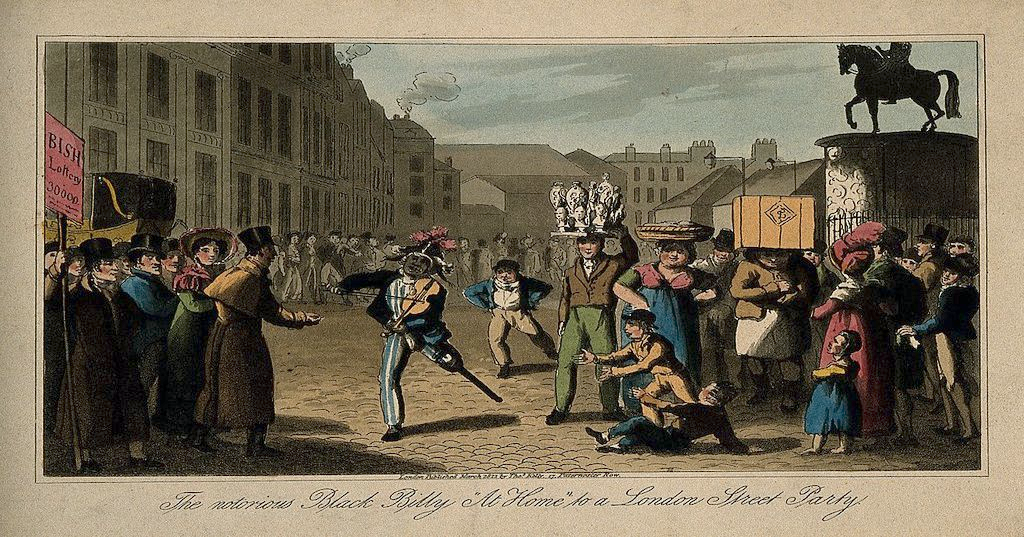
A Hogarth print showing a Black trumpeter was another example. Another character was Billy Walters who busked outside the Adelphi theatre for many years with a wooden leg. His real leg was strapped up behind we were told.

An interesting fact was the role these musicians played in the army where they were used for signalling. Different melodies or riffs were played to send an order or message. One musician was attached to each squadron. Evidently, they were dressed in ‘reverse’ colours to the rest of the soldiers which did rather mark them out for enemy fire.

The arrival of more Black people in 16th Century was resented then much as some are now, the increasing numbers arriving from captured Spanish galleons.

And not forgetting the music. There were 16 pieces played during the course of the evening. Many were to illustrate particular instruments current during the period including for example the cornu, a huge curved horn.

Jeremy had brought along an unusual instrument native to Spain called the flabiol and there was video of someone playing it. A lot of wind instruments have a hole underneath to allow a change of register. This has two with one open or closed with the little finger which makes it something of a rarity and difficult to play.

There were illustrations of Turkish influence which had a big effect on western music. The recognisable beat appears in the overture to the Die Entführung aus dem Serail by Mozart to illustrate the influence.

An extraordinary character was George Bridgetower a violinist (1791?-1860). The son of an Afro-Caribbean servant and a Polish mother at the Esterhazy palace, he was a student of composer Joseph Haydn and a friend of Beethoven. Beethoven dedicated a violin sonata to him, which was so hard to play many gave up. There was a falling out with Beethoven and the sonata became known as the Kreutzer Sonata. However, he never played it and there are moves to getting it renamed as it was originally.

It was something of a revelation that so many Black musicians were around during this period. It does not counter the appalling treatment that Africans experienced during the two centuries of the triangular trade and their fearful exploitation. But it does show that now and again, talented Black people were accepted into British society.

I cannot fail to mention that one of the pieces – La Volta by Byrd – was played by the Broadside Band, the creation of non other than one of the presenters, Jeremy Barlow, described as a ‘formidable presence’ by the Folk Music Journal.

This was an exceptional evening which illuminated and brought into the light the role played, sometimes in the shadows, by Black musicians in England at that time. The evening also illustrated that learning about the history and background of music and musicians is something the Society can do which is unique locally. The presenters made great use of prints and paintings from the time to illustrate their points.

The chair of the Society, Peter Horwood, in thanking both Rosemary and Jeremy for their work and research in their presentation, noted that Black people have a prominent roles in Jazz and popular music but were less evident in the classical world. Clearly there is work still to be done. He also thanked Robin for juggling discs, YouTube clips and PowerPoint to enable the evening to go smoothly.

Peter Curbishley

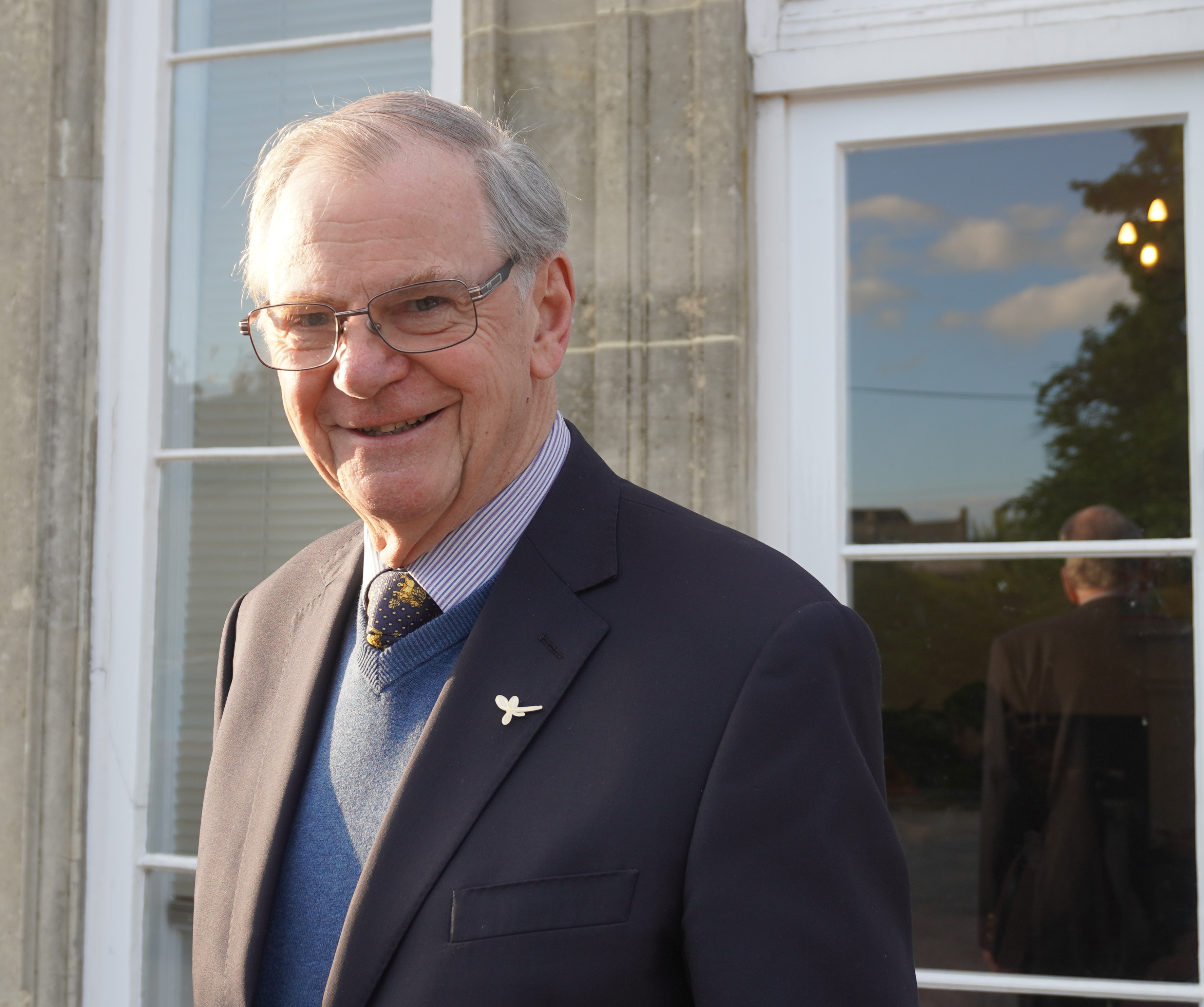
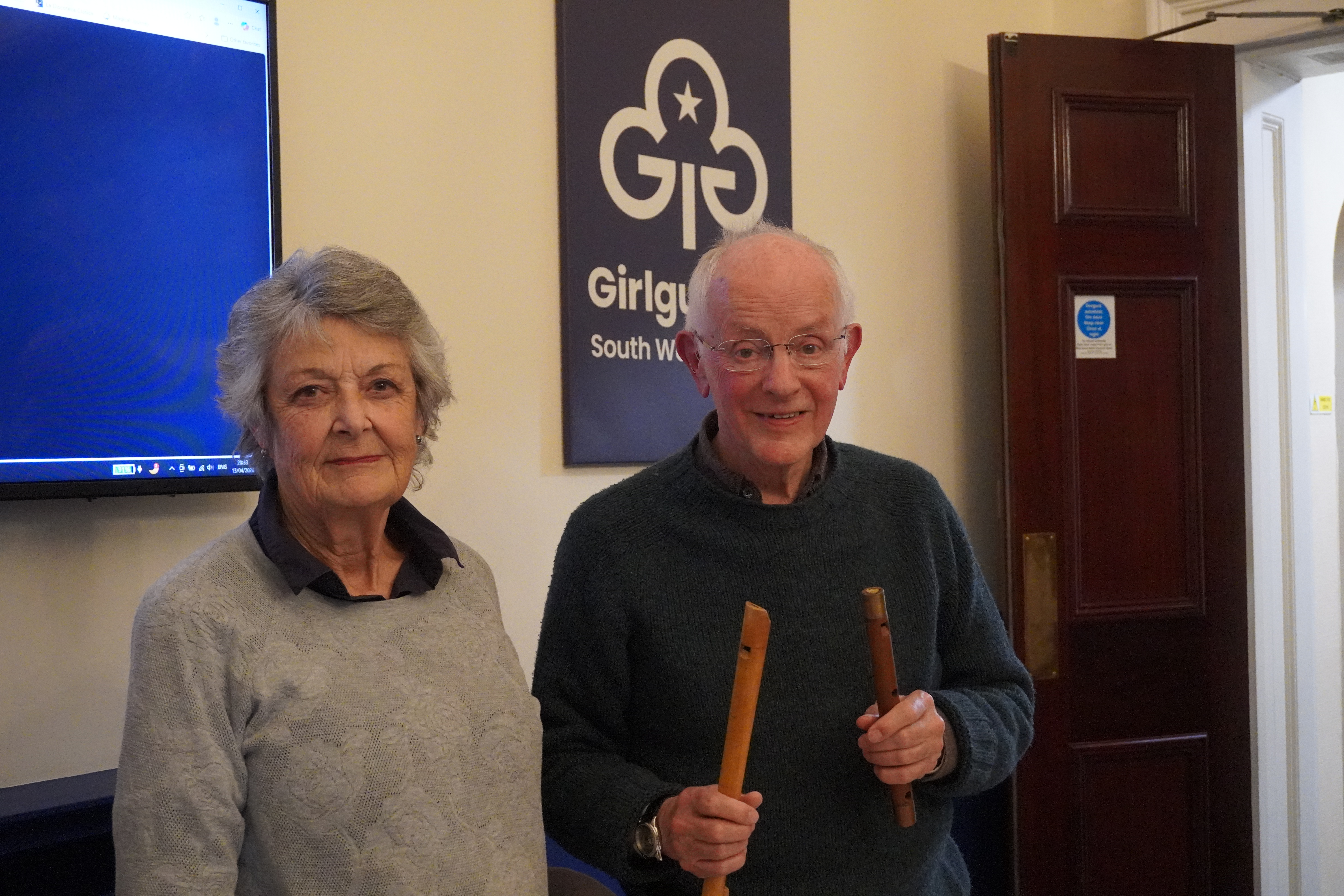
The presenters Rosemary and Jeremy. Jeremy is holding the flabiol in his left hand. Picture: Salisbury RMS


Next meeting

Our next meeting will tomorrow Monday 13th April when Rosemary Pemberton will present, with slides, a talk entitled ‘Black Musicians in Scenes of English Life, 1500-1850’.  Jeremy Barlow will provide the music, with commentary.

Unfortunately our next scheduled speaker is unwell, so we will be amending the rest of this season’s programme as follows: 

On Monday 27th April, we will now have, postponed from February, Tim Rowe and Alan Doel will present:  “Eric Satie: Gymnopediste!” 

Then our final session this season, on  11th May, we will welcome  Simon Coombs who will present: “Music from the Iberian Peninsula” 

We hope you had a good Easter break and that we shall see you at one or preferably more, of these evenings. 

Next meeting

An evening focusing on women composers

March 2026

We are delighted to welcome the ‘cellist Catherine Wilmers to the next meeting on Monday 23 March starting at 7:30 as usual. Catherine is a professional musician and played for many years with the LPO. You can read about her on her extensive website which will also give you a flavour of the evening’s presentation.

She will focus on female composers who all too rarely appear on programmes

and in performances. It seems that Dr Johnson’s disparaging comment is still true when told about a woman preaching at a Quaker event: ‘Sir, a woman’s preaching is like a dog walking in his hind legs. It is not done well but one is surprised to see it done at all’ (Boswell).

She will focus on works for the ‘cello and piano by women composers. No doubt she will show it can be done well.

Free if it is your first visit then £5 if you come again. The next meeting is on 13 April. We are at the rear of St Ann St in the Guides Centre with free parking. Access from Carmalite Way. We finish at 9:30.

PC

Photograph from her website.


Tonight’s meeting

March 2026

Tonight’s meeting will be on Monday 9th March at 7.30 when Peter Curbishley will be presenting “My Musical Journey – Half a century of listening””

At the following meeting on Monday 23rd March we will welcome Catherine Wilmers who will present “Works for ‘cello and piano by British women composers”

At our previous members’ evening several members expressed interest in having a copy of the play list, and of the final two YouTubes.  If you would like me to send these to you, please would you respond ‘Yes please’, to this email.

We hope to welcome you to one or both of these evenings.

Next meeting

CANCELLED

The next meeting takes place on Monday 9 February starting at 7:30 as usual and aims to finish at 9:30 with a break in the middle. It will be presentation by two of our members on the French composer, Eric Satie. Born in Honfleur in 1866 he had a French father and English mother. He went to the Conservatoire and left without qualifying spending much of his early life playing in Paris cafes.

He is famous for a narrow range of compositions but, as a member of Les Six he was influential particularly with Ravel, Debussy and Poulenc. It will be interesting to hear a range of his pieces in a concentrated programme.

Non members are welcome and the first visit is free and £5 thereafter. Parking is on the doorstep and there is reasonable access for people with limited mobility. Satnav SP1 2HB.

Full programme.

PC

With few strings attached

First meeting of the second half

January 2026

In these days of jet travel, the internet and international transport, we can forget that in times past, people lived very local lives, often their village and the local market town was the limit of their universe. Many had never heard a symphony orchestra or went to the opera. Their music would have been travelling players in the local church (village and church halls were a rarity) and if they had access to ‘classical’ music at all, it might be a piano transcription of a symphony or other piece.

The middle classes might have an invitation to the ‘big house’ to hear a small ensemble of some kind. It is this world that Ed Tinline illustrated with his presentation featuring wind ensembles. As ever, there were pieces by composers long forgotten who might have been quite famous in their day.

Wind ensembles trace their roots to military bands in the seventeenth and earlier times and came to the fore in the French Revolution. One of the problems for composers was the lack of standardisation of the instruments which meant writing ensemble pieces difficult. Some pieces were composed to fit the players who were available not the other way round.

The twentieth century saw the form come of age so to speak and major composers start to write pieces specifically for these groups.

We started with a piece by a composer you are likely to have heard of, one WA Mozart and his 1781 Serenade, followed by someone who has almost been forgotten, Franz Tausch (1762 – 1817) and his Wind Quartet op 22. Pieces by Antoine Reicha and Franz Krommer followed. Reicha taught at the Conservatoire and pupils included Liszt and Berlioz but he fell into obscurity after his death.

We moved into later periods with music by Gabriel Pierné and Paul Taffanel who both lived into the twentieth century.

The second half had contributions from Carl Nielson and his Wind Quintet and Leoš Janáček. Someone less well known is John Fernström with his 1943 Wind Quintet. He is another of those who had a significant output of works but who has largely disappeared. Born in China, most of his life was spent in Sweden where he was an orchestral player and conductor.

After a Wind Quintet by Eugène Bozza (1905 – 1991) we listened to an unusual piece for 4 saxophones by Philip Glass. Finally, and cheating a bit (there’s a piano!), was the Quintet in B by Rimsky-Korsakov.

An interesting programme with a variety of forgotten compositions interspersed with works by established composers.

Our next meeting features the work of the eccentric Frenchman Eric Satie on 9 February.

PC

Next meeting

Last meeting before Christmas

November 2025

TONIGHT

Our final meeting in 2025 will be on 1st December when David Davies will be asking “Are you sitting comfortably?” and presenting some Classical Music Signature Tunes. 

In the new year we will resume on Monday 26th January 2026 when Ed Tinline will present: “With few strings attached”,  music for wind ensembles.

We hope you will be able to join us on Monday.

With best wishes for Christmas and the New Year.

Next meeting

October 2025

Our next meeting will be at 7.30pm on Monday 3rd November 2025.
It will commence with a short Annual General Meeting followed by our Members’ Evening.  For this Robin now has almost sufficient pieces for what should be a thoroughly enjoyable evening. Any last minute ideas for possible inclusion if there is time to Robin please.

Following this on 17th November we will have a presentation entitled: “Seventh Son”  An appreciation of the work of Gordon Jacob. Written and presented by Geoff Ogram 

On 1st December at our final session before Christmas, David Davies will  present some Classical Music Signature Tunes.  To help him prepare for this, David has asked me to forward the following to members:

The meeting on December 1 is entitled ‘Are you sitting comfortably? These words began Listen with Mother at 1.45 every weekday on the BBC Light Programme from January 1950 and on into the 60s. And every programme ended with the Berceuse from Faure’s Le Jardin de Dolly suite for piano duet. The words and the tune are still remembered fondly by a whole generation.

But what else in radio and television (including adverts) has used classical music as a signature tune? We shall have a not-too-serious discussion on this topic, and I would appreciate your letting me know your suggestions.

You can email me at davidracheld@gmail.com
Thank you.  David Davies

We hope you will be able to join us at these sessions.

Delius

October 2025

Frederick Delius is well known English composer born of German parents in Yorkshire. He showed early promise and clearly had an eventful life. He was not actually christened Frederick but Fritz. He father was a successful wool merchant but Delius resisted going into that line of business and opted to manage an orange grove in Florida as you do.

He returned some years later and spent much of his early life in Paris. He received a formal musical training in Leipzig. His talent was spotted by Greig.

The presentation was by Alan Doel, a member of our Society, who gave us a lot of background to his life and compositions. Delius was key in the revival of English music and listening to an evening of his compositions, there was a powerful sense of the languid landscape that seemed to emerge, a kind of tonal colouring. This was particularly true of the first, and one of his best known pieces, On Hearing the First Cuckoo in Spring. Another piece which captured that quality was In a Summer Garden.

He was somewhat overlooked as a composer until he was taken up by Sir Thomas Beecham who premiered some of his works. It’s interesting to note that his early success was in Germany. His time in America and the influence of negro music showed through with compositions like Appalachia of which we heard the final part. Another piece with American associations was the Florida Suite.

It was an interesting evening and we learnt a lot more about this English composer who’s works do not appear that regularly in concert programmes. Other works included Sea Drift, the Cello Concerto and an extract from the opera Irmelin first performed in Germany. The audience expressed its appreciation for the work Alan had put into preparing the presentation.

Alan set us some homework which was to listen to The Song of the High Hills conducted by Sir Mark Elder.


The next meeting on 3 November will be preceded by a brief AGM followed by a members’ evening. If you have a piece, lasting less than 10 minutes ideally, which means something to you or you would like others to hear, please let Robin Lim know robert.lim@virginmedia.com.

Peter Curbishley

New season gets off to grand start

September 2025

The new season got off to a flying start with a presentation called Murder, Mishap and Misfortune by Alan Forshaw. The title might lead you to believe this was a dour evening, mawkish even – far from it, Alan selected a range of pieces and to an extent, the unfortunate or sad ways the composers died was almost incidental.

We sometimes forget in our world of inoculation (soon to be changed by Donald Trump), health services and antibiotics, that life even into the early twentieth century was, to quote the Scottish philosopher, ‘nasty, brutish and short’. People died of things we would find surprising today. Whilst studying statistics for example I came across some historical death data and a lot of people died of something called ‘the fluxions’. Who found the cure I do not know. ‘Hissing fits’ was another cause of death. I don’t think people would go into a GP’s surgery today and say ‘doctor, I think I’ve got the fluxions’.

Back to the plot and we started with a scherzo by Alkan, an eccentric French composer of mainly piano pieces. Alan presented an evening featuring this composer a while ago. A prodigy, he entered the Conservatoire at 13 and was perhaps unlucky to be around at the same time as Chopin and Liszt. Turned down by the Conservatoire to be the professor of piano, he largely retired.

Alban Berg can be a little difficult to get to grips with. He was a contemporary of Schoenberg and Webern we heard two early songs which were a delight. The rise of the Nazis made life difficult and he moved out of Vienna. Unfortunately he was stung by an insect and died of blood poisoning.

Marcus Blitzstein is not a name familiar to many and Alan played two of his pieces. American, he was gifted and played a Mozart piano concerto at the age of 7. He was gay (but did get married) and whilst in a bar in Martinique trying to solicit a sailor, he was beaten up and later died of a ruptured liver. He is best remembered for the composition The Cradle will Rock.

Ernest Chausson is well known as a composer although he only composed a modest number of works. Alan chose the Chanson Perpétuelle for soprano, piano and string quartet. He was the son of a contractor who made his fortune redeveloping Paris for Haussmann. We admire Paris for its open layout perhaps not always realising that it wasn’t town planning which inspired the changes but the need for the police and gendarmerie to get a good line of fire against the frequent riots. He died young riding the recently invented bicycle and crashed into a wall, dying instantly.

The Trumpet Voluntary is a very well known piece often played at weddings and was composed by Jeremiah Clarke. Properly titled the ‘Prince of Denmark’s March‘ we heard that and ‘Praise the Lord O Jerusalem’. He fell in love with a female student of higher rank than himself and the tension led to him taking his own life.

Enrique Grenados is well known and we heard his exciting The Fandango of the Lamp. He was delayed from leaving New York and missed the boat to Spain catching one to Britain instead. Unfortunately, the ship was torpedoed by a U-boat and sank in the English Channel. Various accounts of how he died are around but one is that he tried to rescue his wife and because he was wearing a money belt filled with gold, he was unable to swim and sank to his death.

Another victim of the Nazis was Pavel Haas, a Czech composer born in Brno of part Jewish parents. A modest output of music and being very self-critical, only 19 have opus numbers. Originally sent to Theresienstadt he was subsequently transferred to Auschwitz where he was murdered.

Few may have heard of Mieczyslaw Karlowicz (pictured) and the excerpt from his Violin concerto in A major was impressive. He was strongly influenced by Tchaikovsky and later Wagner. Born in what is now Belarus he studied in Warsaw and Berlin. While on a skiing trip in the Tatra Mountains, he was hit by and avalanche and died. Not a large output but his orchestrations are praised.

Karel Komzak is not a name known to many. He was born in what is now the Czech Republic and was an active band leader. We heard the Overture to Operetta Edelweiss. One of his claims to fame was that a young musician who played in one of his orchestras was a certain Antonín Dvořák of whom you may have heard.

Leaving central and eastern Europe and to France and the music of Lully who was in fact born in Florence. He was composing during the Baroque period and many of his works are played today. He was a favourite of Louis IV and composed a number of operas and other music. He stabbed his foot with a conducting staff and a toe became infected. Refusing an amputation, infection set in and he died shortly after of gangrene. Alan played part of – appropriately enough – his Te Deum.

Few will have heard of Johann Schobert born, it’s not clear when and it’s not clear where either but somewhere in Germany. He came to Paris and composed many sonatas. His significance in the history of music was a meeting with the Mozarts who came to Paris as part of their grand tour. It appears that Mozart was strongly influenced by Schobert and used themes and some of his stylistic ideas in his piano concertos from that time. Schobert picked some mushrooms and was told by two restaurateurs that they were poisonous but decided to make soup from them anyway. They killed him and his wife and a doctor friend. There’s an old joke: what did the wife of a mushroom say at his funeral? ‘Shame, he was such a fungi’. His Quartet in F minor was a lively piece.

Colourful does not quite do justice to the life of Alessandro Stradella who was born in Bologna in 1643. Educated in Rome, in his day was well known and produced a number of operas and other works. He clearly had a taste for women and indulged in a number of affairs with many who were already married. He survived one assassination but died after the second.

To more modern times and to Canada: not often we hear music from there. Claude Vivier was born in 1948 in Montreal and spent a lot of time working on ethnic musical themes and a variety of modern themes. We heard a piece for soprano composed in 1973 Jesus Ebarme Dich. He was unashamedly gay and frequented gay bars in Paris. He was eventually murdered by a man called Dolzan. Vivier was a strange man and there is speculation he suffered from Tourette’s syndrome.

Finally, back to northern Europe and the music of Webern a contemporary of Berg (above). He composed a lot of works using the 12 tone scale and it would be fair to say, it takes some while to get to understand it. He was a student of Schoenberg. His death was particularly tragic. In September 1945, he returned home during the Allied occupation of Austria, he was shot and killed by an American Army soldier following the arrest of his son-in-law for black market activities. This incident occurred when, three-quarters of an hour before a curfew was to have gone into effect, he stepped outside the house so as not to disturb his sleeping grandchildren, and in order to enjoy a cigar given him that evening by his son-in-law. The soldier responsible for his death was U. S. Army cook who was overcome by remorse and died of alcoholism in 1955.  Webern would not have understood what the American would have said to him. A kind of double tragedy.

A really fascinating evening and a chance to hear a range of music much of it not often heard.

The next meeting is on 6 October.

Peter Curbishley