
New season kicks off

The new season of the Recorded Music Society kicked off with a flying start with a presentation by Tony Powell entitled One Composer’s journey into silence and then resignation.  He was of course referring to Beethoven who, as is well known, became progressively deaf starting at quite a young age in his 20’s.  By 1816 he had lost nearly all his hearing and visitors had to write down what they wanted to say.

This clearly had a traumatic effect on his musical life.  He was a fine pianist and conductor so he was no longer able to do these things.  Even though the music was in his imagination, not to be able to hear what he had composed was a heavy burden to bear.

Tony attempted to take us through his musical life, starting with the youthful compositions and ending with some of the last completed pieces.  It might be tempting to use the major pieces – the symphonies or concertos for example – but instead he chose the smaller scaled compositions: piano trios; ‘cello sonatas; string quartets and piano sonatas.  These are often give a truer insight into a composer’s ‘soul’ if you will, and are harder to compose.  Some may be surprised at this but even composers like Mozart, who could dash off pieces seemingly at will, found the shorter forms harder to complete sometimes taking months.

The big change in the piano trios Tony explained, between Beethoven and the earlier composers, was the role played by the other two instruments.  With Haydn, they were in support of the piano, in the Beethoven’s work, they played an equal role.  This was particularly evident with Op 1 in G Major composed in 1795 when he was in his 20’s.

The style changed and in Op 70 No 2 composed in 1808 we see a greater intensity.  Events in Europe would no doubt had a role to play, in particular the French Revolution and the increase in enlightenment thinking.

He only wrote 5 ‘cello sonatas and we heard extracts from Op 5; Op 69 and Op 102, again a spread through his lifetime showing stylistic changes between 1797 and 1815.

Next to the string quartets and if you were not a Beethoven scholar and heard string quartet No 6 in B flat Op 18, you might be forgiven in thinking it was a piece by Haydn.  The jaunty theme and structure of the quartet typical of that composer.  You would not make that mistake with the last completed quartet (by Beethoven) No 16 Op 135 composed in 1826 the year before he died.

The piano sonatas were a compositional form Beethoven was most comfortable with, possibly because of his piano playing background.  We heard extracts from three: No 1; No 23 (Appassionata) and No 32.  The increase in intensity and complexity was most marked.

This was a most interesting presentation, showing the changing style of Beethoven’s work over his life.  No doubt events in his life – revolution, the Napoleonic wars for example played their part – but his retreat into an inner life would also have been a powerful influence.

Peter Curbishley


Next meeting 1 October at 7:30 as usual
June concert

Notice of the June meeting on 4th

The June meeting will be a little different from normal and will be in the form of a concert of three works;

  • Bellini – “ Norma” Sinfonia/Overture – Vittorio Gui conducting the Orchestra EIAR, Turin, 1937 -Historic recording
  • Elgar Cello Concerto, Beatrice Harrison with Elgar conducting The New Symphony Orchestra, London, 1928 – Historic recording
  • Beethoven Symphony No 7 Bruno Walter conducting the Columbia Symphony Orchestra, New York, 1969 – Historic recording.

Normal place and normal time with easy parking.  If you don’t know where we are go to the ‘Find us’ tab on the home page where there is a map and a postcode.  Only £3 for non-members

Next meeting – March

Next meeting

The next meeting of Salisbury Recorded Music Society will be held tonight, Monday 5th March 2018 at 7.30pm in the usual venue when Jon Hampton will present: “Earth, Air, Fire and Water – An exploration of how the elements have inspired composers from Haydn to Mahler and beyond.”

Hope to see you there.  Free parking and £3 to non-members

Bach and the Leipzig cantatas

This was the title of a presentation by Tim Rowe at the Society’s last meeting where he played a selection of the cantatas composed by JS Bach during his time in Leipzig.  He was Kantor at the Thomas church.

Born in Eisenach in 1685, Bach had a difficult childhood being orphaned by the age of 10 and spent his early years living with one of his brothers.

Tim explained that despite his enormous output and his amazing genius, very little in fact is known about him as a person.  Almost no letters survive and there is no contemporary biography.  There is even some doubt about what he looked like.

Focusing on the Leipzig years, upon being appointed, Bach set about composing music for the full Lutheran liturgical year.  This was an enormous task.  Tim provided a circular calendar explaining the timetable for the various cantatas.  They were produced in an almost production line process, starting on a Monday, finished by Thursday, copied on Friday, rehearsed on Saturday and then performed on Sunday.

The performances were quite unlike the concert halls of today.  There was considerable noise and confusion as people and animals came and went.  Churches would employ a whipper to keep control of the dogs.  Services lasted hours.  People were segregated according to class.  It’s a wonder in all the confusion that he music was heard at all.

We use the word ‘cantata’ to describe these works yet it is not the word used by Bach himself.  Often pieces had ordinary generic words to describe them such as ‘church music’ or ‘church piece.’  216 of his compositions survive from this period as regrettably, many manuscripts were lost, indeed, it has been estimated that 40% are missing.  Part of the problem might have been paper since this was a valuable commodity at the time, still being produced by hand.

Bach’s modern reputation – his ‘unfathomable genius’ as Tim put it – owes a lot to Felix Mendelssohn who worked hard to revive him.  Had it not been for Mendelssohn, his music may have continued to languish in obscurity.  Mendelssohn was distantly linked to the Bach family through his maternal grandmother who was taught harpsichord by one of Bach’s sons and who collected his manuscripts.

Tim played a range of the cantatas all performed by the English Baroque Soloists and the Monteverdi choir under the baton of John Eliot Gardiner.  These were recorded in the year 2000, the 250th anniversary of Bach’s death.

This was a splendid evening listening to some wonderful works by this great composer.

Peter Curbishley


The next meeting is on 5 March


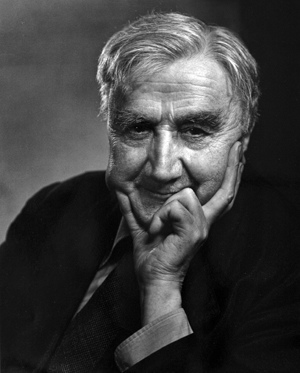
Ralph Vaughan Williams

Chair of the VW Society gives presentation

Simon Coombs, the Chair of the Vaughan Williams Society, gave an extremely interesting and informative talk on the music of Vaughan Williams to a packed room at the last Society meeting on Monday.  Regarded as one of Britain’s great composers, he produced a wide range of music, including songs, symphonies, choral works, chamber music and works with a religious theme.  He was what one might call a ‘late developer’ not finding his voice until his ’30s (reminiscent of Bruckner).

Simon took us through his history starting with his childhood in Down Ampney and his later life in Dorking (Surrey) and Chelsea.  He showed promise at school, composing a short piece called ‘The Robin’ aged 6.  Later he went on to study under Parry and Max Bruch.  He spent time in Paris studying with Maurice Ravel who said of him ‘he was the only one of my students who doesn’t try to write my music’.

He was keenly interested in folk music and started to collect these in 1903.  He was not the first composer to be

Vaughan Williams

influenced by the folk song tradition (one thinks of Bartok) and much of his early work was founded on this tradition.  He was friendly with George Butterworth who shared his passion for English folk songs and who offered advice to VW in his early days including suggesting that he write a symphony.  It is a surprising fact but there are no performed symphonies by a British composer before VW and Elgar.  The suggestion by Butterworth is therefore something of a revolutionary suggestion.  Butterworth died tragically young in the Great War.  VW was keen to contribute to the war and served as an ambulance driver and stretcher bearer.  Like many who served in the trenches, the War made a lasting impression including the loss of friends.

He was keen to popularise his music and started the Leith Hill Music Festival (near Dorking) in 1905 and which still thrives.  He had a huge output which included 9 symphonies.

Simon played a mixture of his works, some familiar, others less often heard.  These included the Fantasia on a Theme by Thomas Tallis; an extract from the Sea Symphony (1909); a song from 5 Mystical Songs; parts of the London Symphony (1913) and the Pastoral Symphony (1921) and from number 4 (1934).

Perhaps the work most recognisably as his is the Lark Ascending strongly influenced by his love of folk songs (1914).  Other pieces included an extract from the English Folk Song Suite (1923), Serenade to Music (1938) and from one of his operas Hugh the Drover.  He was approached by Muir Mathieson to compose the music for the film Thirty Ninth Parallel which he composed in a matter of weeks.

This was a brilliant start to the second half of the season.

Peter Curbishley

Second half of the season kicks off soon

The second half of the season starts tonight, Monday 5 February and we are delighted to welcome Simon Coombs from the Vaughan Williams Society who is going to discuss and play music by this great English composer.  Starts at 7:30 as usual and is only £3 to non-members.  Parking is easy and free and details of how to find us are on the ‘Find us’ tab at the top of the site.

We look forward to welcoming existing members back also any new visitors.

The Case for the Unfinished

The Case for the Unfinished was the title of last nights presentation from Tony Powell.  One might be forgiven for thinking this was about Schubert’s unfinished symphony but in fact it was about other composer’s unfinished works of which of course there are plenty.  Attempts to add another movement to Schubert’s work have not been successful and indeed it is possible that what is left is indeed finished.

Tony instead started with a Night on a Bare Mountain by Mussorgsky.  The final movement was changed by Rimsky Korsakov and this was played first.  Then we heard the original version which was entirely different and a complete contrast.  The point here was that finishing another composer’s work may be acceptable if it is in the spirit of the original.

Mozart
Two evenings devoted to this composer

Another famous unfinished work is the Requiem by Mozart and this was being feverishly composed as he was dying.  It was famously finished by his pupil and sometime collaborator Süssmayr.  There are many arguments about who wrote what bit of the work but nevertheless, there is sufficient of Mozart in the piece to make it a great work of art.  The difference here is that the work was intended to be finished and Mozart was dictating ideas until his actual death.  With Schubert on the other hand, we do not know of his intentions.

Bruckner’s ninth is usually played in its incomplete form but again, a lot of material was left – indeed a substantial number of sketches and completed elements – to enable an attempt to be made to create a final movement.  We heard Sir Simon Rattle conducting a performance and he was quoted as saying that there was ‘more Bruckner in the final movement than there was of Mozart in the Requiem.’  It certainly sounded authentic although there were references to the 5th now and again.

It was a surprise to some present that Puccini did not finish Turandot but the opera was left 15 minutes or so short at his death. It was finished by Franco Alfano yet it is recognisably in the master’s hand.

After a long fallow period following the Great War, Elgar started work on his 3rd Symphony which he did not finish by the time of his death in 1934.  From the surviving material the BBC asked Anthony Payne to finish it and he worked on the project for many years.  The first performance was in 1998 conducted by Andrew Davies.  The usual attribution is to both Elgar and Payne.  We heard part of the 1st movement and most of the 2nd.

Finally, Mahler and the unfinished 10th.  Mahler left a lot of notes and a ‘short score’ that is, not a fully orchestrated version.  Mahler had discovered that his wife had been unfaithful and this added to the turmoil in his life.  Initially his widow resisted attempts to finish and fully orchestrate the score but later relented.   There were several attempts and many statements by musicians saying it shouldn’t be done.  Deryck Cooke worked on the score and this was first performed in 1964.  Alma Mahler had changed her mind once she had seen the finished work and heard a performance.  We listened to one movement which was extremely ‘Mahler like’ in its sound and development.

This was a most interesting evening and shed light on the difficulties and problems of trying to finish another composer’s work.  Composition is a highly individual activity and however many notes and sketches are left, what would have ultimately been produced can never be recreated.  But if the attempts are honest to the original composer’s style and intentions, a worthwhile result can be achieved.

The group next meets on 5 February 2018.