
The next meeting takes place on Monday 8th of May and will be a member’s evening. If you have a particular piece you like or want to hear played then liaise with Anthony Powell. Usual place usual time.
Tag: recorded music
Next meeting
Frederick Delius
Our next meeting on Monday 24th April celebrates the music of the English composer Frederick Delius. We are pleased to welcome Martin Lee-Browne to the Society who is from the Delius Society and will be coming down from the Midlands to speak to us and play some of his works.
Normal start at 7.30 and details of where we are can be found at the top of the page. It is £3 for non-members. Parking is easy and the room is accessible for people with disabilities. We look forward to seeing you.
Next meeting
The next meeting of the Society will be on Monday 20 March starting at 7:30 as usual and will a presentation 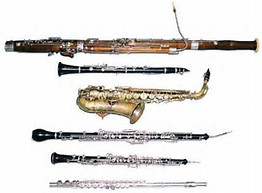 by Ed Tinline on the development of woodwind. He will be playing a selection of pieces including wind soloists and also ensemble playing.
The committee will be meeting immediately prior to the main session. If members reading this have any points they would like the committee to consider, or you might be interested in presenting or co-presenting a session, please let one of the members know.
Meeting tonight
The second half of the season kicks off tonight at 7:30 as usual. Angus Menzies will be talking about music fit for an emperor.
Mozart’s Last Year
Mozart’s last year was the title of a presentation to the Society by group member Peter Curbishley. There probably isn’t another composer about whom there are so many myths particularly surrounding his death in December 1791, almost exactly 225 years ago. The film Amadeus by Peter Shaffer did not help. Although entertaining, it gave credence to wild rumours about poisoning which are now known to be untrue.
Peter played extracts from most of the works he wrote in the final months of his life. This included of course the Requiem, but also from the operas The Magic Flute and La clemenza di Tito. The Magic Flute was a huge success and is the fourth most performed opera ever written. La Clemenza di Tito by contrast was a failure and languished unperformed until the 1950s. This was in part due to a part written for a castrato, a practice which, mercifully, died out soon after the opera was written.
Members also heard extracts from the Clarinet Concerto written two months before his death, a string quintet and the last Horn Concerto. Despite the huge body of brilliant music Mozart had composed before he died, he was Peter explained, only just beginning. Part of the last piano concerto, finished in the early part of that year. Had he lived into the nineteenth century who knows what he might have produced. His death – from a streptococcal throat infection not poison – was a tragic loss to the world of music.
This was the last meeting of the first part of the programme and the next meeting is in February. Seasons greetings to all our readers.
New season starts
The new season got off to a good start with a presentation entitled The Power of Mysticism in Music by Ian Lace. Ian was one of the founder members of the Society (not called that then) so we were pleased to welcome him back. He chose pieces where a sense of something beyond the composer was present in the music. It was interesting that most of the pieces – with one exception in fact – were English composers. Whether this means composers from these shores are more susceptible to these influences is probably unlikely although it was noticeable that several had experience either the first or second world wars.
The pieces played were:
- Adagio from Elgar’s Symphony No 1
- Bax, Symphony No 3
- Finzi Intimations of Mortality
- Bach: Chaconne
- The Romanza from Vaughan William’s Symphony No 5
- Elgar again the time the Kingdom Pentecost and finishing with
- Delius Songs of Farewell
Well not quite finishing there because he finished with Louis Armstrong singing What a Wonderful World.
An excellent evening and an all too rare opportunity to hear the music of Bax.
The next meeting is on 3 October and is on early stereo recordings. It will be preceded by a brief agm.
New season
By now, existing members will have received their invitation letter and programme for the 2016/17 season. We are pleased with what we have in the programme which includes a ‘live’ event and outside speakers on Bruckner and Delius. We have stayed away from Bruckner because his symphonies are on a massive scale but we are delighted that Terry Barfoot has risen to the challenge to give us a presentation on this important composer. Proms listeners will have had a treat this year with several of his works being performed.
If you are new to this site we hope you will give us a try and if you just want to come along to an evening – because you have a particular interest in a composer for example – then it is only £3 to help cover costs.
One of our guiding principles is to widen knowledge of the musical world and speakers will often try to introduce unfamiliar pieces, either by composers who are almost forgotten or less well known pieces by major composers.
Parking is easy with plenty of space and we are within walking distance of the town centre.
Next meeting
 The next meeting of the Society – the penultimate – is on May 9th and is a members’ evening. This is where individual members can suggest pieces which can be played with or without an introduction by them as they wish. It is usually and enjoyable evening, eclectic of course and everyone’s choice is different. Usual place, usual time.
New members are welcome and the entry is a modest £2 to help us defray costs.
We look forward to seeing you.
Follow us on Twitter
In Flanders’ Fields
A century ago, the First World War was in full swing. The battle for Ypres was taking place in April 1916 and it was the first time phosgene gas was used. It is difficult to believe that out of this carnage and bloodletting, some lovely music, poetry and art was created.
At the last meeting, Richard Seal played a selection of pieces which were composed during the time of the war or inspired by it. Richard was much moved by visits to the war graves in Flanders including Vimy Ridge, Arras and Thiepval where he hopes to go to again.
He began with A Shropshire Lad by George Butterworth who died on the Somme in 1916 aged just 31. This is a familiar piece and his death was a great loss to music. This was followed by the last movement of Morning Heroes by Sir Arthur Bliss who lived until 1975 but who lost his brother in the conflict. He returned to the battlefield in 1928 and this piece was the result of that visit.
This was followed by Three songs by Ivor Gurney. Gurney had a troubled life and was both a poet and composer. He was gassed while serving with the Gloucester regiment but his biggest problem was his mental health. At the time he was thought to be the greatest of his generation but his full promise never materialised.
Britten was too young for the war but his War Requiem, which was composed for the consecration of Coventry Cathedral destroyed in WWII, was inspired by the poems of Wilfrid Owen who regrettably died a week before the Armistice.
This was followed by an Elegy for strings and harp by Frederick Kelly who died in 1916. An Australian he also had a gold medal for rowing in the 1908 Olympics and this elegy was in memory of Rupert Brooke who also lost his life.
Some pieces by Charles Ives followed including In Flanders’ Fields composed in 1917.
The evening finished with the last movement of the Pastoral Symphony by Vaughan Williams. The First World War, in which he served in the army in the medical corps, had a lasting emotional effect.
It was a fascinating evening and the presenter’s erudition about this moving period of our history shone through.
The next meeting is on April 18th
peter curbishley
Bernstein: musical polymath
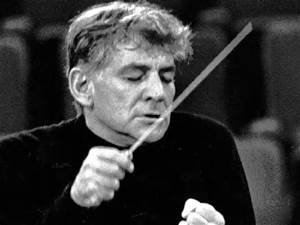
Leonard Bernstein had many talents and at the last meeting of the Society three of them were on vivid display in a presentation by Alan Forshaw. First was his ability as a pianist was shown in a recording, made in 1946, of Ravel’s Concerto for Piano and Orchestra from which we heard the first movement. It is no surprise Bernstein liked this piece with its strong jazz influences and powerful rhythms. We also heard him play one of his own compositions, Seven Anniversaries recorded in 1947.
His second great skill was as a conductor for which he was in great demand. He was the principal conductor for the New York Philharmonic Orchestra for many years. Examples we heard included the second movement from Shostakovich’s Piano Concerto No. 2 with the NYPO with Bernstein conducting from the keyboard and also the Adagietto from Mahler’s 5th Symphony.
He was an accomplished composer in a wide range of genres. Few may of heard of his Clarinet Sonata for example, his first composition. More familiar perhaps is his Symphony No. 1 from which we heard the second movement with its strong rhythms and echoes of Stravinsky. We also heard part of his Symphony No. 2 for Piano and Orchestra both recordings with the NYPO.
He was a composer of operas and first was Trouble in Tahiti – an opera in seven scenes – from which we heard scene 2. Candide did not achieve critical acclaim unfortunately and had to wait two decades before it found a place in the repertoire again. West Side Story is undoubtedly his most successful work, loved the world over and was made into a film. Two extracts were played: Tonight performed by Jose Carreras and Kiri Te Kanawa, and Somewhere, in a performance conducted by Bernstein himself.
Alan explained that Bernstein was the son of a Ukrainian immigrant and it is perhaps worth reflecting on the enormous contribution east European and Russian immigrants made to the life of the United States. Not just musicians, but scientists, writers, mathematicians and in many other areas of cultural life. As the UK is struggling with the ‘threat’ of immigrants fleeing Syria and other war torn areas, it is worth remembering on the benefits that they can bring, as Bernstein did to the USA and musical life generally.
This was an accomplished presentation which gave an insight into the range of talents Bernstein had and the musical legacy he has left behind. A musical polymath indeed.

