Tonight’s programme (Monday, 17th) features the work of Gordon Jacob another of those composers who despite a prolific output, largely remains in the shadows. He composed over 900 works and was a significant figure in the music world.
Presented by Geoff Orgram, it starts at 7:30 as usual. If you have never been before and want to give it a try, then your visit will be free. You can see details of our other evenings on this site.
Frederick Delius is well known English composer born of German parents in Yorkshire. He showed early promise and clearly had an eventful life. He was not actually christened Frederick but Fritz. He father was a successful wool merchant but Delius resisted going into that line of business and opted to manage an orange grove in Florida as you do.
He returned some years later and spent much of his early life in Paris. He received a formal musical training in Leipzig. His talent was spotted by Greig.
The presentation was by Alan Doel, a member of our Society, who gave us a lot of background to his life and compositions. Delius was key in the revival of English music and listening to an evening of his compositions, there was a powerful sense of the languid landscape that seemed to emerge, a kind of tonal colouring. This was particularly true of the first, and one of his best known pieces, On Hearing the First Cuckoo in Spring. Another piece which captured that quality was In a Summer Garden.
He was somewhat overlooked as a composer until he was taken up by Sir Thomas Beecham who premiered some of his works. It’s interesting to note that his early success was in Germany. His time in America and the influence of negro music showed through with compositions like Appalachia of which we heard the final part. Another piece with American associations was the Florida Suite.
It was an interesting evening and we learnt a lot more about this English composer who’s works do not appear that regularly in concert programmes. Other works included Sea Drift, the Cello Concerto and an extract from the opera Irmelin first performed in Germany. The audience expressed its appreciation for the work Alan had put into preparing the presentation.
Alan set us some homework which was to listen to The Song of the High Hills conducted by Sir Mark Elder.
The next meeting on 3 November will be preceded by a brief AGM followed by a members’ evening. If you have a piece, lasting less than 10 minutes ideally, which means something to you or you would like others to hear, please let Robin Lim know robert.lim@virginmedia.com.
Tonight’s meeting (20 October) is on the work of Frederick Delius. Entitled Landscapes of Heart and Mind Alan Doel will explore the works of this English composer who did much to raise the profile of British composers.
Starts at 7:30 as usual at the rear of the Guide’s Centre in St Ann’s Street with free parking at rear. If it’s your first visit it’s free.
Final meeting focused on this somewhat forgotten English composer
May 2025
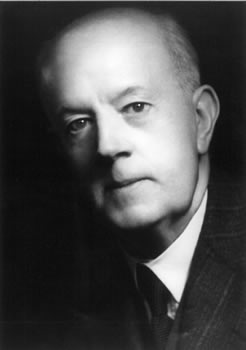
This was the last evening of the current season and we were delighted to welcome Michael Jones who enlightened us about the life and work of this somewhat forgotten English composer. Michael is an accomplished musician in his own right with a number of recordings to his name as well as his special interest in Bainton (pictured). He is developing a website which should be completed soon.
Well, you might not recognise the name but you will recognise one of his pieces And I Saw a New Heaven which was performed at Grenfell Tower memorial and at the Hillsborough memorial. First some history. His father was a Congregational minister who later moved with his family to Coventry. His musical abilities at the piano were noticed early and he made his first public appearance as solo pianist age 9, and at 16 he won an open scholarship to the Royal College of Music to study piano with Franklin Taylor and theory with Walford Davies. In 1899 he won a Scholarship to study composition with Sir Charles Villiers Stanford, and thus became one of the rising generation of British composers destined to contribute extensively to the English Musical Renaissance.
In 1901 he was appointed piano professor to the Newcastle-upon-Tyne Conservatory of Music, and after over thirty years of service emigrated to Australia to take up the Directorship of the Sydney Conservatorium of Music. I should add at this point that the above biography was accompanied with photos, images of his original scores and programmes which amply displayed Michael’s erudition and scholarship. Many items were not the sort of thing you could turn up with a quick Google* search.
He composed pieces in most of the main genres. We heard for example, a tone poem Pompilia; part of The Blessed Damozel; a lovely song Slow, Slow Fresh Fount; and part of a ‘cello sonata.
To demonstrate his diversity we also heard extracts from his second Symphony, an early and most accomplished Fugue, a Viola Sonata and a movement from a String Quartet. Michael finished with a second extract from Prometheus.
This surely has to be a composer who deserves more attention. It is strange how some composers – and most artists I suppose – seem to drift out of fashion and then suddenly their time comes again. We shall see.
We were most grateful for Michael’s presentation delivered with a great deal of enthusiasm and as I say, erudition. His photos illustrated life at the beginning of the last Century.
This was the last evening of the current season and it has been another successful year. We have been pleased to welcome some new faces. A feature has been several evenings exploring the works of composers whose work – like that of Bainton – have been overlooked or who have gone out of fashion. We’ve had music from Scotland, Wales and England as well as Poland and France.
Peter Howard, our chair, thanked all those who have come and supported us during the year and promised next year’s programme will be just as good. We start again in September. A printed programme will be in Salisbury and Amesbury libraries in September and in the Tourism Information Office as well as here on line.
If you want to widen your interest in music keep and eye out here and on Facebook. We look forward to seeing you.
Excellent presentation on this largely forgotten composer
March 2025
One of the puzzles of musical life is why some composers seem to disappear from the repertoire. One thinks of Bruckner who enjoyed great popularity in his day at the end of the nineteenth century then was forgotten for many decades. He began to be appreciated again in the 60s. Bach no less suffered a long period of silence until Mendelssohn brought him out of the shadows.
Last evening we heard a range of compositions by the Welsh composer William Mathias. Unknown to several us, he composed a wide range of material including symphonies, concerti, choral and an opera. Lindsay Dannatt provided several examples from his compositions many of which were accomplished and of great interest. It is true that some have entered the repertory such as the Harp Concerto from which we heard an extract, the Piano Concerto No 3, likewise and the Organ Concerto.
Other works were extracts from Symphony No 1; the Horn Concerto and Divertimento for String Orchestra. Choral works included This World’s Joie and Songs of William Blake.
Mathias’ musical language embraced both instrumental and vocal forms with equal success, and he addressed a large and varied audience both in Britain and abroad. He was widely honoured in the academic word being awarded an Honorary DMus by Westminster Choir College, Princeton USA in 1987 and he was made CBE in the 1985 New Year’s Honours. He was honoured in Wales, his home country as well. He died in 1992 at a relatively young age.
Although some of the references to him, in Groves for example, refer to the influence of Bartok and Hindemith, he had a definite ‘voice’ and was not in any way derivative.
We were enormously grateful to Lindsay for bringing this composer to our attention and for an informed selection of his works.
The March meeting of the Society will take place tonight, Monday 11th March at 7:30 and features the English composer Rutland Boughton. He was extremely popular in his day and was a prolific composer with symphonies and operas to his credit. His star has waned and he is now seldom performed. So it is with great pleasure that we will be welcoming Ian Boughton to play a selection of his works and widen our knowledge of this composer. The title of the presentation is Rutland Boughton: beyond the Immortal Hour, one of his best known operas from a play with the same title.
The Society prides itself on widening the knowledge of its members and this is another example of that, to go along with the presentation on Holst in January.
We look forward to seeing you and it is £3 for non-members at the door. Free parking at the rear.
It is perhaps not too surprising that an island nation should feature the sea in the compositions of its native composers. Examples of these – from well known and some less well known composers – featured in the last meeting of the Society on 27 January 2020.
Society member Ed Tinline kicked of the second half of the season with a wide selection of pieces composed by British composers, all with the sea as their inspiration.
We started with part of Vaughan William’s Symphony No 1, A Sea Symphony composed in 1909. Inspiration for the symphony came in part from Walt Whitman. It was premiered when he was 38 and established him as a leading composer.
Brighton born Frank Bridge was next with his Symphonic Suite: The Sea composed in 1910. Then a piece by Judith Weir with her Lament, Over the Sea from her The Bagpiper’s String Trio first performed in 1989. Judith was the first woman to be appointed Master of the Queen’s Music.
Next – another woman – Ethyl Smyth with her Overture: The Wreckers from 1906. I wrote ‘jaunty’ at one point with some interesting orchestral colours. Dame Ethel Mary Smyth attained prominence as one of the most accomplished female composers in a male dominated environment, and as one of the main representatives of the suffragette movement. Tchaikovsky said of her ‘[she] one of the few women composers whom one can seriously consider to be achieving something valuable in the field of musical creation’. Source: British Library.
The first half ended with Arnold Bax’s On the Sea-shore And Elgar’s Sea Pictures.
The second half started with the unfamiliar Mass of the Sea composed by Paul Patterson composed in 1983. Next was By the Sleepy Lagoon written at Selsey by Eric Coates – who like Frank Bridge, was born in Brighton – looking across the bay and is used as the theme for Desert Island Discs on Radio 4.
The Kent coast inspired David Matthew’s Overture: From Sea to Sky composed quite recently in 1992. The Sea Interludes from Britten’s Peter Grimes are very familiar. Interestingly, Britten was taught composition by Frank Bridge.
The penultimate piece was The Needles by Matthew Taylor commissioned by the LSE Music Society in 2000. Finally we returned to Elgar and another of his Sea Pictures composed at the end of the nineteenth century.
A fascinating evening and a wide range of music based on this one idea.
Peter Curbishley
Next month’s meeting is Berlioz’s vocal music and is on Monday 10 February.
The second half of the season kicks off on Monday 27 January with an evening devoted to the music of Vaughan Williams and other British composers . Ed Tinline will present the evening entitled Behold the sea.
It starts at 7:30 and where to find us is on one of the tabs at the top of the site. There is free parking outside and access is reasonable for those with disabilities (a small step). £3 for non-members. We look forward to seeing you.
George Lloyd was born in 1913 in St Ives (Cornwall) and had a traumatic life. Both his parents were keen musicians and encouraged his talent from an early age. Illness meant he was taught at home then left to continue his studies in London.
He wrote his first symphony at 19 which was premiered in Penzance. We heard the Introduction, Theme and Five Variations and it was music which showed great accomplishment. Two other symphonies followed as well as two operas; The Serf and Lernin. The latter was also first performed in Penzance before being transferred to London where it had an unusually long run. Alan Forshaw, the presenter, played the Duet from the opera and it was an outstanding piece of music.
A crucial event in his life was joining the Marines as a bandsman and took part in the awful North Cape convoys to supply the Red Army in WWII. A most terrible event took place in many of his fellow marines were drowned in fuel oil. This affected his mental wellbeing and prolonged hospitalisation with what was still being called shellshock, now called PTSD.
It was physically difficult for him to write music because of the shaking but with devoted care from his wife he was able to start again. A movement from a subsequent symphony demonstrated a change in style.
He wrote music for brass bands and one such was HMS Trinidad March, the ship he had served on. He had almost no success with commissions from the BBC with his scores returned with no comment. A member of the audience suggested this might have been the influence of William Glock and the pressure to use the 12 tone scale which Lloyd has little time for.
He quit the musical life and he and his wife opened a market garden in Dorset. He began to be appreciated in later life and had some of his work performed at the Proms and he did well in America. Albany Records recorded several of his works. We heard a movement from the 4th Piano Concerto and a movement from the 6th Symphony. Other pieces included extracts from the Requiem, and the Black Dyke Mills Band playing a memoriam following the IRA atrocity in the Royal parks.
For those of us who knew little of this composer’s work it was a revelation. He had a sure touch when it came to orchestration. I felt his style would have suited film music where he may have done well. We were grateful to Alan for his work in preparing the evening.
Peter Curbishley
Please note we now have a page on Facebook – Salisbury recorded music society.


 Salisbury Recorded Music Society