The next meeting of the Society will be on Monday 20 March starting at 7:30 as usual and will a presentation by Ed Tinline on the development of woodwind. He will be playing a selection of pieces including wind soloists and also ensemble playing.
The committee will be meeting immediately prior to the main session. If members reading this have any points they would like the committee to consider, or you might be interested in presenting or co-presenting a session, please let one of the members know.
This was a presentation by Salisbury violinist Frida Backman on music for the solo violin.
Perhaps the first thing to say is that there isn’t that much for the solo instrument. Beyond Bach one might be stumped to think of many solo works and although Kodály was mentioned and later his fellow Hungarian Bartók, apart from a few virtuoso performers, there are not many works of note. There is of course a huge repertoire of accompanied violin music and concertos.
The instrument was developed into what we see today in the sixteenth century in Cremona, Italy and one of the first masters was Amati. The instrument consists of no less than 70 parts.
Frida started with some early works by Nicola Matteis who was a violinist in the early eighteenth century and who composed pieces more advanced than his contemporaries. We then heard a piece by Tartini also of this era, and who was influential in teaching the instrument and wrote a treatise which may have influenced Mozart’s father.
The composer of a large amount of solo work was JS Bach and we heard several pieces by him including an arrangement by Fritz Kreisler in a 1904 recording of a partita with a piano accompaniment. We also heard pieces by Biber, Prokofiev, Ysaÿe, and Ravel’s Tzigane composed in the early ’20s.
A brilliant virtuoso of the early nineteenth century was Paganini who’s phenomenal abilities were said to derive from the devil. He was hugely successful and owned no less than 11 Stradivari violins. Two of his caprices were played, numbers 23 and 24.
Frida explained that development of the bow was crucial to the instrument’s success. As music moved out of the salon into the concert hall, more power and volume was needed and the modern bow enabled that to be achieved. However, many players still use a baroque style bow to achieve greater authenticity and Frida played two CDs of the same piece to illustrate the difference in tone.
Frida ended her presentation with a live rendition of a piece by a modern composer Zura Dzagnidze called Intruder composed in 2005. This she played against a backing track with herself.
A most interesting evening exploring the history of this most versatile of instruments.
The next meeting of Salisbury Recorded Music Society will be held tonight, Monday 6 March 2017 at 7.30 in our usual venue, when Frida Backman will be presentingThe solo violin in classical music. Please feel free to bring a guest or friend.
Superb and surprising selection of music from the Hapsburg empire
Last night’s presentation by Angus Menzies was of music composed for several of the emperors of the Habsburg court from the middle of 16th to the middle of the 17th centuries. This was pre-Haydn and Mozart of course and most of the music played was by composers who, for the most part have been forgotten – undeservedly so.
Johann Fux. Picture: Wikipedia
Each would have his own favourites of course but those who stood out were Antonio Bertali; Johann Schmelzer; Heinrich Biber and Johann Fux. We also heard a piece composed by Leopold I entitled Il lutto dell universe which was ‘not without talent’ as one might say. The pieces played were mostly composed for weddings and coronations and hence had a magisterial quality. Others were from operas. Schmelzer’s Die Fechstchule was played alongside mass horse displays as monarchs from that era often used equestrian events to impress and show off their country. Indeed, portraits from that era often feature monarchs astride a horse as a symbol of power. Little is known of him but he was a favourite of Leopold I and became a Kapellmeister in Vienna.
Another composer to impress was Jan Zelenka and we heard Melodrama de Sancto Wenceslao and also Johann Reutter whose aria Venga l’eta was played from La Magnamitada Alessandro. Zelenka was ranked along side Telemann and Handel in his day but is now mostly forgotten.
A worthwhile evening with many surprises and providing a window into the music of this era in history.
Mozart’s last year was the title of a presentation to the Society by group member Peter Curbishley. There probably isn’t another composer about whom there are so many myths particularly surrounding his death in December 1791, almost exactly 225 years ago. The film Amadeus by Peter Shaffer did not help. Although entertaining, it gave credence to wild rumours about poisoning which are now known to be untrue.
Pic: Anthem Arts
Peter played extracts from most of the works he wrote in the final months of his life. This included of course the Requiem, but also from the operas The Magic Flute and La clemenza di Tito. The Magic Flute was a huge success and is the fourth most performed opera ever written. La Clemenza di Tito by contrast was a failure and languished unperformed until the 1950s. This was in part due to a part written for a castrato, a practice which, mercifully, died out soon after the opera was written.
Members also heard extracts from the Clarinet Concerto written two months before his death, a string quintet and the last Horn Concerto. Despite the huge body of brilliant music Mozart had composed before he died, he was Peter explained, only just beginning. Part of the last piano concerto, finished in the early part of that year. Had he lived into the nineteenth century who knows what he might have produced. His death – from a streptococcal throat infection not poison – was a tragic loss to the world of music.
This was the last meeting of the first part of the programme and the next meeting is in February. Seasons greetings to all our readers.
At Salisbury Recorded Music Society we are now into our Christmas and New Year break, and will start again in February 2017 with what promise to be really excellent presentations by several very good friends of the society:
On Monday 6 February, Angus Menzies will present “Fit for an Emperor: music at the Austrian court 1650 – 1750”.
On Monday 20 February, we shall host a live concert by David Davies (piano), with David Morgan (violin) and Warren Driffill (‘cello), exploring the piano trio.
On Monday 6 March, Frida Backman will be presenting “The solo violin in classical music”.
Meanwhile, can I mention that Frida Backman is giving a series of solo violin concerts, the first of which is this Thursday (1 December) at 7.30pm in St Martin’s Church, Salisbury (with pre concert talk at 7.
We hope you will be able to support some or all of these events. For details nearer the time, look at this Web site for any updates or changes.
Members’ evening on November 14th produced a wide range of interesting, not to say eclectic, offerings from members. Clearly, as a group, we listen to a wide range of sources and this was reflected in the music played.
Derek Bourgeois. Picture: YouTube
First off was a trombone concerto by Derek Bourgeois, born in 1941 and this piece was composed in 1988. We heard the 3rd movement which showed the incredible versatility of the instrument played by Christian Lindberg.
Next – and a complete break in time and tone after the flamboyance of the trombone piece – we heard some selected pieces from the Well-Tempered Clavier by Bach. Quite what instrument these were written for as there is no instrument called the clavier but it is likely they were for clavichord, harpsichord or small organ. They were composed for purposes of tuition and to teach feeling as well as technique.
A complete change again with the title theme to the Carpetbaggers by Elmer Bernstein. Bernstein was a prolific composer for the film industry and his scores include 10 Commandments, The Magnificent 7 and the Great Escape. This was an arrangement by Lalo Schifrin.
Renee Fleming. Picture: Broadwayworld.com
Next, Korngold, a prodigy and prolific composer and from his opera Die Stadt, we heard the lovely Gluck, Das mir Verlieb sung by Renée Fleming.
Source: en-wiki
Female composers are not that common and so it was a pleasure to be introduced to Marie Jaëll and her Cello Concerto from 1882. She was a pupil of Camille Saint-Saëns and Liszt. Marie Jaëll probably represents the most authoritative and accomplished expression of the nineteenth century woman musician. In spite of her coming from the provinces and despite the heavy social restrictions imposed on artists of her gender, she nonetheless succeeded in being recognized as a virtuoso, a composer and as a teacher. Support from her husband – the Austrian pianist Alfred Jaëll – greatly contributed to the positive reception of her initial works for the piano, but it was by herself, armed with her talent and her resolve in the latter part of her life, that she faced up to the Parisian hurly-burly in which she proved herself to be one of its distinctive figures. While her learning method is still taught in various different countries, little interest thus far has been shown in her music, which in the greater part is held in the Bibliothèque Nationale et Universitaire in Strasbourg. Formidable and ambitious symphonic works are revealed on this book-cd as well as a significant facet of her compositions for the piano [Source; Wikipedia].
We then heard an extract from Schubert’s Piano Trio No 2 in E flat. Also by contrast – and harking back to the Venetian evening last month, part of Marcello’s music based on Psalm 11.
Rameau is not a composer we have heard much of at the Society so it was interesting to hear the lively Musette and Tambourin en rondeau pour Terpsicore. Not much is known about his life and he was fairly obscure for many years. There has been something of a revival in recent years and his pieces now appear in concerts.
Another American composer – albeit of Armenian and Scottish descent – is Alan Hovhaness who was another prolific composer who was very popular in the ’50s and ’60s but is less heard today.
Finally, a familiar composer to the Society – Gerald Finzi and his Romance for String Orchestra. There is something in Finzi’s music that seems to capture a sense of a pre First World War world of lazy afternoons in the country.
The next meeting is a members’ evening and we listen to short pieces brought along by members themselves. 23th November, same place. We are short of contributions so if you can volunteer that would be appreciated.
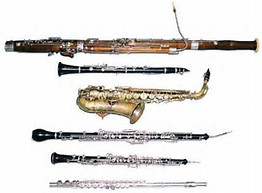 by Ed Tinline on the development of woodwind. He will be playing a selection of pieces including wind soloists and also ensemble playing.