The new starts on Monday 22nd at 7:30 with a presentation called intriguingly Murder, Mishap and Misfortune by Alan Forshaw. Alan’s presentations are always good value and show a deep knowledge of the subject and will no doubt contain some surprises.
The full programme is available and copies can be picked up in the Library (immediately to the right when you go in), the Tourist Information Centre in Fish Row or a pdf can be seen via this link.
If you want to try us out then the first visit is free and full season’s membership (14 evenings) for a mere £25.
We are delighted to attach the programme for the forthcoming season starting on Monday 22 September at 7:30. You can see there is lots to interest with presentations of more familiar composers together with the less well-known. The strange but amazing music of Eric Satie has an outing and also Delius, a composer we have not featured for many years.
There are evenings on American music as well as from Iberia. Indeed, there is considerable variety in the programme. There are two members’ evenings where members bring along one or two of their favourites. The evenings are open to all we should add.
The Society is keen to explore some of the hidden corners of the repertoire, including pieces seldom heard in the concert hall.
The programmes have been printed and if you like a paper version, they will shortly (next week) be in the Library and in the Tourism Information Centre. If you want to give us a try your first visit is free.
Final meeting focused on this somewhat forgotten English composer
May 2025
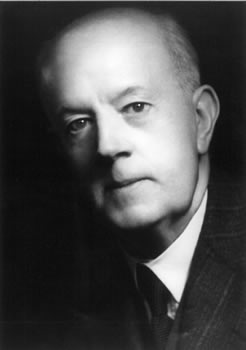
This was the last evening of the current season and we were delighted to welcome Michael Jones who enlightened us about the life and work of this somewhat forgotten English composer. Michael is an accomplished musician in his own right with a number of recordings to his name as well as his special interest in Bainton (pictured). He is developing a website which should be completed soon.
Well, you might not recognise the name but you will recognise one of his pieces And I Saw a New Heaven which was performed at Grenfell Tower memorial and at the Hillsborough memorial. First some history. His father was a Congregational minister who later moved with his family to Coventry. His musical abilities at the piano were noticed early and he made his first public appearance as solo pianist age 9, and at 16 he won an open scholarship to the Royal College of Music to study piano with Franklin Taylor and theory with Walford Davies. In 1899 he won a Scholarship to study composition with Sir Charles Villiers Stanford, and thus became one of the rising generation of British composers destined to contribute extensively to the English Musical Renaissance.
In 1901 he was appointed piano professor to the Newcastle-upon-Tyne Conservatory of Music, and after over thirty years of service emigrated to Australia to take up the Directorship of the Sydney Conservatorium of Music. I should add at this point that the above biography was accompanied with photos, images of his original scores and programmes which amply displayed Michael’s erudition and scholarship. Many items were not the sort of thing you could turn up with a quick Google* search.
He composed pieces in most of the main genres. We heard for example, a tone poem Pompilia; part of The Blessed Damozel; a lovely song Slow, Slow Fresh Fount; and part of a ‘cello sonata.
To demonstrate his diversity we also heard extracts from his second Symphony, an early and most accomplished Fugue, a Viola Sonata and a movement from a String Quartet. Michael finished with a second extract from Prometheus.
This surely has to be a composer who deserves more attention. It is strange how some composers – and most artists I suppose – seem to drift out of fashion and then suddenly their time comes again. We shall see.
We were most grateful for Michael’s presentation delivered with a great deal of enthusiasm and as I say, erudition. His photos illustrated life at the beginning of the last Century.
This was the last evening of the current season and it has been another successful year. We have been pleased to welcome some new faces. A feature has been several evenings exploring the works of composers whose work – like that of Bainton – have been overlooked or who have gone out of fashion. We’ve had music from Scotland, Wales and England as well as Poland and France.
Peter Howard, our chair, thanked all those who have come and supported us during the year and promised next year’s programme will be just as good. We start again in September. A printed programme will be in Salisbury and Amesbury libraries in September and in the Tourism Information Office as well as here on line.
If you want to widen your interest in music keep and eye out here and on Facebook. We look forward to seeing you.
Excellent presentation on this largely forgotten composer
March 2025
One of the puzzles of musical life is why some composers seem to disappear from the repertoire. One thinks of Bruckner who enjoyed great popularity in his day at the end of the nineteenth century then was forgotten for many decades. He began to be appreciated again in the 60s. Bach no less suffered a long period of silence until Mendelssohn brought him out of the shadows.
Last evening we heard a range of compositions by the Welsh composer William Mathias. Unknown to several us, he composed a wide range of material including symphonies, concerti, choral and an opera. Lindsay Dannatt provided several examples from his compositions many of which were accomplished and of great interest. It is true that some have entered the repertory such as the Harp Concerto from which we heard an extract, the Piano Concerto No 3, likewise and the Organ Concerto.
Other works were extracts from Symphony No 1; the Horn Concerto and Divertimento for String Orchestra. Choral works included This World’s Joie and Songs of William Blake.
Mathias’ musical language embraced both instrumental and vocal forms with equal success, and he addressed a large and varied audience both in Britain and abroad. He was widely honoured in the academic word being awarded an Honorary DMus by Westminster Choir College, Princeton USA in 1987 and he was made CBE in the 1985 New Year’s Honours. He was honoured in Wales, his home country as well. He died in 1992 at a relatively young age.
Although some of the references to him, in Groves for example, refer to the influence of Bartok and Hindemith, he had a definite ‘voice’ and was not in any way derivative.
We were enormously grateful to Lindsay for bringing this composer to our attention and for an informed selection of his works.
Our next meeting on 2nd December will be our last before Christmas, and we will be holding our Christmas Quiz. This will be our second such classical music Quiz and, as previously, conducted again by Ruth Barlow So don’t be put ORFF, come BACH for more!
In the New Year we will resume on Monday 27th January 2025 when Peter Horwood will present “Polish Panorama” – a summary and brief survey of Polish composers from Medieval times to the 21st Century.
We hope to see you on 2nd December, and in the New Year.
The next Society meeting is this evening 21 October and is a members’ evening so if you are a member and haven’t sent your contribution to Robin – there’s still time. It will be preceded by a short agm. Same place and same time. Programmes are in the TIC by the way.
The Society meets tonight (12th) to hear Angus Menzies’ presentation The Sound of Music in 17th Century Salzburg. Starts at 7:30, £3 at the door for non-members and there is free parking right outside.
This was the title of a presentation to the Society about this English composer
January 2024
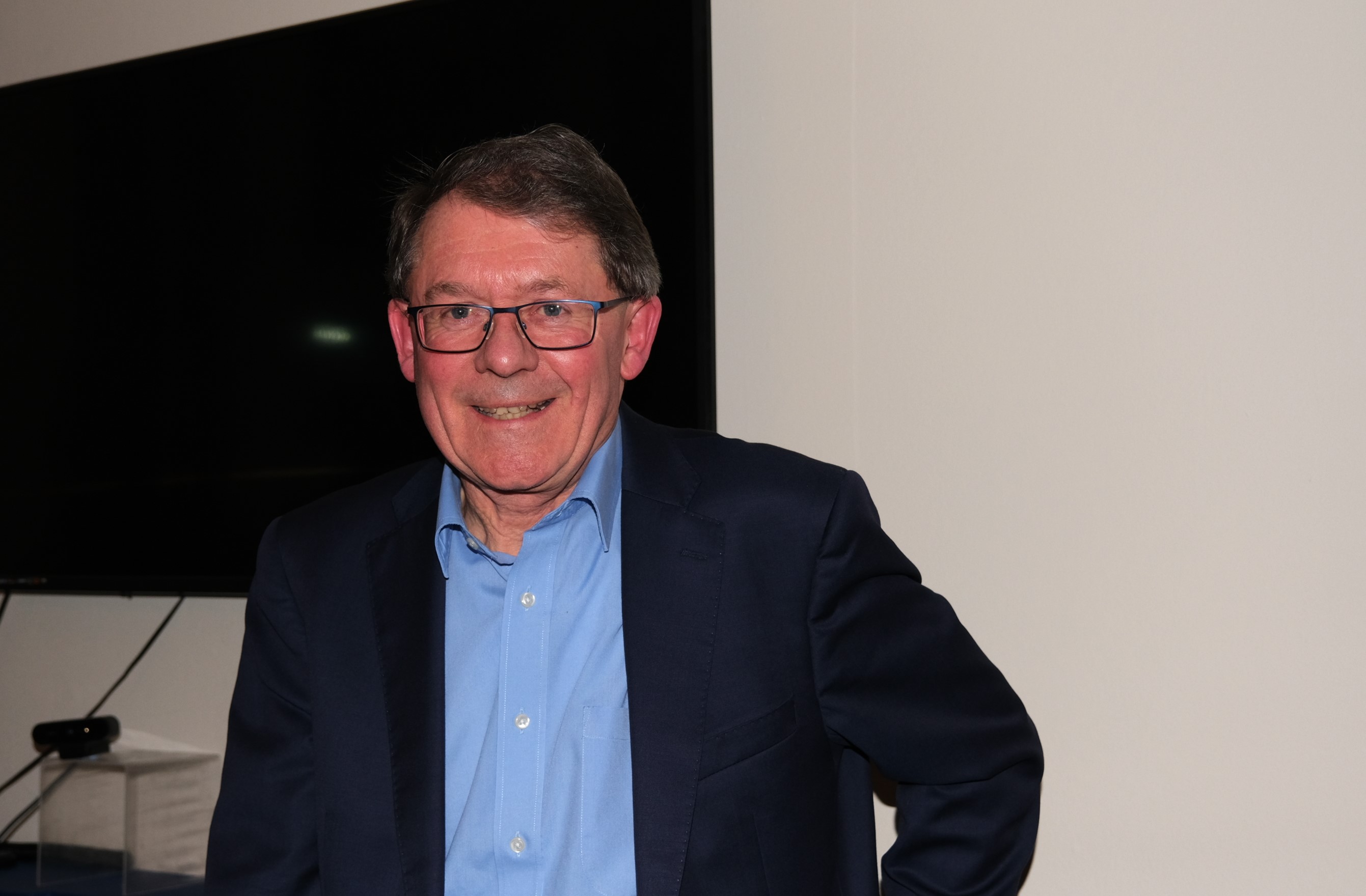
The Society was delighted to kick off the second half of its season with a presentation from the Chairman of the Holst Society, Christopher Cope (pictured). Holst is one of those composers who is almost exclusively known for one work, The Planets. He joins a number of others who are ‘one piece composers’ such as Dukas, Widor and Litolff who almost suffer from the fate of a single piece which crowds out their other works. It has sometimes come as a surprise at Society meetings when other parts of composer’s works are played and we say ‘why haven’t we heard this before?’
This was the theme of Christopher’s presentation who gave a history of this important English composer. Yes, English, for despite his name and the ‘von’, he was born in Cheltenham in 1874. The ‘von’ was added by his grandfather Chris said for added kudos. His early work was strongly influenced by Wagner and he was keen later on to distance himself from him.
He was friendly with Ralph Vaughan Williams who was much influenced by his work. VW gave him a sum of money to enable him to go travelling and he went to Algeria going round on a bicycle noting down musical themes and ideas as he went. A result of this was Beni Mora (AnOriental Suite (a little out place) from which we heard an excerpt.
He took time off to learn Sanskrit at one point in his life and translated some works by writers of that language and set some of them to music.
So why is he not better known and why only The Planets? Chris noted that it was the 150th year of his birth so there will be interest in his music but it is likely only to be this one piece which is played. One reason might be that he spent a lot of time teaching and conducting leaving little time for composition. The great majority of his oeuvre are short pieces: songs and church music with a strong influence of English folk songs. The lack of a corpus of symphonies and concerti may mean promoters do not want to feature his work.
The Planets certainly brought him fame and recognition but it seems he found this to be profoundly unwelcome and turned down honours and eschewed what we would today call the ‘celebrity circuit’.
He was clearly an original and Chris said he was influential with both Vaughan Williams and Ben Britten (and no doubt others as well). He died relatively young at 59 and clearly he still had much to give. He joins a long list of composers who died in their prime.
Chris played a range of pieces including an Invocation for ‘cello, and an excerpt from West Country Tunes, Swansea Town.
It is a pity that he has become this one-horse composer: the pieces we heard were diverse and original. One question might be whether there was a recognisable ‘voice’ which led you to know it was Holst even though you had not heard a particular piece before.
The Chair thanked Chris for his informed, not to say erudite presentation which has opened our eyes to this important but somewhat overlooked English composer.
Peter Curbishley
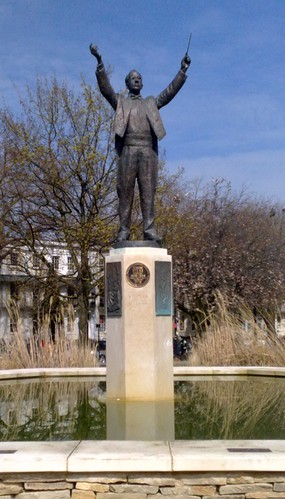
Statue of Holst in Cheltenham
Pictures: Salisbury Recorded Music Society
UPDATE: Readers in the Salisbury area might like to know there is a performance of some of Holst’s choral music on Sunday 18 February at 2pm. They will be performed (with other works) by the Larkhill Choral Society at the Bustard Inn on the edge of the Plain. 2 February
Due to unforeseen circumstances, we have had to make some changes to our programme involving the next three meetings.
On Monday 6th November, Peter Horwood will be presenting Off the Beaten Track in which he takes us on an informal journey along some less familiar musical byways.
On Monday 20th November, Peter again will be presenting, this time the third in his series on 20th Century Music. [This was due to be presented at the previous meeting].
Our final programme this season is slightly changed and will be Christmas Special in which members of the SRMS committee will present a range of pieces with a seasonally appropriate theme.
It was good to read Peter Curbishley’s report on Robin’s presentation in last week’s Salisbury Journal.
Our next meeting will be on Monday 17th April as scheduled, but due to unforeseen circumstances we have had to change the ‘running order’ of our coming evenings. Alan Forshaw has very kindly agreed to bring forward his presentation, so our programme now is:
On Monday 17th April, Alan Forshaw will present “Like father like son . . .” and describe how ‘keeping it in the family’ can work a treat.
This will be followed on Monday 22nd May when our guest presenter, Simon Coombs, will now present “Czech music from Smetana to Martinů” .
And then our final session of 2022-23 will be on Monday 5th June when Peter Horwood will present his ‘American Adventure’.
We hope you can join us for all or most of the remaining sessions for 2022-23.

 Salisbury Recorded Music Society