The ‘curse of the ninth’

April 2024

This was the intriguing title of a fascinating talk by Alan Forshaw on why the ninth symphony seems to loom large in composer’s lives. Beethoven’s 9th is well known although he did attempt a tenth and he left some sketches. It was with him that the myth started and it does seem to have had some kind of effect on those who followed him. Alan played the second movement in a version with a brisk tempo by Toscanini.

Schubert was second, a composer who died tragically young but nevertheless, left a vast treasure trove of music including – nine – symphonies. It has often been suggested that he died of syphilis but medical research suggests this is not true and it is much more likely, in view of the suddenness and the symptoms, he died of typhoid fever which was common at the time. As is well known, his eighth was unfinished. We heard the first movement from the ‘Great’ Symphony – his ninth. Schubert never heard either of them before his death.

Thence to Bruckner who, as Alan reminded us, was a huge admirer of Wagner and said he only worshiped two Gods and the other one was Wagner. He can’t have heard his symphony though … Bruckner was a famous organist and it was he who played the organ at the opening of the Albert Hall. We listened to one of the movements of his ninth, of which he only completed three, and died before finishing it. There may be something in this ‘curse of the ninth’ after all.

Dvořák next who was helped in his composing career by Brahms and was very lucky to get a very generous appointment in New York which gave him plenty of time for composing. We heard a movement from the famous New World Symphony and – you’re getting the hang of this, his ninth. The symphony was hugely important in the development of American music and was discovered after his death. It was premiered in 1893 in New York. Dvořák’s house can be visited just on the outskirts of Prague by the way.

Now Mahler did believe in the curse and went to some lengths to try and avoid labelling it the ninth. No matter, the curse got him and he died the following year.

On to Glazunov who enjoyed much fame and admiration in his day, both in Russia and in the west. He found the more modern composers, and in particular Stravinsky, hard to swallow and thought Petrushka little more than orchestrated dissonance. He never got far with his ninth and we heard an extract of the piano version – perhaps the world was spared. He did however have a pupil at the Leningrad Conservatory called Shostakovich who did go on to write 15 symphonies.

Next was Vaughan Williams who also managed to complete nine and we listened to a movement from it, his ‘last tune’ as he termed it. He died a few months after its premiere in 1958. The symphony is a little unusual in having scored saxophones – perhaps reflecting Ravel’s influence with whom he studied for a year.

And so to Kurt Atterberg, not a name which is that familiar even to keen classical music fans. Swedish, he studied both music and electrical engineering and indeed, it was this latter skill that kept him employed at the Swedish Patent Institute until his retirement. Preferring harmonics to harmony perhaps. He is another composer who had a degree of fame in his lifetime but is little known or played today.

Finally to Northampton born Malcolm Arnold who was a prolific composer well known for his film scores including for example, the St Trinian movies and the Bridge over the River Kwai among many others. An accomplished trumpet player having heard Louis Armstrong play he composed many pieces and including nine symphonies. He was not a pleasant character by all accounts and had a drink problem. He had mental health issues as well. At one point he was given two years to live but manage to live on for another 20. We heard a short extract from his ninth. His musical legacy seems assured.

So is there anything in the ‘curse of the ninth’? Probably not. The idea was created by Mahler who tried to beat it by calling what was his ninth as a song cycle. Looking at the list of composers of symphonies from the nineteenth century onwards it is striking that there is a vast number who wrote a handful, just one, two or three. It is also striking that there are few who wrote between three and 9. Most therefore will compose a small number of symphonies, which consume a significant chunk of time but achieve little success and even less financial reward, and decide to stick to shorter forms.

So how to explain the cluster around nine with few either side having composed eight or eleven symphonies for example? Perhaps the reason is mundane: a modern symphony seems to have taken most composers around two years to complete and not always in a continuous burst. Allowing time between each of say, a year, means each work represents around 3 years out of a composer’s life. Allowing for a productive life of around 40 years which may also include conducting and teaching, means a serious composer of symphonies will end up at the nine or ten mark. So those who do achieve some success at the start of their careers, then go on to reach it: those who don’t stop after one, two or three.

Whatever, it was a really interesting evening and as ever a mixture of the familiar with a handful of rarely heard pieces. The chair of SRMS thanked Alan for putting together an interesting and intriguing topic.

Our last meeting of the current season is on Monday 13 May at 7:30 as usual and is on the subject of Puccini to celebrate the anniversary of his death this year.

Finally, to say we are getting on well with the 2024/25 programme which is all planned and the programme will be available sometime in the summer. For clarity, I should say August since when and if summer comes is not at all certain.

Peter Curbishley
Earth, Air, Fire and Water

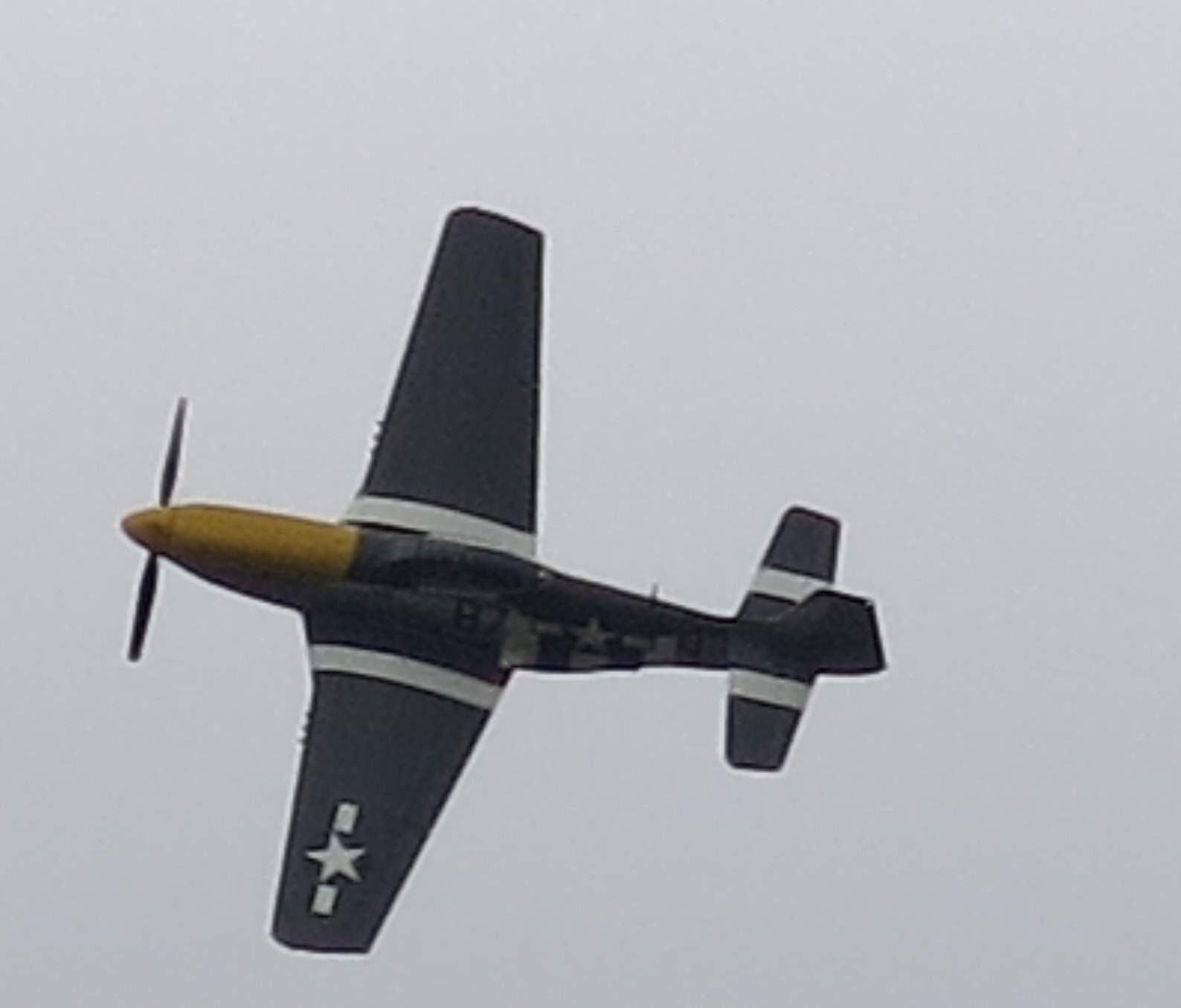
This was the title of the last presentation to the Society by Jon Hampton and it featured music based on these Greek elements.  Before all, there was chaos and we started with an excerpt from Haydn’s Creation which for its time, was harmonically daring.  Next were some songs by Finzi and then an unlikely titled piece by Martinu – Thunderbolt P47 a near relative of which is shown here at the Chalke Valley History Festival.   This was followed by Bantock’s Sea  Reivers.  Bantock is not often heard now but he was influential in the founding of the Birmingham Symphony Orchestra and both Elgar and Sibelius dedicated pieces to him.

Poulenc’s Un Soir de neige followed and then the lively Ritual fire Dance by Manuel de Falla – a piece where the ending never quite seems to come.  More Haydn – this time a movement entitled Earthquake from the Last seven Words of our Saviour on the Cross.

Possibly the loudest work in the classical repertoire is the Icelandic composer Leif’s Heklar.  This is a musical depiction of the eruption of a volcano by this name which Leif witnessed.  Leif studied in Germany and was responsible for organizing the first orchestral concerts in his home country.

The Russian composer Lyadov is not often heard nowadays.  He taught at St Petersburg and one of his pupils was Prokofiev.  We heard his The Enchanted Lake.

Bruckner’s Abendzauber followed which was composed in 1878 and not performed in his lifetime.  It was a popular piece in Austria after the First World War but is seldom heard now.  We then heard Messiaen’s Fetes and a piece by Klami just called BF3.  Weber’s Ocean thy Mighty Monster was followed by Frank Bridge’s Seafoam.  The evening concluded with Britten’s Storm  from Peter Grimes.

This was an entertaining evening with the chance to hear some unfamiliar pieces around the central theme.  The audience were grateful for the time Jon Hampton  put into selecting the works and compiling the programme.

Peter Curbishley


Next meeting on Monday 19 March and will feature the Russian composer Shostakovich.  There will be a few slides of Leningrad taken when the composer was still living there.


Anton Bruckner

Picture: Wikipedia

For some, Anton Bruckner (pictured) was one of the great symphonists to come out of the nineteenth century.  Nowadays, his works are performed around the world and are a regular feature of the repertoire.  There are many recordings of the nine numbered symphonies.  But for a long time, his reputation languished and there was a major effort to recognise his genius in the 1960’s.

At the last meeting of the Society, Terry Barfoot gave an illustrated history of the composer and played four movements from 4 different symphonies to illustrate his work.  Bruckner was born in Ansfelden in Austria in 1824, the son of a school teacher.  He himself became a school teacher.  He was an organist of prodigious ability and toured Europe mostly playing improvisations.  Little of this survives.  He was the first to play the organ at the Royal Albert Hall in London.

View of the organ, RFH. Picture: Peter Curbishley

One can hear the influence of the organ in his music.  As Terry put it:

[…] the sound-world of the organ in the resonant acoustic of a great cathedral is relevant in his symphonies, as of course it is in his religious works.  From Wagner he derived his long time-spans, his weighty brass writing and expressive string textures, while another recurring was Beethoven’s Ninth Symphony, and especially its opening […]

He was clearly a late developer as a composer and Terry made the point that had he died at the same age as Schubert (31) he would today be completely unknown.

He was deeply religious and trained as a musician at the monastery church at Sankt Florian a place he was to return to throughout his life especially when he was depressed.  He was also organist in Linz.

Like so many composers – indeed artists generally – he was not appreciated fully in his lifetime.  The famous critic Eduard Hanslick gave him a hard time and his time with the Vienna Philharmonic was not a success.

Terry put together a programme to illustrate his range and development as a composer.  Bruckner is something of a challenge in the context of a Society evening as the expansiveness of his music does not lend itself to short extracts!  He played the following:

  • Motet: Locus Iste
  • Symphony No. 8 first movement
  • Symphony No. 6 second movement
  • Symphony No. 4 third movement
  • Symphony No. 7 fourth movement

Together with photographs of locations around Austria where Bruckner lived or worked this was an interesting and illuminating evening.  We were grateful to Terry Barfoot for putting it together.

Peter Curbishley


Terry runs Arts in Residence

Note: the next meeting is not for 3 weeks because of Easter


Next meeting: Bruckner

Presentation by Terry Barfoot on Anton Bruckner

The Society is delighted to welcome the well known writer on music Terry Barfoot who is going to do an audio visual presentation on the music of Anton Bruckner.  He was arguably one of the greatest symphonists of the nineteenth century and his symphonies are now rarely out of the repertoire.  They are large in scale however and so presenting them to the Society has been a challenge.

Usual place and usual time.

Terry runs Arts in Residence which are residential weekends with a musical theme.


New season

By now, existing members will have received their invitation letter and programme for the 2016/17 season.  We are pleased with what we have in the programme which includes a ‘live’ event and outside speakers on Bruckner and Delius.  We have stayed away from Bruckner because his symphonies are on a massive scale but we are delighted that Terry Barfoot has risen to the challenge to give us a presentation on this important composer.  Proms listeners will have had a treat this year with several of his works being performed.

If you are new to this site we hope you will give us a try and if you just want to come along to an evening – because you have a particular interest in a composer for example – then it is only £3 to help cover costs.

One of our guiding principles is to widen knowledge of the musical world and speakers will often try to introduce unfamiliar pieces, either by composers who are almost forgotten or less well known pieces by major composers.

Parking is easy with plenty of space and we are within walking distance of the town centre.


New season’s programme

Two evenings devoted to this composer

The new season’s programme has now been finalised and will soon be printed for distribution.  You can see a copy of the brochure here ahead of publication.  The committee has put together an excellent programme with two outside speakers and one, for the first time, from the Delius Society.  We have one ‘live’ music evening as well as presentations on a wide range of topics from Society members themselves.

Meeting arrangements are as before and parking is easy.  New members are always welcome – we’ve had several this year – and if you want to come along to an evening without commitment, there is a small fee of £3 to help with our expenses.

Existing members: if you can do anything to help promote events that would be appreciated.

The first evening will be on Monday 19 September.

Programme