Members’ evening

November 2025

Members’ evenings always bring surprises. It is an opportunity for them to bring for the delectation of others, something that appeals to them or they have discovered recently. They are always eclectic and never with any kind of theme unlike say, a concert where the organisers try to focus on a composer say. Which sort of makes such evenings a strength because no one of knows what the others are going to bring. It is if you will, a kind of musical tapas the only difference being it’s all brought to you and you don’t have to chose.

But enough, what did we hear you ask? We started with Brahm’s second cello sonata in F, a kind of introduction to the evening. Following was a surprise and that was a quartet for saxophones by Jean Francaix (in French) where you will read he had an illustrious career and was encouraged by Ravel. The saxophone does not get much of an airing in classical music – a pity for such versatile family of instruments.

Well, we then had an addition to our evenings in the form of a DVD and a recording of Begin the Beguine performed by Fred Astaire and Eleanor Powell. This Cole Porter song did not get much attention until Artie Shaw recorded a few years later on the B side of a record whereupon it shot to fame and was a huge success for him. Shaw met Porter and words were exchanged apparently because Porter rather resented his success with the number. The film performance was great to see with amazing dancing to go with the music.

We were introduced to the music of Lassana Diabaté a musician from Guinea in Africa in a performance of Sunjata’s Time for string quartet, a quite unusual piece.

Something more traditional but meaningful for the presenter was the third movement from Mozart’s Oboe Quartet in F Major K 370. The concerto (for that effectively what it is) is significant as one of his first major works having left Salzburg in 1781 and started to make his mark in Vienna.

Next was a leap to the American composer Philip Glass and the third movement of his Violin Concerto composed in 1987 and is typical of this composer with its repeated themes and modulation.

Film music doesn’t always get the attention it deserves with three examples from the Italian Job, Once Upon the Time in the West and Where Eagles Dare. It is a creation of the twentieth century with the invention of the cinema and eventually the ‘talkies. Composers have to match the music to the action although in some cases the film is edited around the music.

A wonderful film of a Chaconne from Partita No 2 BWV 1004 followed performed by Nathan Milstein. Although of some vintage, it was outstanding and a reminder of his greatness as a performer. We remarked on how young the audience was when the camera panned back. Would such a performance today attract such an audience …?

We finished with extracts from Samuel Coleridge-Taylor’s best know work Hiawatha’s Wedding Feast. Born in London of West African descent he was nicknamed the ‘African Mahler’ in America but has nowadays largely disappeared. He died young aged 37 and was encouraged in his brief career by Elgar among others.

An enjoyable and informative evening. Eclectic or what?


Next meeting on Monday 17 November.
Next meeting

October 2025

Our next meeting will be at 7.30pm on Monday 3rd November 2025.
It will commence with a short Annual General Meeting followed by our Members’ Evening.  For this Robin now has almost sufficient pieces for what should be a thoroughly enjoyable evening. Any last minute ideas for possible inclusion if there is time to Robin please.

Following this on 17th November we will have a presentation entitled: “Seventh Son”  An appreciation of the work of Gordon Jacob. Written and presented by Geoff Ogram 

On 1st December at our final session before Christmas, David Davies will  present some Classical Music Signature Tunes.  To help him prepare for this, David has asked me to forward the following to members:

The meeting on December 1 is entitled ‘Are you sitting comfortably? These words began Listen with Mother at 1.45 every weekday on the BBC Light Programme from January 1950 and on into the 60s. And every programme ended with the Berceuse from Faure’s Le Jardin de Dolly suite for piano duet. The words and the tune are still remembered fondly by a whole generation.

But what else in radio and television (including adverts) has used classical music as a signature tune? We shall have a not-too-serious discussion on this topic, and I would appreciate your letting me know your suggestions.

You can email me at davidracheld@gmail.com
Thank you.  David Davies

We hope you will be able to join us at these sessions.

Members’ evening

April 2025

Due to illness, our speaker for the evening was unavailable. Undaunted, we held a members’ evening which was – shall we say – diverse with a wide range of contributions.

First was a well-known piece by Hamish MacCunn called Land of the Mountain and the Flood. It was used as the theme music to the TV series Sutherland’s Law. It is one of those melodies which are recognisable but you can never place who might have composed it.

Next was the first movement of Pierre Rode’s Violin Concerto No 7 thought by many to be the best example of his work. Rode was one of those composers who was all the rave when he was young at the turn of the 18th Century and hugely popular. He was admired by Beethoven and Spohr. He left France, spending several years in Russia and upon his return, his star had faded. There was some suggestion that he had picked up an infection which affected his playing. Anyway he left Paris and returned to his home town of Bordeaux. Sadly, he died quite young.

Next we watched – and listened – on screen to the music of Leroy Shield. Who? I

hear you say: he was the composer of the sound track of the Laurel and Hardy movies. So you are likely to be able to call to mind the jaunty theme to their films without knowing who wrote them. He was significant because it was the time of the ‘talkies’ which were hugely disruptive for the industry. Many actors and actresses never survived once people heard their voices. Some studios struggled with the technology especially matching the sound track to the images. Hal Roach and others overcame the problems and helped the comic team to their huge success

Also another familiar piece from those times was the theme to Charlie Chaplin’s film Modern Times which he composed. Chaplin was slow to adapt to sound – his humour was essentially visual – but did so to further enhance his reputation.

Vivaldi was played and no, not the Four Seasons beloved of Classic FM, but Nisi Dominus composed at the beginning of the 18th Century and a setting of Psalm 127. It is a highly regarded piece and shows why he was much admired by JS Bach.

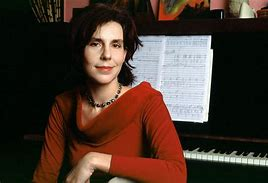
Hanna Kulenty (pictured) is Polish and it was good to feature a female composer. Born in

1961, she has an impressive range of compositions in a variety of genre to her name. Tonight we heard Music for Roy – intriguing and quite different in style to what had gone before.

Still on the subject of women, next was a performance of a movement from Shostakovich’s Cello Concerto No. 1 performed by the Argentinian cellist Sol Gabetta. We watched this on screen and her amazing talent was plain to see. She first started playing the violin at the age of 4 and switched to the larger instrument a year or two later.

Next some jazz by Steve Reich and something completely different. I Sixteenths is typical of his style and can be heard on this clip.

Anouard Brahem is not a name known to many but is a Tunisian player of the oud, a Middle Eastern instrument similar in many ways to the Lute from which the name derived. It differs in having no frets and a shorter neck than a lute. We heard Dances with Waves which started with a bass clarinet solo and then joined by a solo oud piece.

Tchaikovsky: well everyone’s heard of him. But they were unlikely to have heard this recording which was made a century ago and has now been digitised. We forget that stereo recordings were effectively unknown in the ’20s but the vigour and brightness of this exciting piece – oh, didn’t I say, it was an excerpt from his 4th Symphony.

Altogether an fascinating evening with jazz, film and TV scores, and other curiosities.

Peter Curbishley


Our next and last meeting is on Monday 12th May and is a presentation of the music of Edgar Bainton. We look forward to seeing you there. 7:30 as usual.

Programme change!

April 2025

I regret to say that the speaker due to come on 28th April is unwell so we have had to rethink. The committee has decided that it would be best to have a member’s evening to replace the published programme. Accordingly, could you bring with you a piece you would like played and to say a few words – i.e. just a minute or two at the most – about why you have chosen it. It might have meaning for you, it might be something you have just discovered (for yourself that is) or just something you like which you want to share.

Would you let Robin know what the piece is please, its title and length. It might be a CD which you will bring, or if it’s on YouTube, then let him know the URL for the piece. Robin’s email is robert.lim@virginmedia.com.

I look forward to seeing you for the penultimate meeting of this year’s programme. I should add that although this is a member’s evening, non members are welcome to attend.

PC

Recent meetings

November 2024

The Society’s two recent meetings on 21 October and 4 November had a range of interesting music. The first was a members’ evening where members bring along pieces which have interested them or they have discovered for themselves.

This was preceded by our agm which went smoothly enough. The Society is holding its own at present with adequate funds and a healthy programme of events. Indeed plans are afoot for the 2024/25 season with some potentially interesting ideas. The Chair of the society said in the context of reduced funding for the arts that ‘we were keeping the flame of great music alight’.

Members brought a range of pieces one of which was an extract from Gloria Coates’ Symphony number 14. Gloria was from Wisconsin but spent a great deal of time in Europe. She died last year.

Gerald Finzi is a somewhat neglected British composer and few of his works appear on the repertoire these days. One composition which gets an outing now again is his clarinet concerto the first movement of which – an allegro – was played.

The Argentinian violinist Manfredo Kraemer performed an unusual Peruvian piece on the viola di gamba.

One most surprising piece was a Beethoven string quartet played on saxophones by the Sinta quartet. This really worked and shows that compositions can work in different genre and provide fresh insights.

We ended with a performance of a movement from Bruckner’s Symphony No 8. There are many recordings of this great work but this was by von Karajan dating from 1944. Many of these recordings disappeared into the Soviet Union after the war after prolonged negotiations, many have tricked out. As ever with a von Karajan it is a remarkable rendition all the more remarkable bearing in mind the circumstances in Berlin at the time. The recording is incomplete.

4 November

Due to the speaker being unwell, this was a change to the published programme. We were fortunate that Jeremy Barlow stepped into the breach and provided a programme which was both erudite and enjoyable. Entitled Theme and Variations, he explained the importance of variations in the musical world and gave examples of different types.

The standout recording was the chaconne from the partita for violin by Bach played by Victoria Mullova. You may be familiar with this piece but as Jeremy said, the phrasing of her playing made this an outstanding performance. It is thought that it was composed following Bach’s return home to find his wife had died during his absence.

Another piece was the Adagio from Beethoven’s quartet in E minor which has six variations (I think!) some of the breaks between them difficult to spot.

Other pieces included Brahms’s variations on a theme by Paganini, a composition by William Byrd and a movement from Vaughan Williams’ 6th Symphony.

It was an extremely interesting evening and members were grateful to Jeremy for putting it together at short notice.

The next meeting is on 18 November.

Peter Curbishley

Members’ evening

Successful members’ evening held

October 2023

Members’ evenings are always a lucky dip, each cannot know what someone else will bring for the others to listen to. Last night’s meeting (23 October) was packed full of interest with a wide variety of styles and genres. We can all get into something of a rut with our listening and today certainly, the cost of going to live music and especially the opera, can make us conservative and to stay with the familiar and our favourites. It is one of the purposes of the Society to broaden our knowledge and last evening it did so in spades.

Hearing new things can involve diligent listening to Radio 3. Classic FM tends to stick to familiar territory and you are like as not to hear the umpteenth rendition of Concerto de Aranjuez or The Four Seasons rather than something unusual. For some strange reason they are always trying to relax you as well. What they think their listeners are doing in the middle of the day to need relaxing is a mystery but I feel I am drifting off the point.

Last evening. We had a mix of unusual pieces, pieces from familiar composers which a member particularly liked and previously little heard composers. Eclectic doesn’t quite cover it. Aulis Sallinen, the Finnish composer does not get much of an airing but we heard a charming serenade to start the evening. Some variations by Arthur Bliss followed and the same speaker introduced us to an amazing piece by Bill Evans an American who died relatively young at 51.

Mozart’s adagio from the Violin Concerto No 3 followed, one of the 5 concertos he wrote in the space of around 2 years in Salzburg. Numbers 6 are 7 are now known not to be his. Janáček’s work does not often get an airing in our meetings but a new member to the third movement of the 2nd String Quartet which persuaded us I think to give more attention to this composer.

And then for something completely different to wit Malaika performed by William Fedhili, a Kenyan, of a piece composed by Adam Salil.

Back to more familiar territory with a selection of Gretchen am Sprinnade a quite lovely song by Schubert. Michael Tippett, or Sir Michael we should say, got a hearing with the allegro from Concerto for Double String Orchestra. Tippett, with Benjamin Britten were the two post war ‘greats’ of the British musical scene. There followed the second movement from another Finnish composer, Sibelius’ Violin Concerto played by the gifted Ginette Neveu who died tragically young in an air crash aged just 30. She was immensely gifted and beat David Oistrakh twice in an international competition in Warsaw. Her playing has just got to be heard to be believed and the tone she achieved from her violin was unlike any other player – a real revelation. Her limited output is all still available on disc.

Following the last meeting’s presentation of South American music, we had another outing for Villa-Lobos and his Prelude No 1 played by an octogenarian Andres Segovia in a stunning filmed performance.

Another change to a small selection of piano encores – amazing and delightful pieces ‘collated’ one might say by another of our new members. We ended with one of Richard Strauss’ songs, Beim Schlafengehen, selected by another new member, from his Four Last Songs sung by Soile Isokoski and the Berlin RSO. A fitting ending. And we weren’t falling asleep.

I am sure many of those present will be exploring one or other of the samples, shall I say, we heard this evening.

Our next meeting is on 6 November when we shall hear the third instalment of our chair’s presentation of modern music.

Peter Curbishley

A more detailed list of what was played can be accessed here:

1. Kitten on the Keys (1921), by Zez Confrey – from the 1989 festival on DACOCD 349

2. Triple Etude (1992), by M-A Hamelin – from 1992 on DACOCD 399. The three Chopin A minor studies combined: op.10 No.2, op.25 No.4, and op.25 No.11. It became No.1 of his 12 Etudes in all the minor keys (1986 – 2009), although it wasn’t the first to be composed.

3. “Schorschi-Batschi” Fox-Trott (sic) by “Willking Giese”, a.k.a. Walter Gieseking.

Next meeting

The next meeting will be on Monday 22nd November which will be our Members’ Evening.   There is still room for a few more pieces so if you have a piece on CD of around 10 minutes that you would like to bring and have played, please would you email Ed Tinline details quickly, so he can complete the play list.

As before we shall have an interval when we will offer tea or coffee, but you’re welcome to bring your own drink.  

We ask all attending to follow the Covid safety measures we have in place including signing in and sanitising procedures on arrival, well spaced seating, wearing a mask, minimising moving around and maintaining social distancing.  After this, our final meeting before Christmas will be on 6th December 2021 when: Ruth Barlow will present ‘Classical Music in Animations’ and invite us to join her in an end of term scamper  through some cartoons with great classical music, including considering whether Fantasia was Mickey Mouse’s finest hour and listening to Tom and Jerry playing Liszt.

We hope you will be able to come on Monday 22nd November at 7.30 and to feel comfortable with the arrangements we plan to have in place.

Members’ evening

A members’ evening following the agm doesn’t sound like a barrel of fun but in fact it was an outstanding evening with some interesting pieces.   We must thank Robin for assembling the programme for the Society.

First up was the first half of Brahms’s magisterial Piano Concerto No1 played by Stephen Kovacevich.  This can be ‘overplayed’ and I have been to concerts where the pianist seems determined to put the concerto to death but what we heard of this version was finely balanced and it was a pity we could not have heard the whole of it.

Second up was Joseph Kosma’s Les Feuilles Mortes sung by Gigi Marga – a version with the composer can be seen here: https://youtu.be/12BRQQd7myM

Few may have heard of Ginette Neveu, a French violinist but her playing is quite distinctive and, at the risk of sounding like a Classic FM announcer, extremely smooth.  The sound was somewhere between a violin and a viola, quite magical and the adagio from Sibelius’s Violin Concerto was wonderful.

Beatrice and Benedict was Berlioz’s last opera and had some success in Germany.  He wrote it soon after the Trojans disaster and we heard Je vais le voir – Il me revient fidèle in a performance by the LSO and conducted by the late Sir Colin Davies.

The first half ended with the amazingly difficult Violin Sonata in G minor – 3rd movement “Devil’s Trill Sonata” by Tartini the inspiration for which supposedly came to him in a dream.

In the second half we had a audio-visual presentation of Gigue Fugue BWV 577 by JS Bach, played on the organ and which was the music played at the presenter’s marriage.  This mode of playing music was the first for the Society.

Few will have heard of the woman composer and pianist Guirne Creith not least because although not prolific, many or her compositions were lost after her death.  She had a very varied life, not just as a musician but – following her move to France – as a food writer under the name of Guirne van Zylen.  Her best known work is a Violin Concerto from which we heard the Adagio.

After Andantino from Sibelius’s 3rd Symphony, The Man I Love by Gershwin played by Don Shirley.  Shirley was a precocious musician who was the subject of the 2018 film Green Book.  Being black, he had to take a bodyguard with him when he performed in the southern states of the USA.

A most interesting and varied evening with a mixture of the well known and some more or less completely unknown works.

Peter Curbishley


The next meeting is on 11 November and is a presentation on some less well known British composers. 7:30 start as usual.

Members’ evening

Members’ evening had a wide range of interesting pieces

Last night’s members’ evening had a wide range of music – eclectic even – from the traditional, to some pieces with jazz influences and a rarity from South America.

The traditional selections were from the Well Tempered Clavier by Bach and the chosen pieces were from Book 4 – the most difficult to perform.  Angela Hewitt was the pianist and her recordings show great skill and fluidity.  The other traditional selection was of Mozart’s first violin concerto the K207.  Composed when he was probably 17 it is one of five that he composed although there are possibly two more.  Paper analysis suggests an earlier date than originally supposed.

Completely different was Michael Torke’s Javelin one of a series of pieces exploring the relationship between music and colour.  Termed a ‘vitally inventive composer’ by the Financial Times, Javelin is a ‘sonic Olympiad composed for the Atlanta Olympics.

Jazz influences were clearly at work with two acoustic guitar compositions by Clive Carroll The Kid from Clare and Black Nile.  Guitar phenomenon Clive Carroll’s masterful compositions, coupled with his versatility and unparalleled technical virtuosity, have rendered him one of today’s most admired and respected guitarists.

Diego José de Salazar is largely unknown and in writing this it was hard to find anything much about him.  If you do know something, Wikipedia would like to hear from you I am sure.  Bolivian, born in 1659 and his music is classical in style but quite unique.  We heard Saiga el torillo hosquillo this was one of the hits of the evening.

Bantock’s The Frogs of Aristopanes would get the prize for the most curiously name piece of the evening but not only that, it was a version performed with a brass band, in this case the Grimethorpe Colliery band, said by Sir Peter Maxwell Davies to be ‘the finest band in the world’.  They are performing in Sturminster Newton in Dorset in June.

The first half ended with Victoria de Los Angeles performing Piu Jesu from Faure’s Requiem.

The mystery piece turned out to be an orchestrated version of one of Debussy’s preludes by Colin Matthews.  Two arias by Caruso, one from Rigoletto and the other from Othello, the latter sung with Tito Ruffo followed and the evening ended with Lark Ascending  by Vaughan Williams from a poem by George Meredith.

A truly amazing selection of pieces and the chair thanked Anthony for skillfully assembling them especially as he would have been unfamiliar with some.  Evenings such as this can be a collection of hackneyed favourites with little that is unfamiliar.  Although there were some well-known items, the unusual ones added considerable interest.

Peter Curbishley


Next meeting on May 13th

Members’ evening

The next meeting is tomorrow, Monday 29th of April and is a members’ evening.  If you haven’t already done so, please let Tony know of your selection which must be 10 minutes or less including any introduction.  You can ask someone to do that bit of it for you if you are not keen to stand up!  You can come with your piece if you wish and be fitted in on the night.

Usual place, 7:30 start and free parking outside.  See you there.

PC