Music of Salzburg

You might think that an evening of music with a title such as this would be … well, Mozart, Mozart and more Mozart. Anyone who has been to the city will know that he is well remembered there and there are plentiful shops selling Mozart chocolate, Mozart china and I have forgotten what else. Today, we tend to see Vienna as the historic and cultural centre of that part of the world, but it was for a long time Salzburg – once its own kingdom apart from Austria – which was the cultural centre of that part of the world. It was here, that the first opera was performed north of the Alps.

In fact it was an evening with no Mozart at all because, as the speaker explained, the City was something of a centre of music before the famous composer’s time and attracted talented musicians from Italy, Germany and elsewhere. Angus Menzies took us through a number of pieces, some by quite well known composers, and others less well known. 

These included pieces by Biber for example who was thought to be the finest violinist in Europe in his day, Bernardi, the Salzburg Requiem, some Monteverdi, and works by Muffat, Sonata No 5.

The speaker was praised for his breadth of choice and how music at the time linked to social history. It is one of the features of the Society that, in addition to the music, we get to hear something of its place in history, how it came to be written and something about the composer. We also get to hear from composers who are either forgotten or unfairly neglected. One of the problems today is that unless a composers name begins with B, M or S, it is unlikely to be played in a concert setting!

The next meeting is on 26 February at 7:30 as usual and is music from the Southern hemisphere.

Peter Curbishley

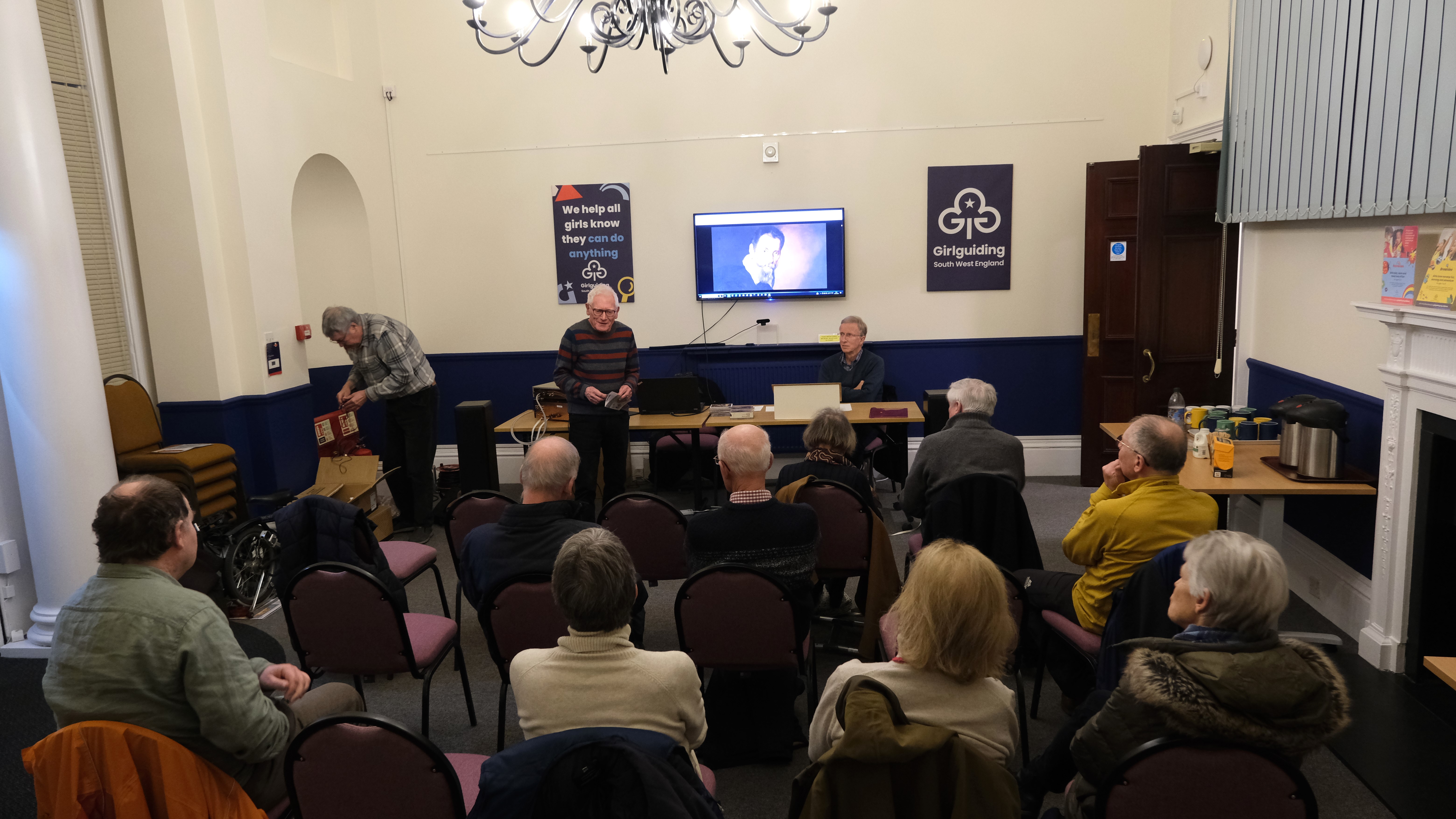
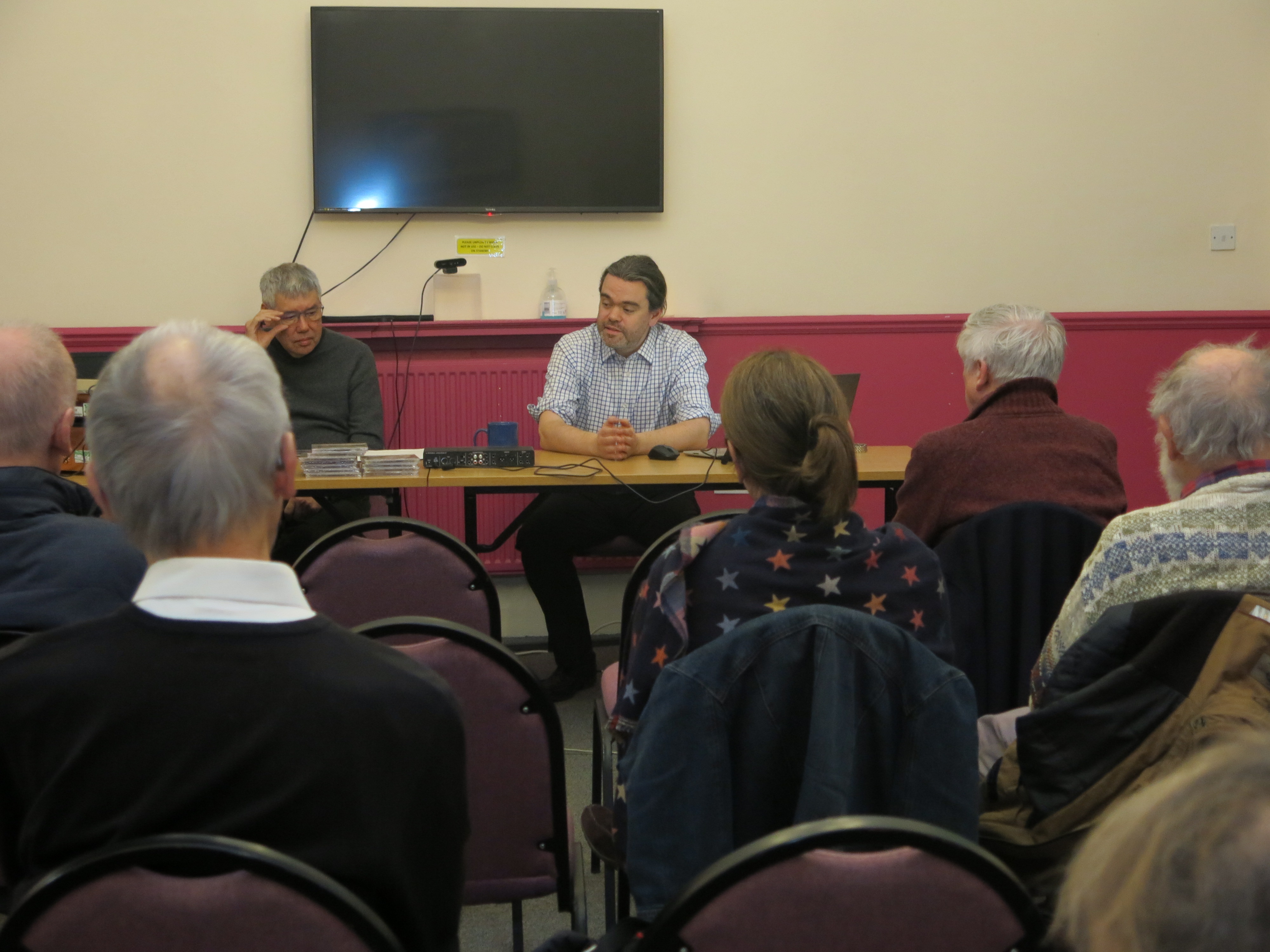
View of the music room (pictures: Salisbury RMS)

Christmas meeting

Successful evening despite change to the programme

Due to unforeseen circumstances the last evening of the year was a success with four of the committee members stepping up with their selections of music with a Christmas theme. Not surprisingly, Bach featured in two of the presentations: first with the Christmas Oratorio BWV 248 intended for performance during the Christmas period.

Second, we had the rather unusual Mrs Kennedy’s adaptation of ‘A Christmas Carol‘ with the voice of Bernard Miles among others. This is available on YouTube .

Thirdly, were two extracts from L’Enfance du Christ by Berlioz. This piece grew slowly following a tune which popped into his head at a card game. This became the well known Le Choeur des Bergers. He added further pieces bit by bit eventually shaping into the final work which was a huge success.

Grieg is one of those composers who is well known for a small handful of their output – in his case the piano concerto comes to mind – the rest of their oeuvre can often remain unperformed appearing fleetingly on Radio 3. We heard his Sonata for violin and piano Opus 45. This is the last of his sonatas for violin and was composed in 1887 a little before he began to enjoy some fame.

Finally, more Bach with some selections from the Christmas Cantatas including BWV 63; 91; 40 and 110. This is part of the major effort by the conductor, John Eliot Gardiner, to record all the extant Bach cantatas, many of which, regrettably have been lost.

Coincidentally, both Bach selections and the Berlioz were by Eliot Gardiner who has stepped back from conducting following an unfortunate incident surrounding the performance of les Troyens at the Proms. We must hope he returns to the music scene soon.

Merry Christmas to our readers and we restart on 29 January 2024 when we welcome a speaker from the Holst Society who, like Greig, is largely know for one piece is in his case the Planets Suite. The title appropriately is ‘Is there more to Holst than solely the Planets?’

Peter Curbishley

Off the Beaten Track

… was the title of last evening’s talk

November 2023

One of the aims of our Society is to play music from the less well known, the overlooked or even the yet to be discovered. Whether it is just composers is hard to say but there are a lot of composers and compositions who were – which were – once well known yet for various reasons seem to disappear never to be heard of again outside perhaps, a small group of aficionados.

Last night’s presentation by our Chair, Peter Horwood, was an attempt – a successful attempt – to bring to our notice just some of those compositions which have been undeservedly forgotten or neglected. We were doubly grateful to Peter who had to step in at short notice because of unforeseen circumstances.

We started with a piece by the sixteenth century German composer Michael Praetorius and one of his ballets – La Bourée. This was followed by a poem set to music by Rachel Portman. Rachel is well-known and was the first woman to win an Academy Award and also an Emmy.

This was followed by an extraordinary composition consisting entirely of percussion instruments of various kinds called Ku-Ka Illmoka, composed by Christopher Rouse III an American who has a wide range of compositions to his name including a Requiem and six symphonies.

An accomplished partita by Johann Gottfried Walther, contemporary of Bach, followed: an example of someone who seems to have been unfairly overlooked. Then it was a piece by Leo Ornstein, a Ukrainian born composer (as we would say today, then part of the Russian empire) who spent most of his life in America. A brilliant pianist, he suddenly gave it up to devote his life to composition. We heard the third movement of the Piano Quintet No 3. His work was controversial and concerts were sometimes riots of jeering and whistling. The piece we heard was outstanding and orginal.

Then a harpsichord piece by Richard Jones from his Suite No 1. A 17th Century composer, little of his work survives particularly his stage compositions. This was a lively harpsichord piece, an instrument which had not long been invented at the time he was alive.

Few will have heard of Nikolai Tcherepnin a Russian composer born in St Petersburg and studied under Rimsky-Korsakov. He was closely involved with Diaghilev’s Ballet Russes and conducted some of their performances. We listened to the prelude from La Princess Lointaine. After the Revolution he left for Paris and spent the rest of his days there.

Few may have heard of Hélène de Montgeroult who lived in France and who experienced first hand, the violence of the Revolution being the daughter of an aristocratic family. She was denounced and imprisoned. She was a brilliant pianist and we heard Etudes 6 & 7. What was astonishing about them was that they were composed not long after Mozart’s death but seemed a world away. Indeed, one commentator said she was the gap between Mozart and Chopin. Like so many female composers she largely disappeared from view.

Next to a composition by Oscar Fried a German composer who was the first to record a Mahler symphony. We heard a setting of Transfigured Night a poem by Richard Dehmel. Jolly Braga Santos is a Portuguese composer, arguably their greatest, born in Lisbon in 1924. He composed symphonies and other works and we enjoyed the 1st movement from his Symphony No 1. An impressive melodic work. He was encouraged in his work by Ralph Vaughan Williams.

We ended the evening with A Drop in the Ocean by Eriks Ešenvalds a Latvian composer born in 1977 who now teaches in his home country.

Few will have heard of these composers or of the compositions. They were in a wide variety of styles and spanned around four centuries. All were indeed off the beaten track and are infrequently heard in concert halls.

Peter Curbishley

Members’ evening

Successful members’ evening held

October 2023

Members’ evenings are always a lucky dip, each cannot know what someone else will bring for the others to listen to. Last night’s meeting (23 October) was packed full of interest with a wide variety of styles and genres. We can all get into something of a rut with our listening and today certainly, the cost of going to live music and especially the opera, can make us conservative and to stay with the familiar and our favourites. It is one of the purposes of the Society to broaden our knowledge and last evening it did so in spades.

Hearing new things can involve diligent listening to Radio 3. Classic FM tends to stick to familiar territory and you are like as not to hear the umpteenth rendition of Concerto de Aranjuez or The Four Seasons rather than something unusual. For some strange reason they are always trying to relax you as well. What they think their listeners are doing in the middle of the day to need relaxing is a mystery but I feel I am drifting off the point.

Last evening. We had a mix of unusual pieces, pieces from familiar composers which a member particularly liked and previously little heard composers. Eclectic doesn’t quite cover it. Aulis Sallinen, the Finnish composer does not get much of an airing but we heard a charming serenade to start the evening. Some variations by Arthur Bliss followed and the same speaker introduced us to an amazing piece by Bill Evans an American who died relatively young at 51.

Mozart’s adagio from the Violin Concerto No 3 followed, one of the 5 concertos he wrote in the space of around 2 years in Salzburg. Numbers 6 are 7 are now known not to be his. Janáček’s work does not often get an airing in our meetings but a new member to the third movement of the 2nd String Quartet which persuaded us I think to give more attention to this composer.

And then for something completely different to wit Malaika performed by William Fedhili, a Kenyan, of a piece composed by Adam Salil.

Back to more familiar territory with a selection of Gretchen am Sprinnade a quite lovely song by Schubert. Michael Tippett, or Sir Michael we should say, got a hearing with the allegro from Concerto for Double String Orchestra. Tippett, with Benjamin Britten were the two post war ‘greats’ of the British musical scene. There followed the second movement from another Finnish composer, Sibelius’ Violin Concerto played by the gifted Ginette Neveu who died tragically young in an air crash aged just 30. She was immensely gifted and beat David Oistrakh twice in an international competition in Warsaw. Her playing has just got to be heard to be believed and the tone she achieved from her violin was unlike any other player – a real revelation. Her limited output is all still available on disc.

Following the last meeting’s presentation of South American music, we had another outing for Villa-Lobos and his Prelude No 1 played by an octogenarian Andres Segovia in a stunning filmed performance.

Another change to a small selection of piano encores – amazing and delightful pieces ‘collated’ one might say by another of our new members. We ended with one of Richard Strauss’ songs, Beim Schlafengehen, selected by another new member, from his Four Last Songs sung by Soile Isokoski and the Berlin RSO. A fitting ending. And we weren’t falling asleep.

I am sure many of those present will be exploring one or other of the samples, shall I say, we heard this evening.

Our next meeting is on 6 November when we shall hear the third instalment of our chair’s presentation of modern music.

Peter Curbishley

A more detailed list of what was played can be accessed here:

1. Kitten on the Keys (1921), by Zez Confrey – from the 1989 festival on DACOCD 349

2. Triple Etude (1992), by M-A Hamelin – from 1992 on DACOCD 399. The three Chopin A minor studies combined: op.10 No.2, op.25 No.4, and op.25 No.11. It became No.1 of his 12 Etudes in all the minor keys (1986 – 2009), although it wasn’t the first to be composed.

3. “Schorschi-Batschi” Fox-Trott (sic) by “Willking Giese”, a.k.a. Walter Gieseking.

Music producer talks about his work

Music producer, Tim Smithies describes his work producing CDs

The first meeting of the new 2023/24 season kicked off with a fascinating talk by Tim Smithies on the problems and challenges producing music recordings for sale. Tim is a leading light of the Metronome label where he has been for 30 years. When we listen to a CD, we are not aware of the effort and time taken to assemble the artists, technical staff and instruments needed to make it all happen. An added problem for small and niche producers is that they are unlikely to have the resources needed to record the standard repertoire with big orchestras and a big name conductor and soloist.

In common with many small firms, survival often depends of locating a gap in the market too small for the heavyweight firms to consider. Metronome started with focusing on early music and the first example was music from the Plantagenet era and a piece composed by John Dunstable and played by the Orlando Consort. Another early recording was Love Affair with the Lute and a piece by John Dowland, Flow my Tears. Tim said the aim of his label was to “focus on the clarity” and this certainly shone through in this and other examples he played.

As time went on, the label got “drawn into other people’s interests” as Tim put it and that means expanding the repertoire to include other artists and genre. This is the classic dilemma for small firms: do you stay focused on your strategy or do you respond to market opportunities as they come along? As Tim explained, trying to do the former can be difficult especially in the world of artists. Opportunities arose and it was sensible to respond to them.

Things can develop from a very small start he said. He instanced the harpsichordist Carole Cerasi whom he heard at a concert playing music by Elizabeth Jacquet de la Guerre. This led to a series of recordings by her on the label.

Closer to home, Metronome has produced music sung by the choir of Salisbury Cathedral in a recording called An English Choristers Songbook.

One of the problems a small producer has – as one might expect – is poaching of artists by larger firms. But it was not all one way he said and there were examples of what he termed ‘rebound’ that is, artists who wanted to do their own thing and found the restrictions of the big labels did not allow them to do that. Christopher Hogwood was an example who wanted to record music on the clavichord, an instrument widely used by Bach for example. The problem is that it does not have that great a volume so is suitable only for intimate settings. We heard a recording of a familiar Bach piece normally heard on a piano, which sounded quite different on a clavichord. The music appears on a Metronome recording called The Secret Bach.

One of the difficulties with recordings of this nature on period instruments is that they have to be made where it is situated since they cannot be moved to a recording studio. This has its own issues of finding a room with the right acoustics. As anyone who has organised an event in such settings will know, as soon as you are poised to start, drilling will start somewhere, as if by magic, making progress impossible. As we heard at a previous Society meeting, instruments need constant tuning during the recordings.

Talking of older instruments, we even heard a piece on the theorba, a double necked lute with an extra set of bass strings.

This was a fascinating evening and a great start to the new season. Not only did we hear some interesting and for some of us, unfamiliar music, but we learned of the story behind it and gained a glimpse of the life of a small, but perfectly formed, record producer.

Peter Curbishley

Next meeting on 9 October 2023. Printed copies are available in the Library, the Tourism Information Centre and Oxfam (upstairs).

Leopold Stokowski

Fascinating talk on this conductor

At its meeting on 27 March, Robin Lim gave a fascinating talk about this famous conductor. If you did not know anything about his life story, you would assume from his showmanship and conducting history, that he was a quintessential American. Indeed, as Robin explained, he went to some pains to conceal his age and his place of birth, at times claiming it to have been Poland or Pomerania. In fact he was born in the rather more mundane St Johns Wood in London in 1882.

For many older people in the audience and more widely, their introduction to classical music came from the 1940 Disney film Fantasia which was recently reworked and reissued. This combination of film and music was in its day, quiet a feat and getting the sound to emerge from the right (correct) part of the screen required a considerable degree of technical expertise. Stereo was in its infancy at the time and the film was the first successful attempt to bring multi-track sound to the cinema. We sometimes forget today, surrounded as we are by the wonders of technology, that it was not always thus: I can recall seeing Fantasia in Manchester as a child and being enthralled by the sound as well as the animations. Fantasia’s remixed multi track soundtrack is still extant, the original takes prior to the remixing have been lost unfortunately .

Stokowski had a colourful life which included having three wives one of whom was Gloria Vanderbilt as well as a number of affairs including one – it is alleged – with Greta Garbo.

He was keen to promote new music and one piece played was the second movement from Shostakovich’s Symphony No. 5 – a 1958 recording which sounded amazing considering its age. Shostakovich was lucky to be alive and was only able to leave Russia because his prestige in the West led Stalin to give him permission to leave.

Another interesting item was a recording of Stokowski rehearsing Tchaikovsky’s 5th Symphony. Tchaikovsky’s parent’s original name was Chaiko as they hailed from Ukraine: interesting in view of attempts to ban his music after the Russian invasion of that country. But I digress.

We heard his impressive arrangement for orchestra of the Toccata and Fugue in D minor played by the Czech Philharmonic. Indeed, all the recordings we heard demonstrated Stokowski’s ability to get the most from an orchestra, particularly the string sections, a point Robin made. On the subject of orchestras, we take for granted the current arrangement of orchestras with strings on the left cellos on the right etc. but this arrangement is down to Stokowski after much experimentation with different arrangements.

He also appeared in films including One Hundred Men and a Girl, (1937) – the mind boggles – as well as Fantasia.

Towards the end of his life, he returned to the UK and decided to live in Nether Wallop, Hampshire, buying Place Farm House in 1972. He had a fatal heart attack in 1977. Local residents recall his strange habit of taking a stroll around the village wearing a sinister full-length opera coat. Another curiosity was his habit of speaking in a curious pseudo East European accent: odd since he was born in London.

A truly interesting evening and Robin had gone to great efforts to research his subject, a point made by the chair in his vote of thanks.

Peter Curbishley

Robin provided an extract written by Michael Draper from the September 2009 issue of Wallop Parish News, reproduced with permission, and some parts of this review were taken from that.

Making recordings during Lockdown

The pianist Christopher Guild discussed the problems of recording during Covid Lockdown

You might think that the Society, having been in existence for several decades now, would not have anything new to offer, yet Christopher’s presentation on 13 March was new in several respects. First, it was a description of the recording process itself (more later) second, we had we had recordings performed by Christopher and third, two recordings which had never been performed in public before. Christopher used to teach at Godolphin School in Salisbury.

One composer he featured was Ronald Stevenson who is somewhat neglected today and whose work Christopher has been exploring and unearthing new pieces. Other composers featured during the evening were by William Beaton Moonie, Berhard van Deeren, Ronald Center and William Brocklesby Wordsworth, great nephew of the poet of the same name. There were transcriptions of works by Purcell. Stevenson is no stranger to the Society as Christopher gave a presentation of some of the composer’s work in an earlier visit in 2015.

Recording, like many other aspects of life, was all but impossible during Lockdown although there were attempts at performing elements and then melding them together. One such was a recording with a poem in medieval French included.

Christopher explained the recording process generally. Except for major stars, the record company will not make any up-front payment. This means the performers need to secure finance themselves unless they self-fund. The process starts with an idea which is proposed to the record label. Then a recording studio needs to be located and in the case of a piano recording, with a full size instrument. This is to do with the dynamics of the sound and the harmonics which are important for the integrity of the final sound. Perhaps surprisingly, the piano has to be kept in tune several times during the day which of course is another expense. This arises because of temperature and other changes in the studio during the day. The studio Christopher used was near Beccles.

Each piece can be played three times together with ‘patching’ where there are mistakes or infelicities of playing to be corrected. This process can take two days.

This was a fascinating evening with several never before heard pieces performed by composers – such as Ronald Center – of whom few if any of us had heard before. The process of recording was especially interesting and it’s perhaps surprising to note that as a recorded music society we have not touched on the process itself before.

PC


The next meeting is on 27th March and concerns the conductor Leopold Stokowski who died at Nether Wallop.

Photo: SRMS

Music in eighteenth century London

This was the title of a presentation by Ruth Barlow which included a range of music popular in that century. London at that time was a rapidly growing city and the largest in Europe. The country was becoming prosperous as a result of the growing empire and people were looking for entertainment which would of course have included music.

Music was also coming out of the great houses and into the public sphere with an ever-increasing number of public concerts. Indeed, it was noted that if you wanted to learn about music you went to Paris or Italy, if you wanted to earn a living, you came to England.

The evening started with a performance of Corelli’s Concerto Grosso No 8 (excerpts) and ended with the last movement of Haydn’s Symphony No 4 nicknamed the ‘London’. This framing so to speak seemed to sum the century up with Corelli’s piece echoing the previous century and Haydn’s symphony, written in 1795, which ended it and gave hints of what was to come.

In between, we heard pieces by Handel, JC Bach, Thomas Arne, and William Boyce. We also heard part of the Beggar’s Opera, hugely popular in its day receiving 62 performances in its first season, on a recording directed by Ruth’s husband Jeremy which must be a first for the Society.

Music from men only ‘catch clubs’ was also performed. Today we would call them rounds but they are centuries old and involve singers coming in one by one singing the same melody. We heard examples by Henry Purcell and JS Smith sung by the Hilliard ensemble.

A sad moment was a Violin Sonata in A major by Thomas Linley, and English prodigy born in Bath who was certainly destined for great things. He was a friend of Mozart and they met and became friends in Italy. Unfortunately, he died at the tender age of 22 thus ending what was likely to have been a successful career.

Altogether a well put together programme and an interesting evening.

Sibelius – the less well known works

Last meeting of the season focused on Sibelius

Just over a century ago, Finland declared its independence at the time of the Russian revolution in 1917. At the start of the second world war in 1940, they then had to fight a fierce war against Stalin’s Russia who invaded the country with overwhelming force. The Russian general assumed it would all be over in around 12 days but the Russian army, although vast, was poorly led – following Stalin’s murder of thousands of Red Army officers – poorly equipped and the Finns put up a fierce resistance. They were ultimately successful losing only a small piece of territory but, they maintained their independence.

There is something faintly familiar with that story in the current events in Ukraine. Russia invading a neighbouring country with overwhelming force with the hope of a quick victory, being resisted by a much smaller but better led army. So what has this to do with the Recorded Music Society you ask? Living through this period was Finland’s greatest composer, Jean (as he is known today) Sibelius. His music contributed to Finland’s sense of nationhood from the time of independence and subsequently the war against Russia. So in addition to writing brilliant music, he was important giving the Finns a sense of national identity and pride. These things are significant during a time when a country is under threat.

Many of Sibelius’s works are well known and receive a regular airing in concert halls around the world. But like many composers, there is the well known and there is the less familiar. At last nights meeting, we were delighted to welcome again, Simon Coombs, who presented a range of less well known works, combining them with the life of the composer through his nation’s sometimes troubled history.

Sibelius started by studying law but while doing so, joined the Helsinki Music Institute. He was a capable violinist but decided to concentrate on composition and to that end, studied in Berlin and Vienna where he met Bruckner. He returned to Helsinki to compose his first major piece Kullervo. Among the pieces selected by Simon was A Conferment Cantata, A Song for Lemminkäinen, Finlandia, and a number of examples of incidental music. Also an extract from Pelléas et Mélisande and incidental music the the Tempest.

Simon was helped in his presentation by discs produced by Bis Records who have produced recordings by all of Sibelius’s music. Simon ended with some fragments of the 8th Symphony: it is not clear if Sibelius ever finished the work and destroyed it. Members were delighted with the presentation and the curation of the pieces linking it to key events in the composer’s life.

Sibelius’s music was an element of Finland’s struggle to achieve statehood and independence from Russia. It is strange to note that Ukraine’s famous composers; Prokofiev and Szymanowski among others, have not played a similar role in Ukraine’s resistance. Tchaikovsky is of Ukrainian extraction – the family name was originally Chaiko before the move to Russia.

This was the last meeting of the current season and the programme for the autumn is in final stages of preparation.

Peter Curbishley

Meeting report – September

The second meeting took place on 13 September 2021 and it was good to be back in person. The sessions have a quite different style now as we are now working around the screen on the wall and linking the sound through our speakers. Initially, there were some technical issues connected with the laptop but once this was changed, we could continue.

It was a member’s choice evening and demonstrated a wide not to say eclectic choice of pieces. The programme was:

  • Rimsky-Korsakov arr. Lindberg: Concerto in Bb for trombone

(Christian Lindberg (Trombone), Tapiola Sinfonietta, Osmo Vänskä)

  • Mozart: Clarinet Concerto, 3rd movement.

(David Shifrin (Bassett Clarinet in A), Mostly Mozart Festival Orchestra, Gerard Schwarz)

  • Wagner: Siegfried Funeral Music

(Vienna Philharmonic, George Solti)

  • Mozart: “Ruhe sanft” from Zaide

(Mojca Erdmann, Salzburg Festival 2006)

  • Mozart: “Misericordias Domini”
  • Shostakovich: Symphony no.8, 3rd movement.

(Leningrad Philharmonic, Evgeny Mravinsky)

  • Hermann Suter: Le Laudi di San Francesco d’ Assisi

No. 2 (Sister Moon and the Stars)

No. 4 (Sister Water)

(Edith Mathis, Norma Procter, Eric Tappy and Fernando Corena, with the Basler Sangverein and Orchester-Gesellschaft, Hans Münch)

  • Vaughan Williams: Concerto in F minor for Bass Tuba

(JáTtik Clark (Tuba), Corvallis-OSU Symphony, Marlan Carlson)

  • “Playing a flaming tuba on Londonʼs South Bank” 
  • Jenny Pluck Pears, a Playford country dance

(The Broadside Band, Jeremy Barlow)

  • Heidrich: Variations on a theme (extracts)

(Zubin Mehta)

A range of pieces and genres with some rarities not usually heard.

We were delighted to welcome two new members to the Society.

Peter Curbishley