Leopold Stokowski

Fascinating talk on this conductor

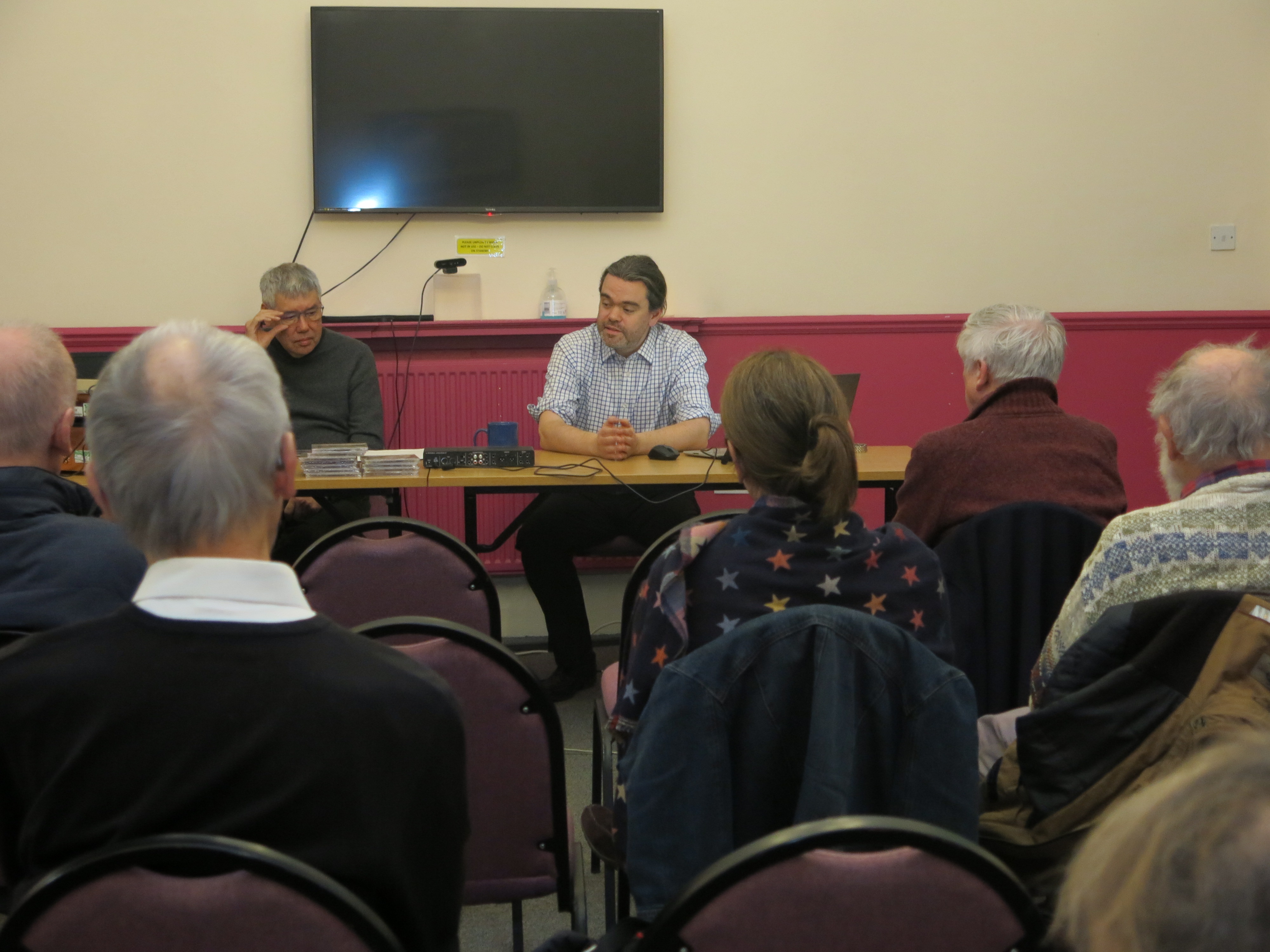
At its meeting on 27 March, Robin Lim gave a fascinating talk about this famous conductor. If you did not know anything about his life story, you would assume from his showmanship and conducting history, that he was a quintessential American. Indeed, as Robin explained, he went to some pains to conceal his age and his place of birth, at times claiming it to have been Poland or Pomerania. In fact he was born in the rather more mundane St Johns Wood in London in 1882.

For many older people in the audience and more widely, their introduction to classical music came from the 1940 Disney film Fantasia which was recently reworked and reissued. This combination of film and music was in its day, quiet a feat and getting the sound to emerge from the right (correct) part of the screen required a considerable degree of technical expertise. Stereo was in its infancy at the time and the film was the first successful attempt to bring multi-track sound to the cinema. We sometimes forget today, surrounded as we are by the wonders of technology, that it was not always thus: I can recall seeing Fantasia in Manchester as a child and being enthralled by the sound as well as the animations. Fantasia’s remixed multi track soundtrack is still extant, the original takes prior to the remixing have been lost unfortunately .

Stokowski had a colourful life which included having three wives one of whom was Gloria Vanderbilt as well as a number of affairs including one – it is alleged – with Greta Garbo.

He was keen to promote new music and one piece played was the second movement from Shostakovich’s Symphony No. 5 – a 1958 recording which sounded amazing considering its age. Shostakovich was lucky to be alive and was only able to leave Russia because his prestige in the West led Stalin to give him permission to leave.

Another interesting item was a recording of Stokowski rehearsing Tchaikovsky’s 5th Symphony. Tchaikovsky’s parent’s original name was Chaiko as they hailed from Ukraine: interesting in view of attempts to ban his music after the Russian invasion of that country. But I digress.

We heard his impressive arrangement for orchestra of the Toccata and Fugue in D minor played by the Czech Philharmonic. Indeed, all the recordings we heard demonstrated Stokowski’s ability to get the most from an orchestra, particularly the string sections, a point Robin made. On the subject of orchestras, we take for granted the current arrangement of orchestras with strings on the left cellos on the right etc. but this arrangement is down to Stokowski after much experimentation with different arrangements.

He also appeared in films including One Hundred Men and a Girl, (1937) – the mind boggles – as well as Fantasia.

Towards the end of his life, he returned to the UK and decided to live in Nether Wallop, Hampshire, buying Place Farm House in 1972. He had a fatal heart attack in 1977. Local residents recall his strange habit of taking a stroll around the village wearing a sinister full-length opera coat. Another curiosity was his habit of speaking in a curious pseudo East European accent: odd since he was born in London.

A truly interesting evening and Robin had gone to great efforts to research his subject, a point made by the chair in his vote of thanks.

Peter Curbishley

Robin provided an extract written by Michael Draper from the September 2009 issue of Wallop Parish News, reproduced with permission, and some parts of this review were taken from that.

Making recordings during Lockdown

The pianist Christopher Guild discussed the problems of recording during Covid Lockdown

You might think that the Society, having been in existence for several decades now, would not have anything new to offer, yet Christopher’s presentation on 13 March was new in several respects. First, it was a description of the recording process itself (more later) second, we had we had recordings performed by Christopher and third, two recordings which had never been performed in public before. Christopher used to teach at Godolphin School in Salisbury.

One composer he featured was Ronald Stevenson who is somewhat neglected today and whose work Christopher has been exploring and unearthing new pieces. Other composers featured during the evening were by William Beaton Moonie, Berhard van Deeren, Ronald Center and William Brocklesby Wordsworth, great nephew of the poet of the same name. There were transcriptions of works by Purcell. Stevenson is no stranger to the Society as Christopher gave a presentation of some of the composer’s work in an earlier visit in 2015.

Recording, like many other aspects of life, was all but impossible during Lockdown although there were attempts at performing elements and then melding them together. One such was a recording with a poem in medieval French included.

Christopher explained the recording process generally. Except for major stars, the record company will not make any up-front payment. This means the performers need to secure finance themselves unless they self-fund. The process starts with an idea which is proposed to the record label. Then a recording studio needs to be located and in the case of a piano recording, with a full size instrument. This is to do with the dynamics of the sound and the harmonics which are important for the integrity of the final sound. Perhaps surprisingly, the piano has to be kept in tune several times during the day which of course is another expense. This arises because of temperature and other changes in the studio during the day. The studio Christopher used was near Beccles.

Each piece can be played three times together with ‘patching’ where there are mistakes or infelicities of playing to be corrected. This process can take two days.

This was a fascinating evening with several never before heard pieces performed by composers – such as Ronald Center – of whom few if any of us had heard before. The process of recording was especially interesting and it’s perhaps surprising to note that as a recorded music society we have not touched on the process itself before.

PC


The next meeting is on 27th March and concerns the conductor Leopold Stokowski who died at Nether Wallop.

Photo: SRMS

Music in eighteenth century London

This was the title of a presentation by Ruth Barlow which included a range of music popular in that century. London at that time was a rapidly growing city and the largest in Europe. The country was becoming prosperous as a result of the growing empire and people were looking for entertainment which would of course have included music.

Music was also coming out of the great houses and into the public sphere with an ever-increasing number of public concerts. Indeed, it was noted that if you wanted to learn about music you went to Paris or Italy, if you wanted to earn a living, you came to England.

The evening started with a performance of Corelli’s Concerto Grosso No 8 (excerpts) and ended with the last movement of Haydn’s Symphony No 4 nicknamed the ‘London’. This framing so to speak seemed to sum the century up with Corelli’s piece echoing the previous century and Haydn’s symphony, written in 1795, which ended it and gave hints of what was to come.

In between, we heard pieces by Handel, JC Bach, Thomas Arne, and William Boyce. We also heard part of the Beggar’s Opera, hugely popular in its day receiving 62 performances in its first season, on a recording directed by Ruth’s husband Jeremy which must be a first for the Society.

Music from men only ‘catch clubs’ was also performed. Today we would call them rounds but they are centuries old and involve singers coming in one by one singing the same melody. We heard examples by Henry Purcell and JS Smith sung by the Hilliard ensemble.

A sad moment was a Violin Sonata in A major by Thomas Linley, and English prodigy born in Bath who was certainly destined for great things. He was a friend of Mozart and they met and became friends in Italy. Unfortunately, he died at the tender age of 22 thus ending what was likely to have been a successful career.

Altogether a well put together programme and an interesting evening.

Sibelius – the less well known works

Last meeting of the season focused on Sibelius

Just over a century ago, Finland declared its independence at the time of the Russian revolution in 1917. At the start of the second world war in 1940, they then had to fight a fierce war against Stalin’s Russia who invaded the country with overwhelming force. The Russian general assumed it would all be over in around 12 days but the Russian army, although vast, was poorly led – following Stalin’s murder of thousands of Red Army officers – poorly equipped and the Finns put up a fierce resistance. They were ultimately successful losing only a small piece of territory but, they maintained their independence.

There is something faintly familiar with that story in the current events in Ukraine. Russia invading a neighbouring country with overwhelming force with the hope of a quick victory, being resisted by a much smaller but better led army. So what has this to do with the Recorded Music Society you ask? Living through this period was Finland’s greatest composer, Jean (as he is known today) Sibelius. His music contributed to Finland’s sense of nationhood from the time of independence and subsequently the war against Russia. So in addition to writing brilliant music, he was important giving the Finns a sense of national identity and pride. These things are significant during a time when a country is under threat.

Many of Sibelius’s works are well known and receive a regular airing in concert halls around the world. But like many composers, there is the well known and there is the less familiar. At last nights meeting, we were delighted to welcome again, Simon Coombs, who presented a range of less well known works, combining them with the life of the composer through his nation’s sometimes troubled history.

Sibelius started by studying law but while doing so, joined the Helsinki Music Institute. He was a capable violinist but decided to concentrate on composition and to that end, studied in Berlin and Vienna where he met Bruckner. He returned to Helsinki to compose his first major piece Kullervo. Among the pieces selected by Simon was A Conferment Cantata, A Song for Lemminkäinen, Finlandia, and a number of examples of incidental music. Also an extract from Pelléas et Mélisande and incidental music the the Tempest.

Simon was helped in his presentation by discs produced by Bis Records who have produced recordings by all of Sibelius’s music. Simon ended with some fragments of the 8th Symphony: it is not clear if Sibelius ever finished the work and destroyed it. Members were delighted with the presentation and the curation of the pieces linking it to key events in the composer’s life.

Sibelius’s music was an element of Finland’s struggle to achieve statehood and independence from Russia. It is strange to note that Ukraine’s famous composers; Prokofiev and Szymanowski among others, have not played a similar role in Ukraine’s resistance. Tchaikovsky is of Ukrainian extraction – the family name was originally Chaiko before the move to Russia.

This was the last meeting of the current season and the programme for the autumn is in final stages of preparation.

Peter Curbishley

Meeting report – September

The second meeting took place on 13 September 2021 and it was good to be back in person. The sessions have a quite different style now as we are now working around the screen on the wall and linking the sound through our speakers. Initially, there were some technical issues connected with the laptop but once this was changed, we could continue.

It was a member’s choice evening and demonstrated a wide not to say eclectic choice of pieces. The programme was:

  • Rimsky-Korsakov arr. Lindberg: Concerto in Bb for trombone

(Christian Lindberg (Trombone), Tapiola Sinfonietta, Osmo Vänskä)

  • Mozart: Clarinet Concerto, 3rd movement.

(David Shifrin (Bassett Clarinet in A), Mostly Mozart Festival Orchestra, Gerard Schwarz)

  • Wagner: Siegfried Funeral Music

(Vienna Philharmonic, George Solti)

  • Mozart: “Ruhe sanft” from Zaide

(Mojca Erdmann, Salzburg Festival 2006)

  • Mozart: “Misericordias Domini”
  • Shostakovich: Symphony no.8, 3rd movement.

(Leningrad Philharmonic, Evgeny Mravinsky)

  • Hermann Suter: Le Laudi di San Francesco d’ Assisi

No. 2 (Sister Moon and the Stars)

No. 4 (Sister Water)

(Edith Mathis, Norma Procter, Eric Tappy and Fernando Corena, with the Basler Sangverein and Orchester-Gesellschaft, Hans Münch)

  • Vaughan Williams: Concerto in F minor for Bass Tuba

(JáTtik Clark (Tuba), Corvallis-OSU Symphony, Marlan Carlson)

  • “Playing a flaming tuba on Londonʼs South Bank” 
  • Jenny Pluck Pears, a Playford country dance

(The Broadside Band, Jeremy Barlow)

  • Heidrich: Variations on a theme (extracts)

(Zubin Mehta)

A range of pieces and genres with some rarities not usually heard.

We were delighted to welcome two new members to the Society.

Peter Curbishley

New season gets underway

The Society was able to meet for the first time in many months at our normal venue off St Ann Street in Salisbury. Covid arrangements meant we could not offer refreshments unfortunately. Being back in person was good however.

The topic for the evening was the legend of Orpheus and the birth of opera. We tend now to think of opera in terms of major theatrical productions by Verdi, Wagner or Mozart etc replete with arias, an overture and full orchestra. It did not start out that way.

The presenter, Jeremy Barlow, introduced the evening with a discussion of the legend of Orpheus. This is a Greek myth and there are several versions but essentially, his wife, Euridice, is bitten by a snake and descends to Hades. Orpheus descends into Hades in an effort to see her again. Orpheus had been given a Lyre by Apollo and taught him to play which he did so well that few could resist his playing, even animals. Jeremy showed a number of artist’s representation of the myth and how the things like the instrument Orpheus played changed as those like the lyre went out of use.

Opera started he explained with things called intermedio which were short intervals between straight plays. These were put on during special court events in Italy such as feasts and weddings. After around 1600, operas as we now know them really began.

Monteverdi was not the first but is remembered because his music is still performed today. Various extracts from these earlier operas were played. Many composers through history have based their work on this legend.

A most interesting evening and the use of the monitor meant it was a new departure for the Society. Jeremy was able to mix legend with history and weave in musical examples to show the early development of the genre. We will almost certainly be using these methods in future and during lockdown, we were able to use YouTube to great effect.


The next meeting, on 27 September, will be ‘committee member’s choices’. We hope to see some returning members then. The full programme can be read here.

PC

Jan Dismas Zelenka

The second meeting of the Society using a combination of Zoom and YouTube took place on 19 October 2020 and concerned the Czech composer Zelenka presented by Peter Horwood. There are many who may not have heard of this composer, born in the town of Lounovice near Prague in 1679. His problem – if it can be described thus – was to be around at roughly the same time as Bach and Handel and so his fame was eclipsed after his death.

We listened and watched his Missa Votiva in E minor performed by Collegium 1704 under the energetic baton of Václav Luks. The playing and singing was of a very high standard and the conductor kept to a brisk tempo. The YouTube video was not of a high quality and may also have been compressed so that the full range of sound was not fully available. The recording took place in a large church yet there were no dynamic problems one usually experiences in these large spaces.

Although the music was harmonically rich, it did lack much in the way of memorable melody which might explain his low profile after his death. He was nevertheless a composer of great talent and does deserve to be heard more. As we have said before, one of the roles of the Society is to bring to the fore some of these lesser lights who sometimes get swept aside by musical titans of Bach, Mozart or Beethoven etc.

For those who want to know more there is a Website which tells you more and also lists recordings available on CD or for download.

Peter Curbishley

Behold the sea …

It is perhaps not too surprising that an island nation should feature the sea in the compositions of its native composers.  Examples of these – from well known and some less well known composers – featured in the last meeting of the Society on 27 January 2020.

Society member Ed Tinline kicked of the second half of the season with a wide selection of pieces composed by British composers, all with the sea as their inspiration.

We started with part of Vaughan William’s Symphony No 1, A Sea Symphony composed in 1909.  Inspiration for the symphony came in part from Walt Whitman.  It was premiered when he was 38 and established him as a leading composer.

Brighton born Frank Bridge was next with his Symphonic Suite: The Sea composed in 1910.  Then a piece by Judith Weir with her Lament, Over the Sea from her The Bagpiper’s String Trio first performed in 1989.  Judith was the first woman to be appointed Master of the Queen’s Music.

Next – another woman – Ethyl Smyth with her Overture: The Wreckers from 1906.  I wrote ‘jaunty’ at one point with some interesting orchestral colours.  Dame Ethel Mary Smyth attained prominence as one of the most accomplished female composers in a male dominated environment, and as one of the main representatives of the suffragette movement.  Tchaikovsky said of her ‘[she] one of the few women composers whom one can seriously consider to be achieving something valuable in the field of musical creation’.  Source: British Library.

The first half ended with Arnold Bax’s On the Sea-shore And Elgar’s Sea Pictures.

The second half started with the unfamiliar Mass of the Sea composed by Paul Patterson composed in 1983.  Next was By the Sleepy Lagoon written at Selsey by Eric Coates – who like Frank Bridge, was born in Brighton – looking across the bay and is used as the theme for Desert Island Discs on Radio 4.

The Kent coast inspired David Matthew’s Overture: From Sea to Sky composed quite recently in 1992.  The Sea Interludes from Britten’s Peter Grimes are very familiar.  Interestingly, Britten was taught composition by Frank Bridge.

The penultimate piece was The Needles by Matthew Taylor commissioned by the LSE Music Society in 2000.  Finally we returned to Elgar and another of his Sea Pictures composed at the end of the nineteenth century.

A fascinating evening and a wide range of music based on this one idea.

Peter Curbishley


Next month’s meeting is Berlioz’s vocal music and is on Monday 10 February. 


Members’ evening

A members’ evening following the agm doesn’t sound like a barrel of fun but in fact it was an outstanding evening with some interesting pieces.   We must thank Robin for assembling the programme for the Society.

First up was the first half of Brahms’s magisterial Piano Concerto No1 played by Stephen Kovacevich.  This can be ‘overplayed’ and I have been to concerts where the pianist seems determined to put the concerto to death but what we heard of this version was finely balanced and it was a pity we could not have heard the whole of it.

Second up was Joseph Kosma’s Les Feuilles Mortes sung by Gigi Marga – a version with the composer can be seen here: https://youtu.be/12BRQQd7myM

Few may have heard of Ginette Neveu, a French violinist but her playing is quite distinctive and, at the risk of sounding like a Classic FM announcer, extremely smooth.  The sound was somewhere between a violin and a viola, quite magical and the adagio from Sibelius’s Violin Concerto was wonderful.

Beatrice and Benedict was Berlioz’s last opera and had some success in Germany.  He wrote it soon after the Trojans disaster and we heard Je vais le voir – Il me revient fidèle in a performance by the LSO and conducted by the late Sir Colin Davies.

The first half ended with the amazingly difficult Violin Sonata in G minor – 3rd movement “Devil’s Trill Sonata” by Tartini the inspiration for which supposedly came to him in a dream.

In the second half we had a audio-visual presentation of Gigue Fugue BWV 577 by JS Bach, played on the organ and which was the music played at the presenter’s marriage.  This mode of playing music was the first for the Society.

Few will have heard of the woman composer and pianist Guirne Creith not least because although not prolific, many or her compositions were lost after her death.  She had a very varied life, not just as a musician but – following her move to France – as a food writer under the name of Guirne van Zylen.  Her best known work is a Violin Concerto from which we heard the Adagio.

After Andantino from Sibelius’s 3rd Symphony, The Man I Love by Gershwin played by Don Shirley.  Shirley was a precocious musician who was the subject of the 2018 film Green Book.  Being black, he had to take a bodyguard with him when he performed in the southern states of the USA.

A most interesting and varied evening with a mixture of the well known and some more or less completely unknown works.

Peter Curbishley


The next meeting is on 11 November and is a presentation on some less well known British composers. 7:30 start as usual.

George Lloyd

George Lloyd was born in 1913 in St Ives (Cornwall) and had a traumatic life.  Both his parents were keen musicians and encouraged his talent from an early age.  Illness meant he was taught at home then left to continue his studies in London.

He wrote his first symphony at 19 which was premiered in Penzance.  We heard the Introduction,  Theme and Five Variations and it was music which showed great accomplishment.  Two other symphonies followed as well as two operas; The Serf and Lernin.  The latter was also first performed in Penzance before being transferred to London where it had an unusually long run.  Alan Forshaw, the presenter, played the Duet from the opera and it was an outstanding piece of music.

A crucial event in his life was joining the Marines as a bandsman and took part in the awful North Cape convoys to supply the Red Army in WWII.  A most terrible event took place in many of his fellow marines were drowned in fuel oil.  This affected his mental wellbeing and prolonged hospitalisation with what was still being called shellshock, now called PTSD.

It was physically difficult for him to write music because of the shaking but with devoted care from his wife he was able to start again.  A movement from a subsequent symphony demonstrated a change in style.

He wrote music for brass bands and one such was HMS Trinidad March, the ship he had served on.  He had almost no success with commissions from the BBC with his scores returned with no comment.  A member of the audience suggested this might have been the influence of William Glock and the pressure to use the 12 tone scale which Lloyd has little time for.

He quit the musical life and he and his wife opened a market garden in Dorset.  He began to be appreciated in later life and had some of his work performed at the Proms and he did well in America.  Albany Records recorded several of his works.  We heard a movement from the 4th Piano Concerto and a movement from the 6th Symphony.  Other pieces included extracts from the Requiem, and the Black Dyke Mills Band playing a memoriam following the IRA atrocity in the Royal parks.

For those of us who knew little of this composer’s work it was a revelation.  He had a sure touch when it came to orchestration.  I felt his style would have suited film music where he may have done well.  We were grateful to Alan for his work in preparing the evening.

Peter Curbishley


Please note we now have a page on Facebook – Salisbury recorded music society.

Next meeting on 28 October