Leopold Stokowski

Fascinating talk on this conductor

At its meeting on 27 March, Robin Lim gave a fascinating talk about this famous conductor. If you did not know anything about his life story, you would assume from his showmanship and conducting history, that he was a quintessential American. Indeed, as Robin explained, he went to some pains to conceal his age and his place of birth, at times claiming it to have been Poland or Pomerania. In fact he was born in the rather more mundane St Johns Wood in London in 1882.

For many older people in the audience and more widely, their introduction to classical music came from the 1940 Disney film Fantasia which was recently reworked and reissued. This combination of film and music was in its day, quiet a feat and getting the sound to emerge from the right (correct) part of the screen required a considerable degree of technical expertise. Stereo was in its infancy at the time and the film was the first successful attempt to bring multi-track sound to the cinema. We sometimes forget today, surrounded as we are by the wonders of technology, that it was not always thus: I can recall seeing Fantasia in Manchester as a child and being enthralled by the sound as well as the animations. Fantasia’s remixed multi track soundtrack is still extant, the original takes prior to the remixing have been lost unfortunately .

Stokowski had a colourful life which included having three wives one of whom was Gloria Vanderbilt as well as a number of affairs including one – it is alleged – with Greta Garbo.

He was keen to promote new music and one piece played was the second movement from Shostakovich’s Symphony No. 5 – a 1958 recording which sounded amazing considering its age. Shostakovich was lucky to be alive and was only able to leave Russia because his prestige in the West led Stalin to give him permission to leave.

Another interesting item was a recording of Stokowski rehearsing Tchaikovsky’s 5th Symphony. Tchaikovsky’s parent’s original name was Chaiko as they hailed from Ukraine: interesting in view of attempts to ban his music after the Russian invasion of that country. But I digress.

We heard his impressive arrangement for orchestra of the Toccata and Fugue in D minor played by the Czech Philharmonic. Indeed, all the recordings we heard demonstrated Stokowski’s ability to get the most from an orchestra, particularly the string sections, a point Robin made. On the subject of orchestras, we take for granted the current arrangement of orchestras with strings on the left cellos on the right etc. but this arrangement is down to Stokowski after much experimentation with different arrangements.

He also appeared in films including One Hundred Men and a Girl, (1937) – the mind boggles – as well as Fantasia.

Towards the end of his life, he returned to the UK and decided to live in Nether Wallop, Hampshire, buying Place Farm House in 1972. He had a fatal heart attack in 1977. Local residents recall his strange habit of taking a stroll around the village wearing a sinister full-length opera coat. Another curiosity was his habit of speaking in a curious pseudo East European accent: odd since he was born in London.

A truly interesting evening and Robin had gone to great efforts to research his subject, a point made by the chair in his vote of thanks.

Peter Curbishley

Robin provided an extract written by Michael Draper from the September 2009 issue of Wallop Parish News, reproduced with permission, and some parts of this review were taken from that.

Making recordings during Lockdown

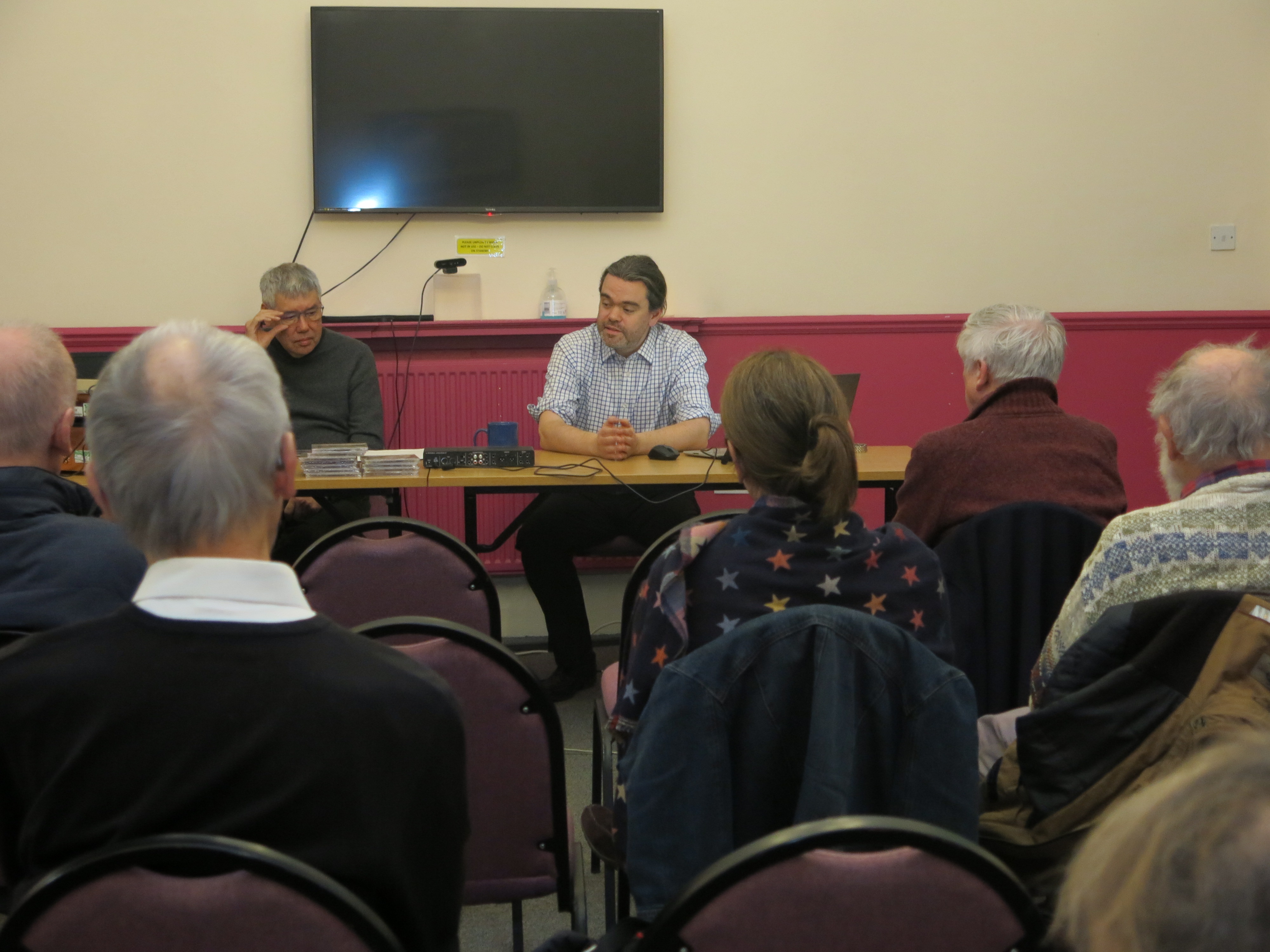
The pianist Christopher Guild discussed the problems of recording during Covid Lockdown

You might think that the Society, having been in existence for several decades now, would not have anything new to offer, yet Christopher’s presentation on 13 March was new in several respects. First, it was a description of the recording process itself (more later) second, we had we had recordings performed by Christopher and third, two recordings which had never been performed in public before. Christopher used to teach at Godolphin School in Salisbury.

One composer he featured was Ronald Stevenson who is somewhat neglected today and whose work Christopher has been exploring and unearthing new pieces. Other composers featured during the evening were by William Beaton Moonie, Berhard van Deeren, Ronald Center and William Brocklesby Wordsworth, great nephew of the poet of the same name. There were transcriptions of works by Purcell. Stevenson is no stranger to the Society as Christopher gave a presentation of some of the composer’s work in an earlier visit in 2015.

Recording, like many other aspects of life, was all but impossible during Lockdown although there were attempts at performing elements and then melding them together. One such was a recording with a poem in medieval French included.

Christopher explained the recording process generally. Except for major stars, the record company will not make any up-front payment. This means the performers need to secure finance themselves unless they self-fund. The process starts with an idea which is proposed to the record label. Then a recording studio needs to be located and in the case of a piano recording, with a full size instrument. This is to do with the dynamics of the sound and the harmonics which are important for the integrity of the final sound. Perhaps surprisingly, the piano has to be kept in tune several times during the day which of course is another expense. This arises because of temperature and other changes in the studio during the day. The studio Christopher used was near Beccles.

Each piece can be played three times together with ‘patching’ where there are mistakes or infelicities of playing to be corrected. This process can take two days.

This was a fascinating evening with several never before heard pieces performed by composers – such as Ronald Center – of whom few if any of us had heard before. The process of recording was especially interesting and it’s perhaps surprising to note that as a recorded music society we have not touched on the process itself before.

PC


The next meeting is on 27th March and concerns the conductor Leopold Stokowski who died at Nether Wallop.

Photo: SRMS

Next meeting

The next meeting is tonight, 13 March 2023, and is a presentation about making recordings during Lockdown. It will be by concert pianist Christopher Guild and this is an extract from his biography:

Born in Scotland in 1986, Christopher Guild studied piano and violin locally before entering St Mary’s Music School, Edinburgh aged 13. He took top honours in the Moray Piano Competition 2001 – he remains the youngest winner to this day.  Christopher entered the Royal College of Music in 2005 as a Foundation Scholar and studied for six years with Andrew Ball, gaining a First Class BMus (Hons), and the MMus and Artist Diploma with Distinction.  He went on to be the Richard Carne Junior Fellowship in Performance at Trinity Laban Conservatoire of Music and Dance 2012-13.  

Christopher teaches at Godolphin School. We look forward to seeing you at 7:30pm

Next meeting

Our next meeting will be this Monday, 27th February, when Jon Hampton will be presenting a fascinating insight into the colourful life of Alma Schindler – a woman who had an immense influence on music and the creative arts. Starting at 7:30 as usual and free parking outside the door.

We hope we will be able to welcome you on 27th February.

Christmas meeting

Our next meeting will be on Monday 5th December 2022 at 7.30 when Ruth Barlow will be gently challenging us with ‘Christmas Crackers’ – her classical music quiz. Ruth’s presentation last year was a great success, so we are looking forward to this years. Non-members will be very welcome and entry is only £3.

It will be our last meeting in 2022. 

We will resume in the new year on Monday 30th January 2023 when Jeremy Barlow will be presenting: “Sergio Celibidache: the greatest conductor of the 20th Century?”

Scriabin

Our next meeting will be on Monday 21st November 2022 at 7.30 when Simon Nicholls from the Scriabin Society will explore aspects of the work of Alexander Scriabin. Simon is a leading authority on this composer and we are delighted that he has agreed to come to Salisbury for this presentation.

Looking ahead our last meeting before Christmas will be on 5th December when Ruth Barlow will present  ‘Christmas Crackers’ – her classical music quiz.

We hope we will be able to welcome you on Monday and on 5th December.

ET

Music in eighteenth century London

This was the title of a presentation by Ruth Barlow which included a range of music popular in that century. London at that time was a rapidly growing city and the largest in Europe. The country was becoming prosperous as a result of the growing empire and people were looking for entertainment which would of course have included music.

Music was also coming out of the great houses and into the public sphere with an ever-increasing number of public concerts. Indeed, it was noted that if you wanted to learn about music you went to Paris or Italy, if you wanted to earn a living, you came to England.

The evening started with a performance of Corelli’s Concerto Grosso No 8 (excerpts) and ended with the last movement of Haydn’s Symphony No 4 nicknamed the ‘London’. This framing so to speak seemed to sum the century up with Corelli’s piece echoing the previous century and Haydn’s symphony, written in 1795, which ended it and gave hints of what was to come.

In between, we heard pieces by Handel, JC Bach, Thomas Arne, and William Boyce. We also heard part of the Beggar’s Opera, hugely popular in its day receiving 62 performances in its first season, on a recording directed by Ruth’s husband Jeremy which must be a first for the Society.

Music from men only ‘catch clubs’ was also performed. Today we would call them rounds but they are centuries old and involve singers coming in one by one singing the same melody. We heard examples by Henry Purcell and JS Smith sung by the Hilliard ensemble.

A sad moment was a Violin Sonata in A major by Thomas Linley, and English prodigy born in Bath who was certainly destined for great things. He was a friend of Mozart and they met and became friends in Italy. Unfortunately, he died at the tender age of 22 thus ending what was likely to have been a successful career.

Altogether a well put together programme and an interesting evening.

New season about to start!

NOTE: please note that the first meeting does not take place tomorrow, 12th September as printed in Music in Salisbury. We had to change our programme at the last minute due to unforeseen circumstances. The first meeting is on 26th. We are sorry for this sudden change.

The new season gets underway soon and the programme is printed and will soon be in various locations around town. A pdf version is below. It is a varied and extremely interesting programme so we look forward to seeing you again on Monday 26th September for a presentation of music from Ukraine. We look forward to seeing you again or welcoming new members.

New programme

The new programme for 2022 – 23 is available and the print version can be found in the Library, TIC, and the Oxfam music Room. We have some outside speakers including someone from the Scriabin Society and old friends returning with new topics.

There will be a coupon in the programme entitling you to a free evening* for those who are curious about what we do. Keep an eye on this site – better still put it into your favourites – and we look forward to seeing you when we kick off again in the autumn.

*can only be used once

Sibelius – the less well known works

Last meeting of the season focused on Sibelius

Just over a century ago, Finland declared its independence at the time of the Russian revolution in 1917. At the start of the second world war in 1940, they then had to fight a fierce war against Stalin’s Russia who invaded the country with overwhelming force. The Russian general assumed it would all be over in around 12 days but the Russian army, although vast, was poorly led – following Stalin’s murder of thousands of Red Army officers – poorly equipped and the Finns put up a fierce resistance. They were ultimately successful losing only a small piece of territory but, they maintained their independence.

There is something faintly familiar with that story in the current events in Ukraine. Russia invading a neighbouring country with overwhelming force with the hope of a quick victory, being resisted by a much smaller but better led army. So what has this to do with the Recorded Music Society you ask? Living through this period was Finland’s greatest composer, Jean (as he is known today) Sibelius. His music contributed to Finland’s sense of nationhood from the time of independence and subsequently the war against Russia. So in addition to writing brilliant music, he was important giving the Finns a sense of national identity and pride. These things are significant during a time when a country is under threat.

Many of Sibelius’s works are well known and receive a regular airing in concert halls around the world. But like many composers, there is the well known and there is the less familiar. At last nights meeting, we were delighted to welcome again, Simon Coombs, who presented a range of less well known works, combining them with the life of the composer through his nation’s sometimes troubled history.

Sibelius started by studying law but while doing so, joined the Helsinki Music Institute. He was a capable violinist but decided to concentrate on composition and to that end, studied in Berlin and Vienna where he met Bruckner. He returned to Helsinki to compose his first major piece Kullervo. Among the pieces selected by Simon was A Conferment Cantata, A Song for Lemminkäinen, Finlandia, and a number of examples of incidental music. Also an extract from Pelléas et Mélisande and incidental music the the Tempest.

Simon was helped in his presentation by discs produced by Bis Records who have produced recordings by all of Sibelius’s music. Simon ended with some fragments of the 8th Symphony: it is not clear if Sibelius ever finished the work and destroyed it. Members were delighted with the presentation and the curation of the pieces linking it to key events in the composer’s life.

Sibelius’s music was an element of Finland’s struggle to achieve statehood and independence from Russia. It is strange to note that Ukraine’s famous composers; Prokofiev and Szymanowski among others, have not played a similar role in Ukraine’s resistance. Tchaikovsky is of Ukrainian extraction – the family name was originally Chaiko before the move to Russia.

This was the last meeting of the current season and the programme for the autumn is in final stages of preparation.

Peter Curbishley