
The Society meets tonight (12th) to hear Angus Menzies’ presentation The Sound of Music in 17th Century Salzburg. Starts at 7:30, £3 at the door for non-members and there is free parking right outside.
Tag: Salisbury
Is there more to Holst than the Planets?
This was the title of a presentation to the Society about this English composer
January 2024
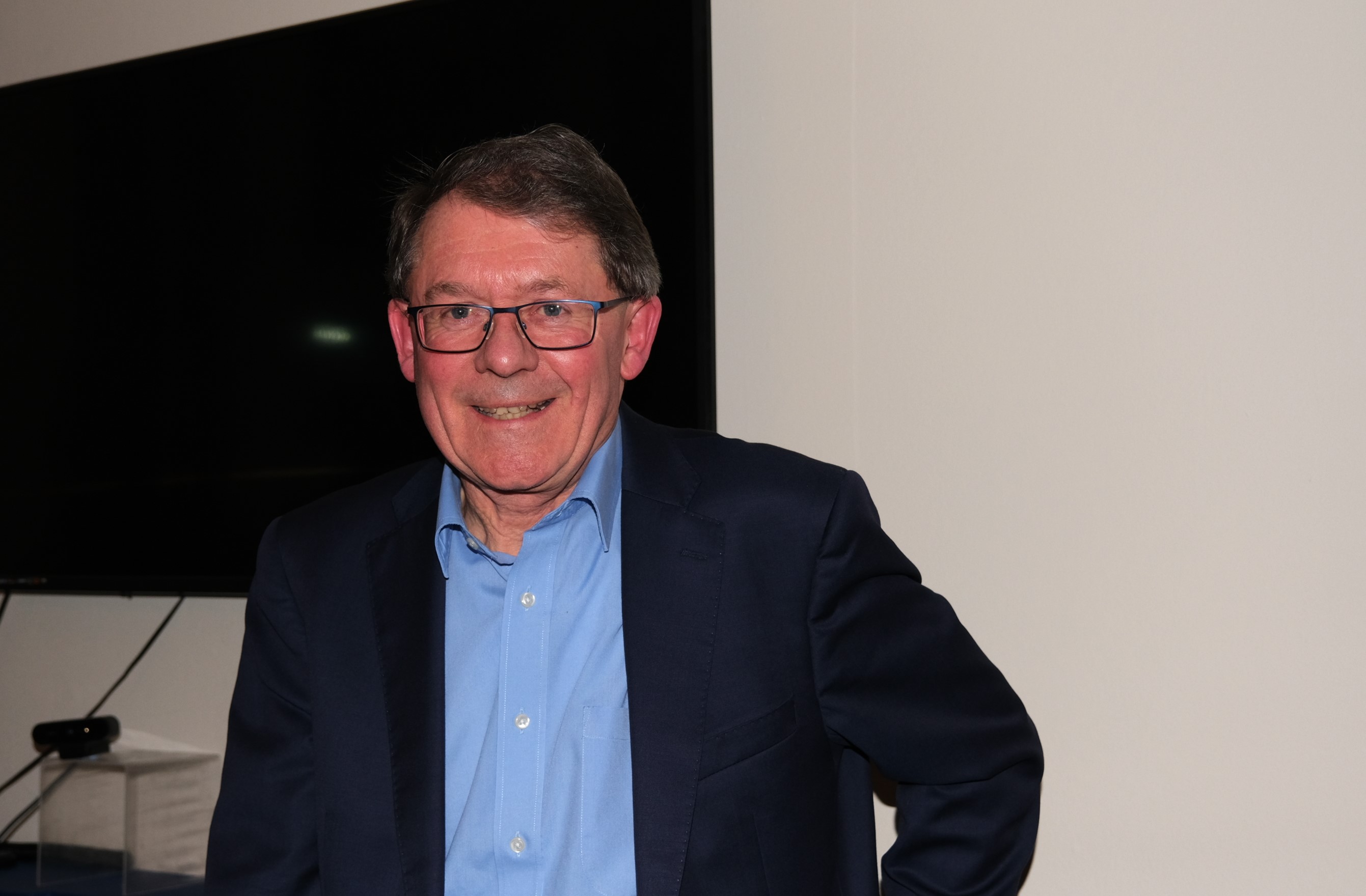
The Society was delighted to kick off the second half of its season with a presentation from the Chairman of the Holst Society, Christopher Cope (pictured). Holst is one of those composers who is almost exclusively known for one work, The Planets. He joins a number of others who are ‘one piece composers’ such as Dukas, Widor and Litolff who almost suffer from the fate of a single piece which crowds out their other works. It has sometimes come as a surprise at Society meetings when other parts of composer’s works are played and we say ‘why haven’t we heard this before?’
This was the theme of Christopher’s presentation who gave a history of this important English composer. Yes, English, for despite his name and the ‘von’, he was born in Cheltenham in 1874. The ‘von’ was added by his grandfather Chris said for added kudos. His early work was strongly influenced by Wagner and he was keen later on to distance himself from him.
He was friendly with Ralph Vaughan Williams who was much influenced by his work. VW gave him a sum of money to enable him to go travelling and he went to Algeria going round on a bicycle noting down musical themes and ideas as he went. A result of this was Beni Mora (An Oriental Suite (a little out place) from which we heard an excerpt.
He took time off to learn Sanskrit at one point in his life and translated some works by writers of that language and set some of them to music.
So why is he not better known and why only The Planets? Chris noted that it was the 150th year of his birth so there will be interest in his music but it is likely only to be this one piece which is played. One reason might be that he spent a lot of time teaching and conducting leaving little time for composition. The great majority of his oeuvre are short pieces: songs and church music with a strong influence of English folk songs. The lack of a corpus of symphonies and concerti may mean promoters do not want to feature his work.
The Planets certainly brought him fame and recognition but it seems he found this to be profoundly unwelcome and turned down honours and eschewed what we would today call the ‘celebrity circuit’.
He was clearly an original and Chris said he was influential with both Vaughan Williams and Ben Britten (and no doubt others as well). He died relatively young at 59 and clearly he still had much to give. He joins a long list of composers who died in their prime.
Chris played a range of pieces including an Invocation for ‘cello, and an excerpt from West Country Tunes, Swansea Town.
It is a pity that he has become this one-horse composer: the pieces we heard were diverse and original. One question might be whether there was a recognisable ‘voice’ which led you to know it was Holst even though you had not heard a particular piece before.
The Chair thanked Chris for his informed, not to say erudite presentation which has opened our eyes to this important but somewhat overlooked English composer.
Peter Curbishley
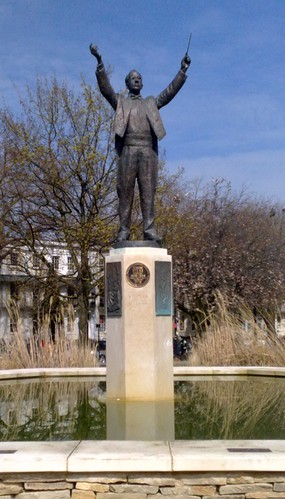
Statue of Holst in Cheltenham
Pictures: Salisbury Recorded Music Society
UPDATE: Readers in the Salisbury area might like to know there is a performance of some of Holst’s choral music on Sunday 18 February at 2pm. They will be performed (with other works) by the Larkhill Choral Society at the Bustard Inn on the edge of the Plain. 2 February
Second half starts
Second half of the programme starts on Monday 29th January
January 2024
Last night: review shortly.
The second half of the Society’s season starts on Monday 29th at 7:30 as usual with a presentation by Chris Cope posing the question ‘is there more to Gustav Holst than the Planets?’ Holst was a reticent man and the fame which followed the success of the Planets was not altogether welcome. Much of his music was unknown but there has been something of a revival since the ’80s and hopefully we will hear more during Chris’s presentation.
[This event may appear in the Salisbury Journal’s What’s On page and even though it was posted with the correct date, the confirmation was returned with Friday shown and I have been unable to change it. To confirm: the meeting is on Monday 29th].
PC
Christmas meeting
Successful evening despite change to the programme
Due to unforeseen circumstances the last evening of the year was a success with four of the committee members stepping up with their selections of music with a Christmas theme. Not surprisingly, Bach featured in two of the presentations: first with the Christmas Oratorio BWV 248 intended for performance during the Christmas period.
Second, we had the rather unusual Mrs Kennedy’s adaptation of ‘A Christmas Carol‘ with the voice of Bernard Miles among others. This is available on YouTube .
Thirdly, were two extracts from L’Enfance du Christ by Berlioz. This piece grew slowly following a tune which popped into his head at a card game. This became the well known Le Choeur des Bergers. He added further pieces bit by bit eventually shaping into the final work which was a huge success.
Grieg is one of those composers who is well known for a small handful of their output – in his case the piano concerto comes to mind – the rest of their oeuvre can often remain unperformed appearing fleetingly on Radio 3. We heard his Sonata for violin and piano Opus 45. This is the last of his sonatas for violin and was composed in 1887 a little before he began to enjoy some fame.
Finally, more Bach with some selections from the Christmas Cantatas including BWV 63; 91; 40 and 110. This is part of the major effort by the conductor, John Eliot Gardiner, to record all the extant Bach cantatas, many of which, regrettably have been lost.
Coincidentally, both Bach selections and the Berlioz were by Eliot Gardiner who has stepped back from conducting following an unfortunate incident surrounding the performance of les Troyens at the Proms. We must hope he returns to the music scene soon.
Merry Christmas to our readers and we restart on 29 January 2024 when we welcome a speaker from the Holst Society who, like Greig, is largely know for one piece is in his case the Planets Suite. The title appropriately is ‘Is there more to Holst than solely the Planets?’
Peter Curbishley
Next meeting
The next meeting of the Society is tomorrow, Monday 20 November starting at 7:30 as usual. It will be a change to the published programme due to unforeseen circumstances and will be on the subject of modern music. It is the last presentation on this subject by Peter Horwood who has found some gems from the world of recent compositions.
Only £3 on the door and there is ample parking outside.
Next meeting
Next meeting and changes to the programme
Due to unforeseen circumstances, we have had to make some changes to our programme involving the next three meetings.
On Monday 6th November, Peter Horwood will be presenting Off the Beaten Track in which he takes us on an informal journey along some less familiar musical byways.
On Monday 20th November, Peter again will be presenting, this time the third in his series on 20th Century Music. [This was due to be presented at the previous meeting].
Our final programme this season is slightly changed and will be Christmas Special in which members of the SRMS committee will present a range of pieces with a seasonally appropriate theme.
We look forward to seeing you at these evenings.
Members’ evening
Successful members’ evening held
October 2023
Members’ evenings are always a lucky dip, each cannot know what someone else will bring for the others to listen to. Last night’s meeting (23 October) was packed full of interest with a wide variety of styles and genres. We can all get into something of a rut with our listening and today certainly, the cost of going to live music and especially the opera, can make us conservative and to stay with the familiar and our favourites. It is one of the purposes of the Society to broaden our knowledge and last evening it did so in spades.
Hearing new things can involve diligent listening to Radio 3. Classic FM tends to stick to familiar territory and you are like as not to hear the umpteenth rendition of Concerto de Aranjuez or The Four Seasons rather than something unusual. For some strange reason they are always trying to relax you as well. What they think their listeners are doing in the middle of the day to need relaxing is a mystery but I feel I am drifting off the point.
Last evening. We had a mix of unusual pieces, pieces from familiar composers which a member particularly liked and previously little heard composers. Eclectic doesn’t quite cover it. Aulis Sallinen, the Finnish composer does not get much of an airing but we heard a charming serenade to start the evening. Some variations by Arthur Bliss followed and the same speaker introduced us to an amazing piece by Bill Evans an American who died relatively young at 51.
Mozart’s adagio from the Violin Concerto No 3 followed, one of the 5 concertos he wrote in the space of around 2 years in Salzburg. Numbers 6 are 7 are now known not to be his. Janáček’s work does not often get an airing in our meetings but a new member to the third movement of the 2nd String Quartet which persuaded us I think to give more attention to this composer.
And then for something completely different to wit Malaika performed by William Fedhili, a Kenyan, of a piece composed by Adam Salil.
Back to more familiar territory with a selection of Gretchen am Sprinnade a quite lovely song by Schubert. Michael Tippett, or Sir Michael we should say, got a hearing with the allegro from Concerto for Double String Orchestra. Tippett, with Benjamin Britten were the two post war ‘greats’ of the British musical scene. There followed the second movement from another Finnish composer, Sibelius’ Violin Concerto played by the gifted Ginette Neveu who died tragically young in an air crash aged just 30. She was immensely gifted and beat David Oistrakh twice in an international competition in Warsaw. Her playing has just got to be heard to be believed and the tone she achieved from her violin was unlike any other player – a real revelation. Her limited output is all still available on disc.
Following the last meeting’s presentation of South American music, we had another outing for Villa-Lobos and his Prelude No 1 played by an octogenarian Andres Segovia in a stunning filmed performance.
Another change to a small selection of piano encores – amazing and delightful pieces ‘collated’ one might say by another of our new members. We ended with one of Richard Strauss’ songs, Beim Schlafengehen, selected by another new member, from his Four Last Songs sung by Soile Isokoski and the Berlin RSO. A fitting ending. And we weren’t falling asleep.
I am sure many of those present will be exploring one or other of the samples, shall I say, we heard this evening.
Our next meeting is on 6 November when we shall hear the third instalment of our chair’s presentation of modern music.
Peter Curbishley
A more detailed list of what was played can be accessed here:
UPDATE: 25th October. One of the presentations was of three piano pieces and I was not able to list them above. Details are now to hand and they were:
1. Kitten on the Keys (1921), by Zez Confrey – from the 1989 festival on DACOCD 349
2. Triple Etude (1992), by M-A Hamelin – from 1992 on DACOCD 399. The three Chopin A minor studies combined: op.10 No.2, op.25 No.4, and op.25 No.11. It became No.1 of his 12 Etudes in all the minor keys (1986 – 2009), although it wasn’t the first to be composed.
3. “Schorschi-Batschi” Fox-Trott (sic) by “Willking Giese”, a.k.a. Walter Gieseking.
Next meeting
Our next meeting will be this evening, Monday 23 October at 7.30pm in our usual venue.
We will commence at 7.30pm with our short Annual General Meeting and then move on to our Members’ Evening at which several members will introduce and play pieces of their own choice. We are grateful to Robin for coordinated contributions and drawing up the programme.
If you have not already paid may we remind you that membership subscriptions of £22 are now due and will be welcome at the meeting.
After this, our next evening will be on Monday 6th November when Peter Horwood will be presenting a programme of 20th century music. We look forward to seeing you at both events.
Next meeting
Details of the next meeting on 9 October: tonight!
This meeting will be a presentation of music from South America, a continent with a strong tradition which does not receive the attention it deserves.
The following meeting on 23rd October 2023 will be our Members’ Evening. All members are invited to select a piece of music, of up to 8 minutes, to have played. This can either be on your own CD which you bring, or a link to a YouTube recording. In either case, so we can draw up a schedule in advance, please will you bring details on 9 October or send details to Robin Lim email: robert.lim@virginmedia.com.
The meeting on 23 October will be start at 7.30 with our Annual General Meeting which we hope will just take a few minutes.
If you have not already done so may I remind you that membership subscriptions of £22 are now due and will be welcome at the next meeting.
Details of our coming programme are available in our leaflet and on this site along with an account of our very enjoyable and informative last meeting presented by Tim Smithies. Copies can be found in the Library, Oxfam and the TIC.
We hope to see you on 9th October
ET
Music producer talks about his work
Music producer, Tim Smithies describes his work producing CDs
The first meeting of the new 2023/24 season kicked off with a fascinating talk by Tim Smithies on the problems and challenges producing music recordings for sale. Tim is a leading light of the Metronome label where he has been for 30 years. When we listen to a CD, we are not aware of the effort and time taken to assemble the artists, technical staff and instruments needed to make it all happen. An added problem for small and niche producers is that they are unlikely to have the resources needed to record the standard repertoire with big orchestras and a big name conductor and soloist.
In common with many small firms, survival often depends of locating a gap in the market too small for the heavyweight firms to consider. Metronome started with focusing on early music and the first example was music from the Plantagenet era and a piece composed by John Dunstable and played by the Orlando Consort. Another early recording was Love Affair with the Lute and a piece by John Dowland, Flow my Tears. Tim said the aim of his label was to “focus on the clarity” and this certainly shone through in this and other examples he played.
As time went on, the label got “drawn into other people’s interests” as Tim put it and that means expanding the repertoire to include other artists and genre. This is the classic dilemma for small firms: do you stay focused on your strategy or do you respond to market opportunities as they come along? As Tim explained, trying to do the former can be difficult especially in the world of artists. Opportunities arose and it was sensible to respond to them.
Things can develop from a very small start he said. He instanced the harpsichordist Carole Cerasi whom he heard at a concert playing music by Elizabeth Jacquet de la Guerre. This led to a series of recordings by her on the label.
Closer to home, Metronome has produced music sung by the choir of Salisbury Cathedral in a recording called An English Choristers Songbook.
One of the problems a small producer has – as one might expect – is poaching of artists by larger firms. But it was not all one way he said and there were examples of what he termed ‘rebound’ that is, artists who wanted to do their own thing and found the restrictions of the big labels did not allow them to do that. Christopher Hogwood was an example who wanted to record music on the clavichord, an instrument widely used by Bach for example. The problem is that it does not have that great a volume so is suitable only for intimate settings. We heard a recording of a familiar Bach piece normally heard on a piano, which sounded quite different on a clavichord. The music appears on a Metronome recording called The Secret Bach.
One of the difficulties with recordings of this nature on period instruments is that they have to be made where it is situated since they cannot be moved to a recording studio. This has its own issues of finding a room with the right acoustics. As anyone who has organised an event in such settings will know, as soon as you are poised to start, drilling will start somewhere, as if by magic, making progress impossible. As we heard at a previous Society meeting, instruments need constant tuning during the recordings.
Talking of older instruments, we even heard a piece on the theorba, a double necked lute with an extra set of bass strings.
This was a fascinating evening and a great start to the new season. Not only did we hear some interesting and for some of us, unfamiliar music, but we learned of the story behind it and gained a glimpse of the life of a small, but perfectly formed, record producer.
Peter Curbishley
Next meeting on 9 October 2023. Printed copies are available in the Library, the Tourism Information Centre and Oxfam (upstairs).
 Salisbury Recorded Music Society