
The next Society meeting is this evening 21 October and is a members’ evening so if you are a member and haven’t sent your contribution to Robin – there’s still time. It will be preceded by a short agm. Same place and same time. Programmes are in the TIC by the way.
Tag: Salisbury
The ‘curse of the ninth’
April 2024
This was the intriguing title of a fascinating talk by Alan Forshaw on why the ninth symphony seems to loom large in composer’s lives. Beethoven’s 9th is well known although he did attempt a tenth and he left some sketches. It was with him that the myth started and it does seem to have had some kind of effect on those who followed him. Alan played the second movement in a version with a brisk tempo by Toscanini.
Schubert was second, a composer who died tragically young but nevertheless, left a vast treasure trove of music including – nine – symphonies. It has often been suggested that he died of syphilis but medical research suggests this is not true and it is much more likely, in view of the suddenness and the symptoms, he died of typhoid fever which was common at the time. As is well known, his eighth was unfinished. We heard the first movement from the ‘Great’ Symphony – his ninth. Schubert never heard either of them before his death.
Thence to Bruckner who, as Alan reminded us, was a huge admirer of Wagner and said he only worshiped two Gods and the other one was Wagner. He can’t have heard his symphony though … Bruckner was a famous organist and it was he who played the organ at the opening of the Albert Hall. We listened to one of the movements of his ninth, of which he only completed three, and died before finishing it. There may be something in this ‘curse of the ninth’ after all.
Dvořák next who was helped in his composing career by Brahms and was very lucky to get a very generous appointment in New York which gave him plenty of time for composing. We heard a movement from the famous New World Symphony and – you’re getting the hang of this, his ninth. The symphony was hugely important in the development of American music and was discovered after his death. It was premiered in 1893 in New York. Dvořák’s house can be visited just on the outskirts of Prague by the way.
Now Mahler did believe in the curse and went to some lengths to try and avoid labelling it the ninth. No matter, the curse got him and he died the following year.
On to Glazunov who enjoyed much fame and admiration in his day, both in Russia and in the west. He found the more modern composers, and in particular Stravinsky, hard to swallow and thought Petrushka little more than orchestrated dissonance. He never got far with his ninth and we heard an extract of the piano version – perhaps the world was spared. He did however have a pupil at the Leningrad Conservatory called Shostakovich who did go on to write 15 symphonies.
Next was Vaughan Williams who also managed to complete nine and we listened to a movement from it, his ‘last tune’ as he termed it. He died a few months after its premiere in 1958. The symphony is a little unusual in having scored saxophones – perhaps reflecting Ravel’s influence with whom he studied for a year.
And so to Kurt Atterberg, not a name which is that familiar even to keen classical music fans. Swedish, he studied both music and electrical engineering and indeed, it was this latter skill that kept him employed at the Swedish Patent Institute until his retirement. Preferring harmonics to harmony perhaps. He is another composer who had a degree of fame in his lifetime but is little known or played today.
Finally to Northampton born Malcolm Arnold who was a prolific composer well known for his film scores including for example, the St Trinian movies and the Bridge over the River Kwai among many others. An accomplished trumpet player having heard Louis Armstrong play he composed many pieces and including nine symphonies. He was not a pleasant character by all accounts and had a drink problem. He had mental health issues as well. At one point he was given two years to live but manage to live on for another 20. We heard a short extract from his ninth. His musical legacy seems assured.
So is there anything in the ‘curse of the ninth’? Probably not. The idea was created by Mahler who tried to beat it by calling what was his ninth as a song cycle. Looking at the list of composers of symphonies from the nineteenth century onwards it is striking that there is a vast number who wrote a handful, just one, two or three. It is also striking that there are few who wrote between three and 9. Most therefore will compose a small number of symphonies, which consume a significant chunk of time but achieve little success and even less financial reward, and decide to stick to shorter forms.
So how to explain the cluster around nine with few either side having composed eight or eleven symphonies for example? Perhaps the reason is mundane: a modern symphony seems to have taken most composers around two years to complete and not always in a continuous burst. Allowing time between each of say, a year, means each work represents around 3 years out of a composer’s life. Allowing for a productive life of around 40 years which may also include conducting and teaching, means a serious composer of symphonies will end up at the nine or ten mark. So those who do achieve some success at the start of their careers, then go on to reach it: those who don’t stop after one, two or three.
Whatever, it was a really interesting evening and as ever a mixture of the familiar with a handful of rarely heard pieces. The chair of SRMS thanked Alan for putting together an interesting and intriguing topic.
Our last meeting of the current season is on Monday 13 May at 7:30 as usual and is on the subject of Puccini to celebrate the anniversary of his death this year.
Finally, to say we are getting on well with the 2024/25 programme which is all planned and the programme will be available sometime in the summer. For clarity, I should say August since when and if summer comes is not at all certain.
Peter Curbishley
Meeting tonight
The Society’s penultimate meeting takes place tonight, Monday 29th April, and is entitled The curse of the ninth. Some symphonic composers have reached nine but not quite managed, or finished, a tenth. Alan Forshaw examines the myth that of why nine composers couldn’t or wouldn’t write a tenth symphony.
Starts at 7:30 as usual.
Nino Rota
April 2024
There are few who do not know the instantly recognisable theme to The Godfather, the composer of which is less well known. Nino Rota, real name Rinaldi, born in 1911, composed this and over a hundred other film scores as well as much other music during the course of a prolific career.
Last evening, Robin Lim gave an excellent presentation of this composer’s life. He was a prodigy and, aged 11, while the rest of us were reading Enid Blyton or looking at our stamp collections, he was composing an oratorio which was performed in Milan. Aged 14, following his father’s death and with the help of the Italian conductor, Arturo Toscanini, he went to the Curtis Institute in America to study composing and conducting.
Apart from The Godfather, another film score which received critical acclaim was for the Glass Mountain. The film itself was not a success but the music – of which we heard and saw an extract – was recognisable.
We heard a movement from the Clarinet Sonata composed in 1945 and also from a symphony. The sonata was very moving but the Symphony might need another hearing to appreciate it more. He composed four symphonies but they have been somewhat overshadowed by his film and operatic scores.
The overture to the opera I Cappello di Paglia di Firenze was lively and tuneful. For the film The Leopard by Visconti, he adapted the music from an unfinished symphony and we watched an excerpt featuring a waltz.
We could not of course escape hearing his famous composition but this was not the familiar version but one played on a harp.
He has sometimes been described as a musical chameleon – perhaps not always flatteringly – as his style is sometimes a little derivative of other composers.
In any event, it was a fascinating evening and we certainly learned more of this prolific composer.
And talking of unfinished symphonies. the next meeting on 29th April is ‘The curse of the ninth’ looking at those composers who never quite manage ten symphonies.
Peter Curbishley
Robin has kindly sent the full playlist:
1. Cello Concerto (1925) excerpt
2. Symphony No. 1 (1936 – 39) – 1st movement (Allegro con moto)
3. Clarinet Sonata (1945) – 1st movement (Allegretto scorrevole)
4. “The Glass Mountain” (Henry Cass,1949) – Opera sequence
5. Sinfonia on a Love Song (1947, 1st Perf 1972) – 1st movement
6. “Obsession” (Edward Dmytryk, 1949) – Opening titles
7. “The Stranger’s Hand” (Mario Soldati, 1954) – Opening titles and scene
INTERVAL
8. Overture to The Florentine Straw Hat, operetta (1st perf 1955)
9. “La Dolce Vita” (Federico Fellini, 1959) – Opening Titles
10. “La Dolce Vita” – Blues
11. Concerto Soiree for piano and orchestra (1958) – 1st Movement (Walzer-fantasia)
12. “The Leopard” (Luchino Visconti, 1963) – Opening Titles
13. Sinfonia on a Love Song – 3rd movement
14. “The Leopard” – Ball scene
15. “The Godfather” (Francis Ford Coppola, 1972) – Love Theme – transcribed by Rota for solo harp
16. Le Moliere Imaginaire , Ballet (1976) excerpts
Next meeting
The next meeting will take place tonight, Monday 15 April starting at 7:30 as usual and is on the subject of Nino Rota a composer of several operas and a number of film scores.
Meeting tonight
The Society meets tonight (25th March) at 7:30 as usual for a members’ evening. This will be a series of favourite pieces selected by members themselves. All are welcome.
Next meeting
March 2024
The March meeting of the Society will take place tonight, Monday 11th March at 7:30 and features the English composer Rutland Boughton. He was extremely popular in his day and was a prolific composer with symphonies and operas to his credit. His star has waned and he is now seldom performed. So it is with great pleasure that we will be welcoming Ian Boughton to play a selection of his works and widen our knowledge of this composer. The title of the presentation is Rutland Boughton: beyond the Immortal Hour, one of his best known operas from a play with the same title.
The Society prides itself on widening the knowledge of its members and this is another example of that, to go along with the presentation on Holst in January.
We look forward to seeing you and it is £3 for non-members at the door. Free parking at the rear.
Music of the southern hemisphere
February 2024
The February meeting of the Society was an exploration of the music south of the equator presented by Ed Tinline of this parish. With the odd exception, it would be fair to say that much of the music from this part of our world is largely unknown. The dominance of the European canon makes pieces from faraway places like Australia or New Zealand something of a rarity despite people claiming we live in small world nowadays.
Perhaps an exception is Percy Grainger who is well known although it has to be said he lived much of his life in America and from time to time in Europe. We heard the Colonial Song of 1911 which originally was poorly received. It was meant as an evocation of the Australian landscape. Grainger held some extreme racist views and was a supporter of Nordic culture.
John Antill was an Australian composer best known for his work Corroboree of which we heard three extracts: the Welcome Ceremony, Dance to the Evening Sun and A Rain Dance. The first was strongly influenced by Aboriginal rhythms.
The Australian composer Peter Sculthorpe focused much of his compositional energy on incorporating themes from Aboriginal culture and sounds of the Outback. Ed selected one his better known works Kakado which I noted as a ‘sombre piece buy richly textured’. We also heard part of Earth Cry which may be the only orchestral composition to incorporate the didgeridoo.
The first half ended with a composition by another Australian Ross Edwards, another composer with a strong interest in Australian culture. We heard two movements from Full Moon Dances – Concerto for alto saxophone and orchestra. Edwards was something of a recluse although his work has found its way into concert programmes around the world.
The last Australian composer to be featured was Alfred Hill and his Symphony No 5 in A minor – the Carnival. This had a strong European feel, in contrast to his fellow compatriots and there were odd traces of Tchaikovsky and maybe others.
The last item was by Douglas Lilburn, the only New Zealander to feature, with his Aotearoa (Land of the Long White Cloud), and the Festival Overture. Lilburn was taught composition by Ralph Vaughan Williams.
Well it wasn’t quite the last as we ended with the Traditional Maori song Pokarehare sung by Dame Kiri Te Kanawa.
As ever, it was an evening of mostly discoveries with the odd familiar piece and reflected the range and depth of music in this part of the world. We only heard a small sample of course and was summed up in the vote of thanks that the music had an ‘intangible flavour of its own’.
Peter Curbishley
The next meeting is on Monday 11 March
Meeting tonight
The Society meets tonight, Monday 26th February, for an evening of music from the southern hemisphere. Starts at 7:30 as usual and only £3 at the door if you are not a member. Free parking just outside the door.
Music of Salzburg
You might think that an evening of music with a title such as this would be … well, Mozart, Mozart and more Mozart. Anyone who has been to the city will know that he is well remembered there and there are plentiful shops selling Mozart chocolate, Mozart china and I have forgotten what else. Today, we tend to see Vienna as the historic and cultural centre of that part of the world, but it was for a long time Salzburg – once its own kingdom apart from Austria – which was the cultural centre of that part of the world. It was here, that the first opera was performed north of the Alps.
In fact it was an evening with no Mozart at all because, as the speaker explained, the City was something of a centre of music before the famous composer’s time and attracted talented musicians from Italy, Germany and elsewhere. Angus Menzies took us through a number of pieces, some by quite well known composers, and others less well known.
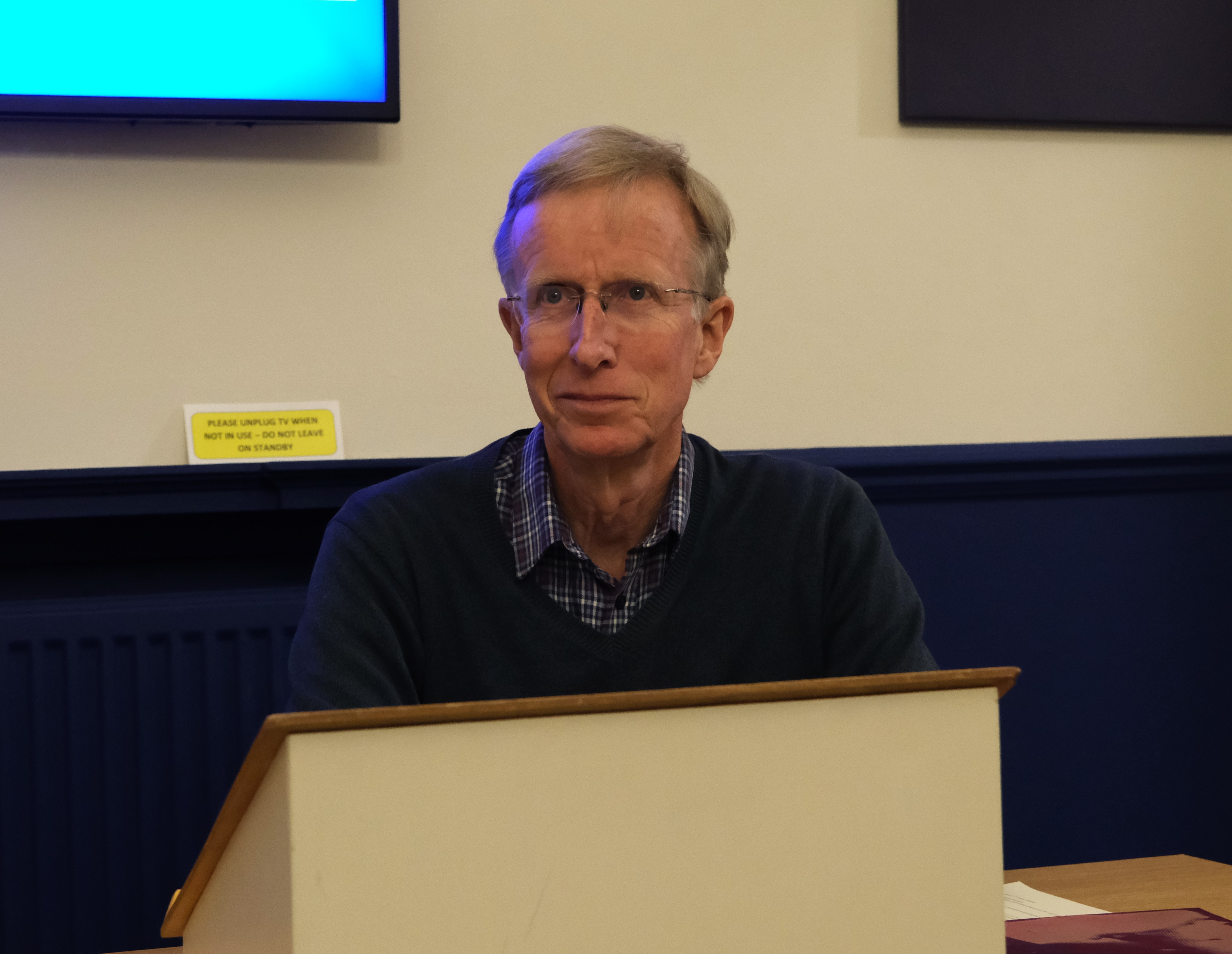
These included pieces by Biber for example who was thought to be the finest violinist in Europe in his day, Bernardi, the Salzburg Requiem, some Monteverdi, and works by Muffat, Sonata No 5.
The speaker was praised for his breadth of choice and how music at the time linked to social history. It is one of the features of the Society that, in addition to the music, we get to hear something of its place in history, how it came to be written and something about the composer. We also get to hear from composers who are either forgotten or unfairly neglected. One of the problems today is that unless a composers name begins with B, M or S, it is unlikely to be played in a concert setting!
The next meeting is on 26 February at 7:30 as usual and is music from the Southern hemisphere.
Peter Curbishley
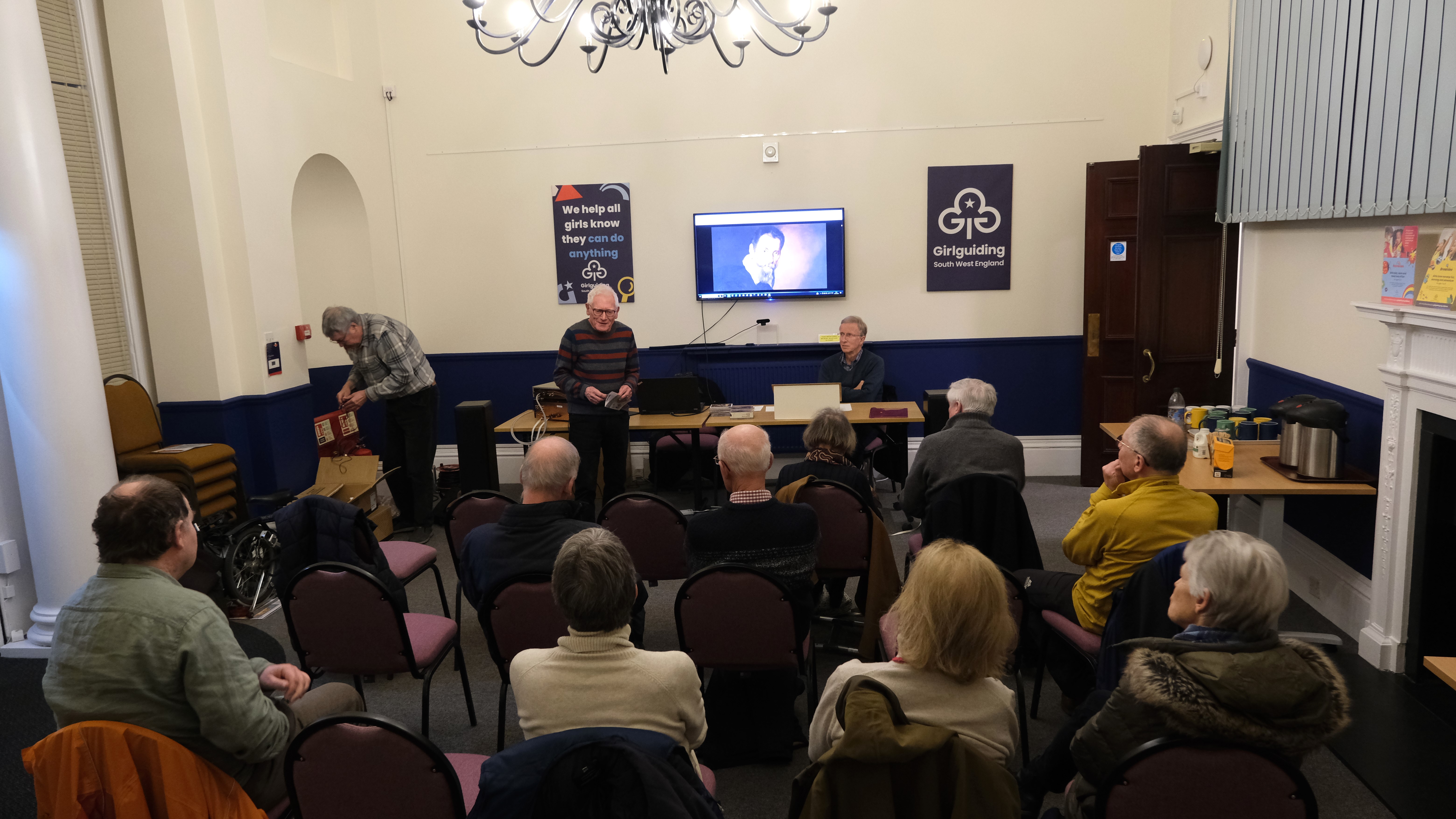
View of the music room (pictures: Salisbury RMS)
 Salisbury Recorded Music Society