By now, existing members will have received their invitation letter and programme for the 2016/17 season. We are pleased with what we have in the programme which includes a ‘live’ event and outside speakers on Bruckner and Delius. We have stayed away from Bruckner because his symphonies are on a massive scale but we are delighted that Terry Barfoot has risen to the challenge to give us a presentation on this important composer. Proms listeners will have had a treat this year with several of his works being performed.
If you are new to this site we hope you will give us a try and if you just want to come along to an evening – because you have a particular interest in a composer for example – then it is only £3 to help cover costs.
One of our guiding principles is to widen knowledge of the musical world and speakers will often try to introduce unfamiliar pieces, either by composers who are almost forgotten or less well known pieces by major composers.
Parking is easy with plenty of space and we are within walking distance of the town centre.
The new season’s programme has now been finalised and will soon be printed for distribution. You can see a copy of the brochure here ahead of publication. The committee has put together an excellent programme with two outside speakers and one, for the first time, from the Delius Society. We have one ‘live’ music evening as well as presentations on a wide range of topics from Society members themselves.
Meeting arrangements are as before and parking is easy. New members are always welcome – we’ve had several this year – and if you want to come along to an evening without commitment, there is a small fee of £3 to help with our expenses.
Existing members: if you can do anything to help promote events that would be appreciated.
With last night’s meeting, the current season of the Society came to an end and will resume in September. Next year’s programme is well underway and has a lively combination of home grown and invited speakers as well as a ‘live’ performance. The committee met before the meeting and one item was a review of the year and all agreed that it had been an excellent one. With two live performances as well as the usual fare of CDs, the programme was diverse and interesting. The Society exists to enable people to broaden their knowledge and enjoyment of classical music in a non challenging way.
We had presentations which focused on the Great War, two on famous conductors – Mackerras and Bernstein – and we welcomed Lord Aberdare of the Berlioz Society for a memorable presentation. The role of lesser known composers especially from these shores and from the Baltic countries was also notable. Altogether a successful year.
Meetings take place in Salisbury every other Monday evening during the season which starts again on 19 September. Directions can be found on the ‘Find us’ tab. Parking is easy. New members are always welcome and feel free to come along to a meeting. Full details of the new programme will be published here once it is finalised and a leaflet will be available in the Collector’s Room in Endless Street; Oxfam’s music room and in the Tourism Office in Butcher Row.
The last meeting of Salisbury Recorded Music Society took place last nightMonday 23rd May 2016 at 7.30pm, in our usual venue. Jon Hampton presented ‘The art of the arranger’ including works by Boccherini arranged by Berio, Bach by Elgar, and Schubert by Britten. An excellent and interesting evening and there will be a full report soon.
There was a selection of records (as in vinyl) which have been kindly donated to the Society and these are available with members asked to make a small contribution as they see fit. They are listed below:
Composer
Piece
Orchestra
Schubert/ Beethoven
Symphony #8 and #5
Berlin PO, Maazel
Orff
Carmina Burana
Andre Previn, LSO
Tchaikovsky
Romeo & Juliet
J Pritchard, LPO
Festival of Carols
Bath Abbey
Festival of Lessons and carols
Kings College
Mendelsaohn
Scottish & Italian Sym
Solti, LSO
Mozart
Piano Concertos #20 #23
Brendel, Academy St M in the Fields
Bath Abbey organ
Various
Handel
Water Music
Boyd Neel and Orchestra
Mozart
Symphonies #29 #39
Colin Davies, S of London
Beethoven
Sonatas, Moonlight, Pathetique, #17
Albert Ferber
Mozart
Symphonies # 39 #40
Böhm, Vienna PO
Bruch & Beethoven
Violin Conc #1; Romances for V and orchestra
Oistrach, RPO
Various, Smyth, MacCunn
Music of the four countries
Gibson, Scottish Nat Orch
Messager
The two pigeons
Jacquillat, Orchestra de Paris
Boyce, W
The 8 symphonies
Faerber, Württbergberg Ch O
Bach
Brandenburg #4 #5 #6
Davison, Virtuoso of England
Brandenburg #1 #2 #3
do –
Holst
The Planets
Sargent, BBCSO
Chopin
Piano Concerto # 1
Pressler, Vienna State Opera
Vivaldi
4 seasons etc
Various
Tchaikovsky
Piano Conc #1
Makaloff, Hague PH Orch
Handel
Messiah
Sargent, RPO
Box sets
Gateway to the Classics and Opera
G & S
Overtures, Mikado, Gondoliers etc
Godfrey, New SO of London
G & S
Best of …
Walker, RPO
Most look to be in good condition and the discs I’ve looked at seem clean and unscratched. If you are interested in any of these please ring 01722 782382 and we can try and arrange delivery.
The next meeting of the Society – the penultimate – is on May 9th and is a members’ evening. This is where individual members can suggest pieces which can be played with or without an introduction by them as they wish. It is usually and enjoyable evening, eclectic of course and everyone’s choice is different. Usual place, usual time.
New members are welcome and the entry is a modest £2 to help us defray costs.
A century ago, the First World War was in full swing. The battle for Ypres was taking place in April 1916 and it was the first time phosgene gas was used. It is difficult to believe that out of this carnage and bloodletting, some lovely music, poetry and art was created.
At the last meeting, Richard Seal played a selection of pieces which were composed during the time of the war or inspired by it. Richard was much moved by visits to the war graves in Flanders including Vimy Ridge, Arras and Thiepval where he hopes to go to again.
He began with A Shropshire Lad by George Butterworth who died on the Somme in 1916 aged just 31. This is a familiar piece and his death was a great loss to music. This was followed by the last movement of Morning Heroes by Sir Arthur Bliss who lived until 1975 but who lost his brother in the conflict. He returned to the battlefield in 1928 and this piece was the result of that visit.
This was followed by Three songs by Ivor Gurney. Gurney had a troubled life and was both a poet and composer. He was gassed while serving with the Gloucester regiment but his biggest problem was his mental health. At the time he was thought to be the greatest of his generation but his full promise never materialised.
Britten was too young for the war but his War Requiem, which was composed for the consecration of Coventry Cathedral destroyed in WWII, was inspired by the poems of Wilfrid Owen who regrettably died a week before the Armistice.
This was followed by an Elegy for strings and harp by Frederick Kelly who died in 1916. An Australian he also had a gold medal for rowing in the 1908 Olympics and this elegy was in memory of Rupert Brooke who also lost his life.
Some pieces by Charles Ives followed including In Flanders’ Fields composed in 1917.
The evening finished with the last movement of the Pastoral Symphony by Vaughan Williams. The First World War, in which he served in the army in the medical corps, had a lasting emotional effect.
It was a fascinating evening and the presenter’s erudition about this moving period of our history shone through.
The next meeting of Salisbury Recorded Music Society, will be tonight Monday 4th April 2016 at 7.30pm, in our usual venue. Richard Seal will be presenting In Flanders Fields – music inspired by World War I including works by Vaughan Williams, Britten and George Butterworth. A great deal of attention is paid to the poets who were affected by the war, rather less attention is paid to the composers who were also strongly influenced by the carnage.
Yes, we are the ‘recorded’ music society but this is an exception. Members will recall a previous evening at which David Davies performed on the keyboard. Now we are delighted to see him return for an evening of baroque music played by David and some friends. These include David Morgan and Sue Wyatt (violins), Sally Reid (‘cello) and David himself who will be on the harpsichord. It will be more than just the music as there will be some explanation about the music and the instruments.
The programme includes works by familiar composers including Boyce, Bach, Handel and Corelli as well as some less well know composers such as Veracini, Krieger, Leclair and Finger.
For non-members, tickets on the door will be a modest £2 for the evening.
7.30 on Monday 29th February at the rear of the Guide’s Centre. Details of how to find us is on the ‘Find us’ tab. Parking is easy and free. We look forward to seeing you. Space is limited so please arrive in good time.
Wine merchants often say that particular wines needed ‘careful selection’ especially after a poor harvest and these words came to mind after last night’s presentation of new music by Peter Horwood. Some modern music is difficult to take to especially if melody, harmony and structure have all been abandoned in the name of some kind of ‘ism. Under the title of Bright, shiny and new, Peter had selected works composed this century and what a fine selection it was. With perhaps a few notable exceptions, many of the composers were unfamiliar and their pieces for the most part unheard.
He focused on works which were approachable starting with extracts from Flight by Oliver Davis, a violin concerto composed in 2012. Davis only graduated in 1994 yet has many pieces to his name. This is definitely a composer to look out for and the concerto was melodic and definitely ‘approachable’.
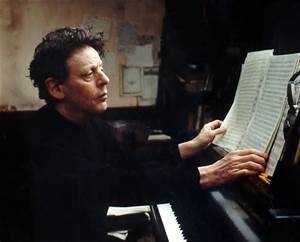
This was followed by three pieces by Philip Glass: first piano etude No. 17 which was more lyrical than we have come to expect from this composer; the third movement of his Symphony No. 10 which had rhythmic brass and a march like theme and thirdly, the second movement of Symphony No. 10 which had a magical feel to it. It is easy to be put off by some of Glass’s music but this selection was certainly a ‘way in’ to this composer.
We moved on to Kenneth Fuch’s string quartet No. 5 called the American. This was followed by James MacMillan’s Tu es Petrus (no, not the wine!) from his percussion concerto with plainchant (sounds odd described thus but it does work) premiered in 2010 which has been performed in Westminster Cathedral. We also heard his more modest O Radiant Dawn from his Strathclyde motet.
On to the Baltic next and a piece by he Finnish composer Rautavaala, born in 1928, called Incantations – a percussion concerto – and the extract we heard had a xylophone accompanied by a string ensemble. He has written eight symphonies and is described as a ‘neo-romantic’.
Valentyn Sylvestrov
The Ukrainian composer Valentyn Sylvestrov contributed some pieces next, first Bagatelles Nos. 1 -3 and then, Waltz of the Hours. Sylvestrov was one of those who struggled under the yolk of ‘Soviet Realism’ but has lived to tell the tale. Parts of his work were reminiscent of Mahler.
Finally, two pieces by Pêteris Vasks: the first movement from his Cello Concerto No. 2 composed in 2015 and started with a long solo section followed by the orchestra and this was followed by Viatore – a tribute to the Finnish composer Avo Pärt. Vasts had to leave Latvia during the Soviet era as he was a Baptist and had to finish his training in Lithuania.
… well not quite final because we had a brief extract from the music to Pirates of the Caribbean composed by Hans Zimmer.
This was a particularly enjoyable evening and one of discoveries. That the speaker was able to come up with nearly two hours of approachable music composed in this century was an achievement.

 The next meeting of the Society – the penultimate – is on May 9th and is a members’ evening. This is where individual members can suggest pieces which can be played with or without an introduction by them as they wish. It is usually and enjoyable evening, eclectic of course and everyone’s choice is different. Usual place, usual time.
 Salisbury Recorded Music Society