
The next meeting takes place on Monday 8th of May and will be a member’s evening. If you have a particular piece you like or want to hear played then liaise with Anthony Powell. Usual place usual time.
Delius
The works of Frederick Delius
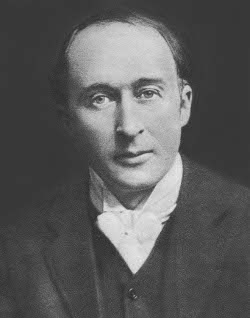
The works of Frederick Delius were the subject of the Society’s evening on April 24th and we were delighted to welcome Martin Lee-Browne, the ex-president of the Delius Society. This was an informed presentation – not just because Martin knew a great deal about this composer – but because of the family connections he has with him. His grandfather was a good friend to Delius and also taught Sir Thomas Beecham the famous conductor. It was Beecham who did so much to promote the composer.
Delius’s father was a wool merchant and wanted his son to go into the business which he did for about 2 years. His heart was not in it so he then persuaded his father to help set him up in the orange plantation business in Florida which he did for a couple of years. He then gave that up and moved to Danville in Virginia.
He studied music in Leipzig in 1886 but was unimpressed with the teaching there which he found old fashioned and apparently, they were not too impressed with him. He met and became friends with the Norwegian Composer Edvard Grieg and persuaded him to come to England to meet his father. Norway was a big influence on his work and the Song of the High Hills is based on his time there. Beecham described this as one of the composer’s major works.
His father was so impressed that his son knew someone as famous as Grieg that he continued funding his musical activities for another year. This he spent living in Montparnasse in Paris. He struggled to make a living there as a composer. By 1899 he had managed to get only 20 songs published.
He returned to England and self-funded a concert of his own works which had mixed success but began to get him recognised as a serious composer. Gradually his pieces entered the repertoire. Martin played several of his works – including some early compositions which one would not at first sight have realised were by him – as well as selections from his more famous and familiar works. These included Brigg Fair, the single movement Violin Concerto and Sea Drift, the latter strongly influenced by Walt Whitman.

Martin also brought along some memorabilia included a score annotated in the margin by Percy Grainger. In 1910 his health seriously declined and he was only able to compose with the aid of Eric Fenby who wrote the music to Delius’s direction. He lived for most of his life in Grez-sur-Loing in France and he is buried with his wife in Limpsfield in Surrey.
Next meeting
Frederick Delius
Our next meeting on Monday 24th April celebrates the music of the English composer Frederick Delius. We are pleased to welcome Martin Lee-Browne to the Society who is from the Delius Society and will be coming down from the Midlands to speak to us and play some of his works.
Normal start at 7.30 and details of where we are can be found at the top of the page. It is £3 for non-members. Parking is easy and the room is accessible for people with disabilities. We look forward to seeing you.
Anton Bruckner

For some, Anton Bruckner (pictured) was one of the great symphonists to come out of the nineteenth century. Nowadays, his works are performed around the world and are a regular feature of the repertoire. There are many recordings of the nine numbered symphonies. But for a long time, his reputation languished and there was a major effort to recognise his genius in the 1960’s.
At the last meeting of the Society, Terry Barfoot gave an illustrated history of the composer and played four movements from 4 different symphonies to illustrate his work. Bruckner was born in Ansfelden in Austria in 1824, the son of a school teacher. He himself became a school teacher. He was an organist of prodigious ability and toured Europe mostly playing improvisations. Little of this survives. He was the first to play the organ at the Royal Albert Hall in London.

One can hear the influence of the organ in his music. As Terry put it:
[…] the sound-world of the organ in the resonant acoustic of a great cathedral is relevant in his symphonies, as of course it is in his religious works. From Wagner he derived his long time-spans, his weighty brass writing and expressive string textures, while another recurring was Beethoven’s Ninth Symphony, and especially its opening […]
He was clearly a late developer as a composer and Terry made the point that had he died at the same age as Schubert (31) he would today be completely unknown.
He was deeply religious and trained as a musician at the monastery church at Sankt Florian a place he was to return to throughout his life especially when he was depressed. He was also organist in Linz.
Like so many composers – indeed artists generally – he was not appreciated fully in his lifetime. The famous critic Eduard Hanslick gave him a hard time and his time with the Vienna Philharmonic was not a success.
Terry put together a programme to illustrate his range and development as a composer. Bruckner is something of a challenge in the context of a Society evening as the expansiveness of his music does not lend itself to short extracts! He played the following:
- Motet: Locus Iste
- Symphony No. 8 first movement
- Symphony No. 6 second movement
- Symphony No. 4 third movement
- Symphony No. 7 fourth movement
Together with photographs of locations around Austria where Bruckner lived or worked this was an interesting and illuminating evening. We were grateful to Terry Barfoot for putting it together.
Peter Curbishley
Terry runs Arts in Residence
Note: the next meeting is not for 3 weeks because of Easter
Next meeting: Bruckner
Presentation by Terry Barfoot on Anton Bruckner
The Society is delighted to welcome the well known writer on music Terry Barfoot who is going to do an audio visual presentation on the music of Anton Bruckner. He was arguably one of the greatest symphonists of the nineteenth century and his symphonies are now rarely out of the repertoire. They are large in scale however and so presenting them to the Society has been a challenge.
Usual place and usual time.
Terry runs Arts in Residence which are residential weekends with a musical theme.
Next meeting
The next meeting of the Society will be on Monday 20 March starting at 7:30 as usual and will a presentation 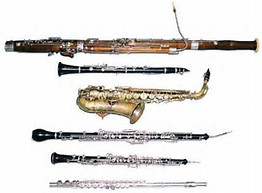 by Ed Tinline on the development of woodwind. He will be playing a selection of pieces including wind soloists and also ensemble playing.
The committee will be meeting immediately prior to the main session. If members reading this have any points they would like the committee to consider, or you might be interested in presenting or co-presenting a session, please let one of the members know.
The solo violin
The solo violin in classical music
This was a presentation by Salisbury violinist Frida Backman on music for the solo violin.

Perhaps the first thing to say is that there isn’t that much for the solo instrument. Beyond Bach one might be stumped to think of many solo works and although Kodály was mentioned and later his fellow Hungarian Bartók, apart from a few virtuoso performers, there are not many works of note. There is of course a huge repertoire of accompanied violin music and concertos.
The instrument was developed into what we see today in the sixteenth century in Cremona, Italy and one of the first masters was Amati. The instrument consists of no less than 70 parts.
Frida started with some early works by Nicola Matteis who was a violinist in the early eighteenth century and who composed pieces more advanced than his contemporaries. We then heard a piece by Tartini also of this era, and who was influential in teaching the instrument and wrote a treatise which may have influenced Mozart’s father.
The composer of a large amount of solo work was JS Bach and we heard several pieces by him including an arrangement by Fritz Kreisler in a 1904 recording of a partita with a piano accompaniment. We also heard pieces by Biber, Prokofiev, Ysaÿe, and Ravel’s Tzigane composed in the early ’20s.
A brilliant virtuoso of the early nineteenth century was Paganini who’s phenomenal abilities were said to derive from the devil. He was hugely successful and owned no less than 11 Stradivari violins. Two of his caprices were played, numbers 23 and 24.
Frida explained that development of the bow was crucial to the instrument’s success. As music moved out of the salon into the concert hall, more power and volume was needed and the modern bow enabled that to be achieved. However, many players still use a baroque style bow to achieve greater authenticity and Frida played two CDs of the same piece to illustrate the difference in tone.
Frida ended her presentation with a live rendition of a piece by a modern composer Zura Dzagnidze called Intruder composed in 2005. This she played against a backing track with herself.
A most interesting evening exploring the history of this most versatile of instruments.
Peter Curbishley
Picture: Frida Backman
Next meeting
The next meeting of Salisbury Recorded Music Society will be held tonight, Monday 6 March 2017 at 7.30 in our usual venue, when Frida Backman will be presenting The solo violin in classical music. Please feel free to bring a guest or friend.
Music fit for an Emperor
Superb and surprising selection of music from the Hapsburg empire
Last night’s presentation by Angus Menzies was of music composed for several of the emperors of the Habsburg court from the middle of 16th to the middle of the 17th centuries. This was pre-Haydn and Mozart of course and most of the music played was by composers who, for the most part have been forgotten – undeservedly so.
Each would have his own favourites of course but those who stood out were Antonio Bertali; Johann Schmelzer; Heinrich Biber and Johann Fux. We also heard a piece composed by Leopold I entitled Il lutto dell universe which was ‘not without talent’ as one might say. The pieces played were mostly composed for weddings and coronations and hence had a magisterial quality. Others were from operas. Schmelzer’s Die Fechstchule was played alongside mass horse displays as monarchs from that era often used equestrian events to impress and show off their country. Indeed, portraits from that era often feature monarchs astride a horse as a symbol of power. Little is known of him but he was a favourite of Leopold I and became a Kapellmeister in Vienna.
Another composer to impress was Jan Zelenka and we heard Melodrama de Sancto Wenceslao and also Johann Reutter whose aria Venga l’eta was played from La Magnamitada Alessandro. Zelenka was ranked along side Telemann and Handel in his day but is now mostly forgotten.
A worthwhile evening with many surprises and providing a window into the music of this era in history.
Meeting tonight
The second half of the season kicks off tonight at 7:30 as usual. Angus Menzies will be talking about music fit for an emperor.
 Salisbury Recorded Music Society