With last night’s meeting, the current season of the Society came to an end and will resume in September. Next year’s programme is well underway and has a lively combination of home grown and invited speakers as well as a ‘live’ performance. The committee met before the meeting and one item was a review of the year and all agreed that it had been an excellent one. With two live performances as well as the usual fare of CDs, the programme was diverse and interesting. The Society exists to enable people to broaden their knowledge and enjoyment of classical music in a non challenging way.
We had presentations which focused on the Great War, two on famous conductors – Mackerras and Bernstein – and we welcomed Lord Aberdare of the Berlioz Society for a memorable presentation. The role of lesser known composers especially from these shores and from the Baltic countries was also notable. Altogether a successful year.
Meetings take place in Salisbury every other Monday evening during the season which starts again on 19 September. Directions can be found on the ‘Find us’ tab. Parking is easy. New members are always welcome and feel free to come along to a meeting. Full details of the new programme will be published here once it is finalised and a leaflet will be available in the Collector’s Room in Endless Street; Oxfam’s music room and in the Tourism Office in Butcher Row.
THE next meeting of the Society will be tonight, Monday, 18th April starting at 7:30 usual place. See the ‘Find us’ tab on the front page for a map or details if this will be your first visit. The presentation will be by Anthony Powell – no stranger to the Society – who will be taking about the conductor Sir Charles Mackerras and illustrating his talk with examples of his conducting.
Sir Charles Mackerras. Picture filharmonie-brno.cz
Mackerras was one of the great polymath conductors of the 20th century, with interests that ranged from the operettas of Gilbert and Sullivan to the high opera of Wagner and Strauss. His rigour and empathy with both music and musicians, as well as his intellectual curiosity, earned acclaim and respect from across the musical world. Any performance directed by Mackerras – particularly one featuring Janacek – bore the imprimatur of unsurpassed authority.
In the 1960s he was at the forefront of the period instrument movement, uncovering the original intentions of composers such as Handel, Mozart and Beethoven, and bringing to audiences some of the first “authentic” performances to be heard in Britain. Of particular note was a production of Mozart’s The Marriage of Figaro at Sadler’s Wells in 1965 in which he controversially – and to some ridicule – reinstated the appoggiaturas and other ornamentation that would have been used in the 18th century.
A century ago, the First World War was in full swing. The battle for Ypres was taking place in April 1916 and it was the first time phosgene gas was used. It is difficult to believe that out of this carnage and bloodletting, some lovely music, poetry and art was created.
At the last meeting, Richard Seal played a selection of pieces which were composed during the time of the war or inspired by it. Richard was much moved by visits to the war graves in Flanders including Vimy Ridge, Arras and Thiepval where he hopes to go to again.
He began with A Shropshire Lad by George Butterworth who died on the Somme in 1916 aged just 31. This is a familiar piece and his death was a great loss to music. This was followed by the last movement of Morning Heroes by Sir Arthur Bliss who lived until 1975 but who lost his brother in the conflict. He returned to the battlefield in 1928 and this piece was the result of that visit.
This was followed by Three songs by Ivor Gurney. Gurney had a troubled life and was both a poet and composer. He was gassed while serving with the Gloucester regiment but his biggest problem was his mental health. At the time he was thought to be the greatest of his generation but his full promise never materialised.
Britten was too young for the war but his War Requiem, which was composed for the consecration of Coventry Cathedral destroyed in WWII, was inspired by the poems of Wilfrid Owen who regrettably died a week before the Armistice.
This was followed by an Elegy for strings and harp by Frederick Kelly who died in 1916. An Australian he also had a gold medal for rowing in the 1908 Olympics and this elegy was in memory of Rupert Brooke who also lost his life.
Some pieces by Charles Ives followed including In Flanders’ Fields composed in 1917.
The evening finished with the last movement of the Pastoral Symphony by Vaughan Williams. The First World War, in which he served in the army in the medical corps, had a lasting emotional effect.
It was a fascinating evening and the presenter’s erudition about this moving period of our history shone through.
Yes, we are the ‘recorded’ music society but this is an exception. Members will recall a previous evening at which David Davies performed on the keyboard. Now we are delighted to see him return for an evening of baroque music played by David and some friends. These include David Morgan and Sue Wyatt (violins), Sally Reid (‘cello) and David himself who will be on the harpsichord. It will be more than just the music as there will be some explanation about the music and the instruments.
The programme includes works by familiar composers including Boyce, Bach, Handel and Corelli as well as some less well know composers such as Veracini, Krieger, Leclair and Finger.
For non-members, tickets on the door will be a modest £2 for the evening.
7.30 on Monday 29th February at the rear of the Guide’s Centre. Details of how to find us is on the ‘Find us’ tab. Parking is easy and free. We look forward to seeing you. Space is limited so please arrive in good time.
Wine merchants often say that particular wines needed ‘careful selection’ especially after a poor harvest and these words came to mind after last night’s presentation of new music by Peter Horwood. Some modern music is difficult to take to especially if melody, harmony and structure have all been abandoned in the name of some kind of ‘ism. Under the title of Bright, shiny and new, Peter had selected works composed this century and what a fine selection it was. With perhaps a few notable exceptions, many of the composers were unfamiliar and their pieces for the most part unheard.
He focused on works which were approachable starting with extracts from Flight by Oliver Davis, a violin concerto composed in 2012. Davis only graduated in 1994 yet has many pieces to his name. This is definitely a composer to look out for and the concerto was melodic and definitely ‘approachable’.
This was followed by three pieces by Philip Glass: first piano etude No. 17 which was more lyrical than we have come to expect from this composer; the third movement of his Symphony No. 10 which had rhythmic brass and a march like theme and thirdly, the second movement of Symphony No. 10 which had a magical feel to it. It is easy to be put off by some of Glass’s music but this selection was certainly a ‘way in’ to this composer.
We moved on to Kenneth Fuch’s string quartet No. 5 called the American. This was followed by James MacMillan’s Tu es Petrus (no, not the wine!) from his percussion concerto with plainchant (sounds odd described thus but it does work) premiered in 2010 which has been performed in Westminster Cathedral. We also heard his more modest O Radiant Dawn from his Strathclyde motet.
On to the Baltic next and a piece by he Finnish composer Rautavaala, born in 1928, called Incantations – a percussion concerto – and the extract we heard had a xylophone accompanied by a string ensemble. He has written eight symphonies and is described as a ‘neo-romantic’.
Valentyn Sylvestrov
The Ukrainian composer Valentyn Sylvestrov contributed some pieces next, first Bagatelles Nos. 1 -3 and then, Waltz of the Hours. Sylvestrov was one of those who struggled under the yolk of ‘Soviet Realism’ but has lived to tell the tale. Parts of his work were reminiscent of Mahler.
Finally, two pieces by Pêteris Vasks: the first movement from his Cello Concerto No. 2 composed in 2015 and started with a long solo section followed by the orchestra and this was followed by Viatore – a tribute to the Finnish composer Avo Pärt. Vasts had to leave Latvia during the Soviet era as he was a Baptist and had to finish his training in Lithuania.
… well not quite final because we had a brief extract from the music to Pirates of the Caribbean composed by Hans Zimmer.
This was a particularly enjoyable evening and one of discoveries. That the speaker was able to come up with nearly two hours of approachable music composed in this century was an achievement.
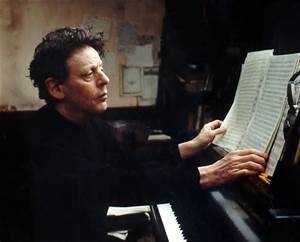
The Society will meet again for the first time in 2016 tonight Monday February 1st at 7.30 pm in the usual place. The presentation will be by Peter Horwood and the title is Bright, Shiny and New. This will be a selection of 21st Century composers who are approachable and stimulating. It will include pieces by Philip Glass (pictured); Valentine Silvestrov; Peteris Vasks; Oliver Davis; Kenneth Fuchs; James Macmillan and Einojuhani Rautavaara.
If you want to know where we meet, details are in the ‘Find us’ tab on the Home page. There is easy parking. New members very welcome.
The next meeting is tonight, 2 November, and will concentrate on the music of Ronald Stevenson. A prolific composer of around 500 works, he was born in Blackburn in 1928 and died in Scotland in 2015. He was a pianist/composer in the manner of Liszt and Busoni. Christopher Guild will be presenting and he will play works transcribed by Stevenson composed by Percy Grainger, Busoni and the Scottish composer Ronald Centre. 7.30 as usual.
We are saddened to report the death of Vic Riches who died following a heart attack. Vic was a stalwart of the Society and was one of the founder members in 2002. He moved to Chichester about two years ago but last returned to present an evening in 2014. He will be sadly missed.
Those members who came to the first meeting this year given by our chair Ed Tinline might like to know there is a live follow up, in Salisbury, to his presentation in September of Music from a Sibelius 150th Anniversary Festival!
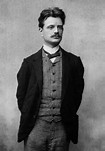
Sibelius
Folke Gräsbeck (two of whose recordings he included in his programme) will be giving a piano recital on Wednesday 4th November at 7.30pm in St Martin’s Church, Salisbury.
The publicity for the event says
Finnish pianist Folke Gräsbeck has recorded much of Sibelius’s piano music for Scandinavian record label BIS’s Sibelius Complete Edition, including a well-reviewed recital on the composer’s own piano at his home Ainola.
The programme is still to be confirmed in detail, but will feature several more well known pieces such as valse triste and may well include some UK premières of Sibelius’s lesser known piano works.
The next meeting of the Society is on Monday 5 October – usual time, usual place. It is entitled 1911 – New music of a sunset year and will be given by Barry Conaway. It will include music by Mahler, Delius, Sibelius, Elgar and Nielsen. We look forward to seeing you there.


 Salisbury Recorded Music Society