Music producer talks about his work

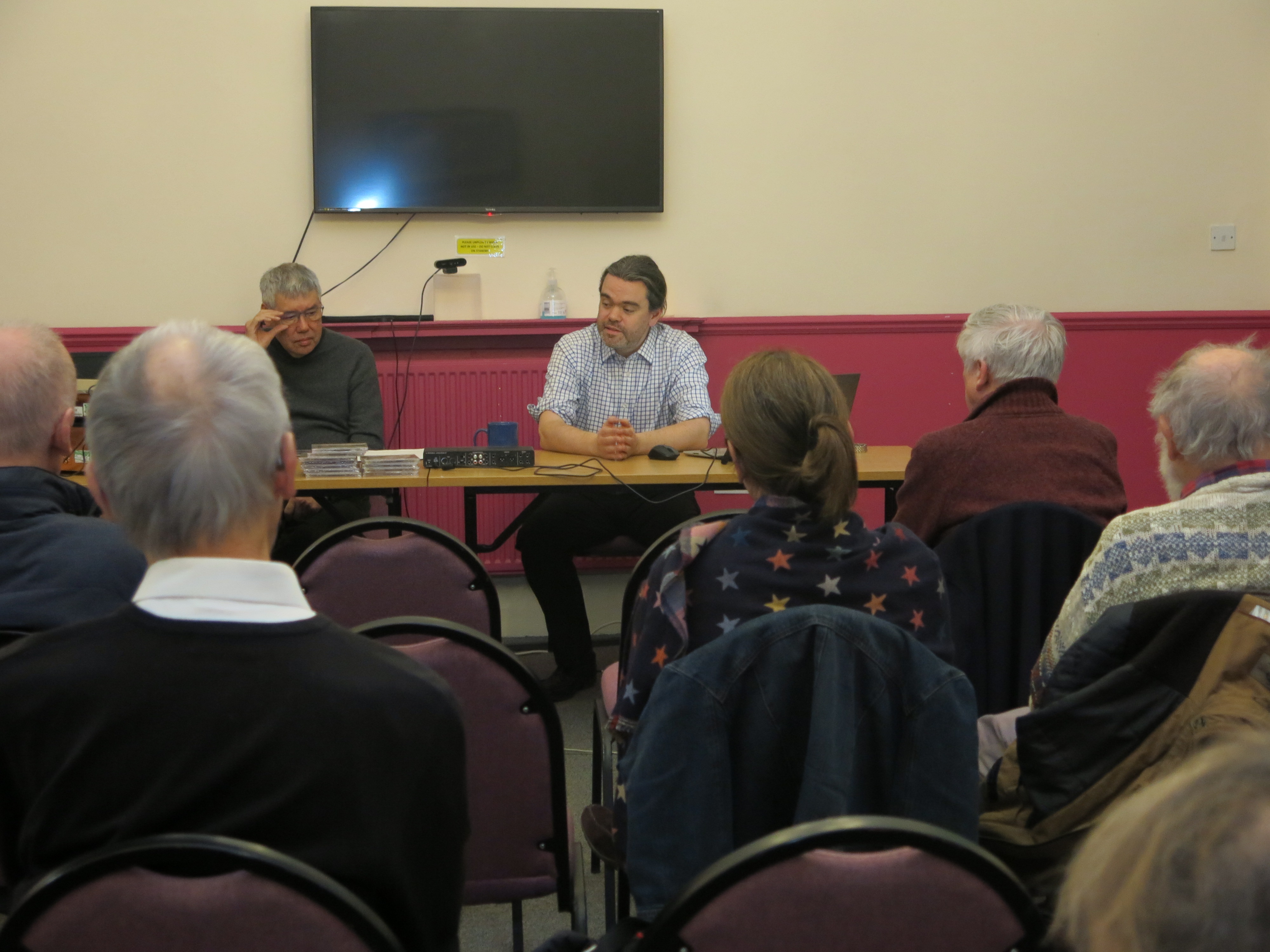
Music producer, Tim Smithies describes his work producing CDs

The first meeting of the new 2023/24 season kicked off with a fascinating talk by Tim Smithies on the problems and challenges producing music recordings for sale. Tim is a leading light of the Metronome label where he has been for 30 years. When we listen to a CD, we are not aware of the effort and time taken to assemble the artists, technical staff and instruments needed to make it all happen. An added problem for small and niche producers is that they are unlikely to have the resources needed to record the standard repertoire with big orchestras and a big name conductor and soloist.

In common with many small firms, survival often depends of locating a gap in the market too small for the heavyweight firms to consider. Metronome started with focusing on early music and the first example was music from the Plantagenet era and a piece composed by John Dunstable and played by the Orlando Consort. Another early recording was Love Affair with the Lute and a piece by John Dowland, Flow my Tears. Tim said the aim of his label was to “focus on the clarity” and this certainly shone through in this and other examples he played.

As time went on, the label got “drawn into other people’s interests” as Tim put it and that means expanding the repertoire to include other artists and genre. This is the classic dilemma for small firms: do you stay focused on your strategy or do you respond to market opportunities as they come along? As Tim explained, trying to do the former can be difficult especially in the world of artists. Opportunities arose and it was sensible to respond to them.

Things can develop from a very small start he said. He instanced the harpsichordist Carole Cerasi whom he heard at a concert playing music by Elizabeth Jacquet de la Guerre. This led to a series of recordings by her on the label.

Closer to home, Metronome has produced music sung by the choir of Salisbury Cathedral in a recording called An English Choristers Songbook.

One of the problems a small producer has – as one might expect – is poaching of artists by larger firms. But it was not all one way he said and there were examples of what he termed ‘rebound’ that is, artists who wanted to do their own thing and found the restrictions of the big labels did not allow them to do that. Christopher Hogwood was an example who wanted to record music on the clavichord, an instrument widely used by Bach for example. The problem is that it does not have that great a volume so is suitable only for intimate settings. We heard a recording of a familiar Bach piece normally heard on a piano, which sounded quite different on a clavichord. The music appears on a Metronome recording called The Secret Bach.

One of the difficulties with recordings of this nature on period instruments is that they have to be made where it is situated since they cannot be moved to a recording studio. This has its own issues of finding a room with the right acoustics. As anyone who has organised an event in such settings will know, as soon as you are poised to start, drilling will start somewhere, as if by magic, making progress impossible. As we heard at a previous Society meeting, instruments need constant tuning during the recordings.

Talking of older instruments, we even heard a piece on the theorba, a double necked lute with an extra set of bass strings.

This was a fascinating evening and a great start to the new season. Not only did we hear some interesting and for some of us, unfamiliar music, but we learned of the story behind it and gained a glimpse of the life of a small, but perfectly formed, record producer.

Peter Curbishley

Next meeting on 9 October 2023. Printed copies are available in the Library, the Tourism Information Centre and Oxfam (upstairs).

New season has got underway

Next meeting on 6 November 2023

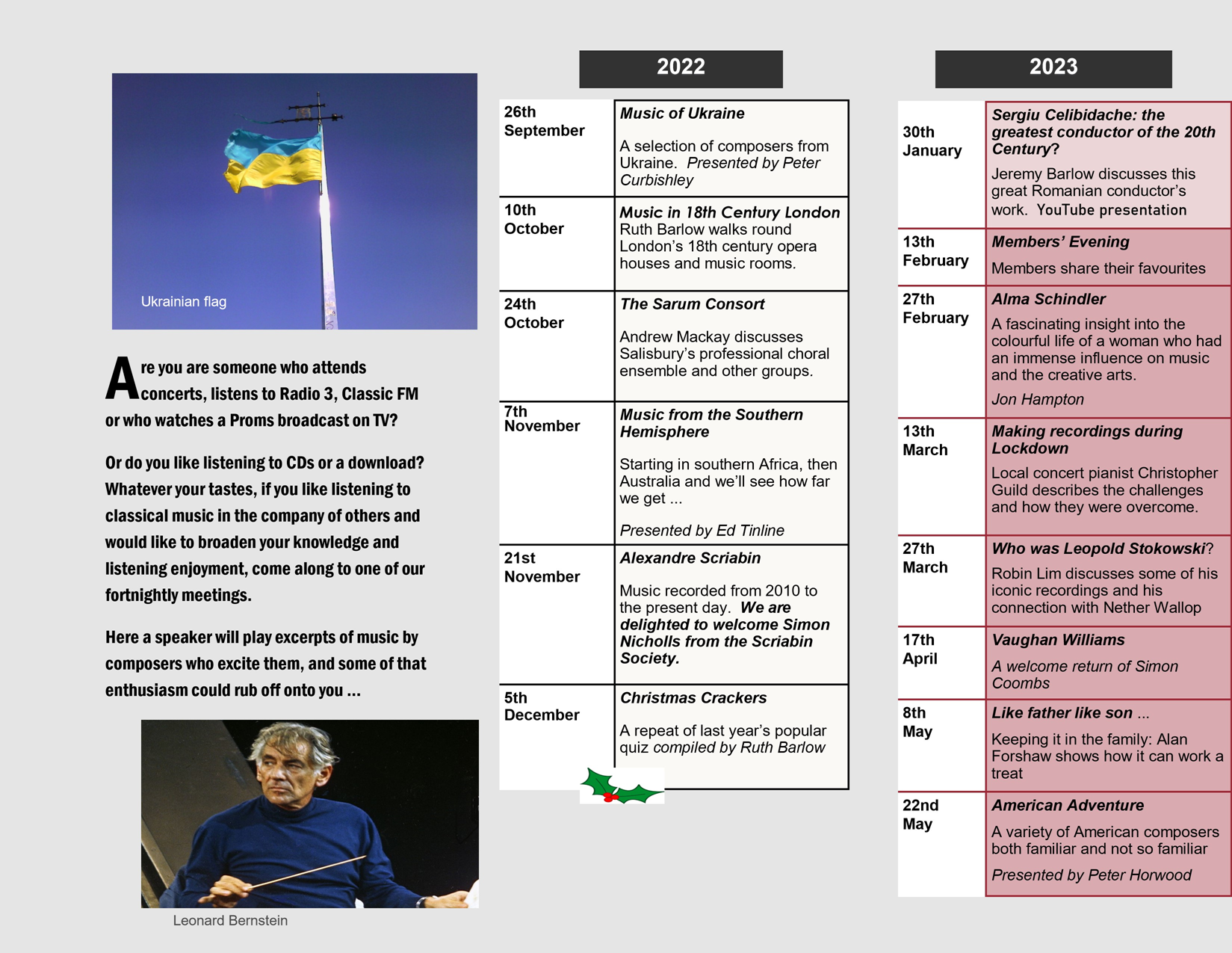
The Society’s new season started in September and we have an interesting programme again this year. We have a wide ranging series of evenings including music by Puccini, Gustav Holst, the best of the 20th Century and on why so few composers managed a tenth symphony. We also have two members’ evenings and a Christmas quiz.

You can download the programme here or printed copies will be in the Library, Oxfam (upstairs) and the Tourism Information Centre next week.

The Society meets once a fortnight on a Monday evening starting at 7:30 and we aim to finish at 10 pm. It meets in the Guides’ Centre in St Ann Street although access is from the rear off Friary Lane. Parking is free and it is accessible for people with mobility difficulties.

If you want to speak on the phone then contact Ruth on T: 01722 782387 or M: 07759 785760

Last meeting

Our final session of 2022-23 will be tonight, Monday 5 June when Peter Horwood will present his ‘American Adventure’. This will be a selection of composers both familiar and less so.

Our programme for 2023-24 is almost completed and will be published shortly.  We will resume on Monday 25th September 2023 when we hope to welcome you back.

Making recordings during Lockdown

The pianist Christopher Guild discussed the problems of recording during Covid Lockdown

You might think that the Society, having been in existence for several decades now, would not have anything new to offer, yet Christopher’s presentation on 13 March was new in several respects. First, it was a description of the recording process itself (more later) second, we had we had recordings performed by Christopher and third, two recordings which had never been performed in public before. Christopher used to teach at Godolphin School in Salisbury.

One composer he featured was Ronald Stevenson who is somewhat neglected today and whose work Christopher has been exploring and unearthing new pieces. Other composers featured during the evening were by William Beaton Moonie, Berhard van Deeren, Ronald Center and William Brocklesby Wordsworth, great nephew of the poet of the same name. There were transcriptions of works by Purcell. Stevenson is no stranger to the Society as Christopher gave a presentation of some of the composer’s work in an earlier visit in 2015.

Recording, like many other aspects of life, was all but impossible during Lockdown although there were attempts at performing elements and then melding them together. One such was a recording with a poem in medieval French included.

Christopher explained the recording process generally. Except for major stars, the record company will not make any up-front payment. This means the performers need to secure finance themselves unless they self-fund. The process starts with an idea which is proposed to the record label. Then a recording studio needs to be located and in the case of a piano recording, with a full size instrument. This is to do with the dynamics of the sound and the harmonics which are important for the integrity of the final sound. Perhaps surprisingly, the piano has to be kept in tune several times during the day which of course is another expense. This arises because of temperature and other changes in the studio during the day. The studio Christopher used was near Beccles.

Each piece can be played three times together with ‘patching’ where there are mistakes or infelicities of playing to be corrected. This process can take two days.

This was a fascinating evening with several never before heard pieces performed by composers – such as Ronald Center – of whom few if any of us had heard before. The process of recording was especially interesting and it’s perhaps surprising to note that as a recorded music society we have not touched on the process itself before.

PC


The next meeting is on 27th March and concerns the conductor Leopold Stokowski who died at Nether Wallop.

Photo: SRMS

Next meeting

The next meeting is tonight, 13 March 2023, and is a presentation about making recordings during Lockdown. It will be by concert pianist Christopher Guild and this is an extract from his biography:

Born in Scotland in 1986, Christopher Guild studied piano and violin locally before entering St Mary’s Music School, Edinburgh aged 13. He took top honours in the Moray Piano Competition 2001 – he remains the youngest winner to this day.  Christopher entered the Royal College of Music in 2005 as a Foundation Scholar and studied for six years with Andrew Ball, gaining a First Class BMus (Hons), and the MMus and Artist Diploma with Distinction.  He went on to be the Richard Carne Junior Fellowship in Performance at Trinity Laban Conservatoire of Music and Dance 2012-13.  

Christopher teaches at Godolphin School. We look forward to seeing you at 7:30pm

Music in eighteenth century London

This was the title of a presentation by Ruth Barlow which included a range of music popular in that century. London at that time was a rapidly growing city and the largest in Europe. The country was becoming prosperous as a result of the growing empire and people were looking for entertainment which would of course have included music.

Music was also coming out of the great houses and into the public sphere with an ever-increasing number of public concerts. Indeed, it was noted that if you wanted to learn about music you went to Paris or Italy, if you wanted to earn a living, you came to England.

The evening started with a performance of Corelli’s Concerto Grosso No 8 (excerpts) and ended with the last movement of Haydn’s Symphony No 4 nicknamed the ‘London’. This framing so to speak seemed to sum the century up with Corelli’s piece echoing the previous century and Haydn’s symphony, written in 1795, which ended it and gave hints of what was to come.

In between, we heard pieces by Handel, JC Bach, Thomas Arne, and William Boyce. We also heard part of the Beggar’s Opera, hugely popular in its day receiving 62 performances in its first season, on a recording directed by Ruth’s husband Jeremy which must be a first for the Society.

Music from men only ‘catch clubs’ was also performed. Today we would call them rounds but they are centuries old and involve singers coming in one by one singing the same melody. We heard examples by Henry Purcell and JS Smith sung by the Hilliard ensemble.

A sad moment was a Violin Sonata in A major by Thomas Linley, and English prodigy born in Bath who was certainly destined for great things. He was a friend of Mozart and they met and became friends in Italy. Unfortunately, he died at the tender age of 22 thus ending what was likely to have been a successful career.

Altogether a well put together programme and an interesting evening.

New programme

The new programme for 2022 – 23 is available and the print version can be found in the Library, TIC, and the Oxfam music Room. We have some outside speakers including someone from the Scriabin Society and old friends returning with new topics.

There will be a coupon in the programme entitling you to a free evening* for those who are curious about what we do. Keep an eye on this site – better still put it into your favourites – and we look forward to seeing you when we kick off again in the autumn.

*can only be used once

New season starts

Second half programme kicks off on Monday, 31 January 2022

The second half of the programme starts in style on Monday with a presentation by John Challenger of Salisbury cathedral on the Father Willis organ, one of the finest organs in the country. He will explore the highs and lows, delights and difficulties of recording on the organ.

As before, we feel it is appropriate to ask all attending to follow the Covid safety measures we have in place including well spaced seating, wearing a mask and as far as possible maintaining social distancing.  

The next meeting after this will be on Monday 14th February, when Angus Menzies will be presenting: ‘H is for Heinichen and Hesse, masters of the Dresden baroque’

Reduced membership for the second half of the year available. £3 at the door for non-members

Next meeting

The next meeting will be on Monday 27th September at 7:30 and will be a Members’ Evening for which the Committee will bring and introduce their choice of pieces.

The meeting will start with the Annual General Meeting.

We shall have an interval when we will be able to offer tea or coffee, but you’re welcome to bring your own drink. May we remind any member who has not yet joined for this season, that the membership fee is £20 as before, and that Ruth would be pleased to accept cash or a cheque payable to SRMS. The fee for occasional visitors continues at £3.

We have met staff at the Guides and agreed appropriate Covid safety measures which we ask all attending to follow.  These will include sanitising procedures on arrival, well spaced seating, wearing a mask, minimising moving around and maintaining social distancing. 

Copies of the full programme for the season will be available at the meeting.  The next meeting will be on 11th October and will be presented by Peter Horwood.

We hope you will be able to come on Monday 27th September at 7.30 and to feel comfortable with the arrangements we plan to have in place.

What a strange season!

We held our last meeting on Monday evening (10 May 2021) using a combination of Zoom and YouTube. It was a presentation by Ruth of a selection of humoresques. She said  ‘a humoresque is not necessarily funny, but they do tend to have a whimsical, flippant character, and a general disregard for musical convention.’ You can listen to her selection – which is well worth while – by following this YouTube link:  https://youtube.com/playlist?list=PLDYYr-sXg1St6Iys2ElVT3tRHS-btqDs2

It has been a funny season where we have not of course, been able to meet. However, the online format has worked surprisingly well and has enabled a different perspective from our normal modus operandi. We have been able to see some of the performances as well as listen which does sometimes add to the experience. When we meet in person again – which we hope to do in the autumn – we plan to do more of the visual presentations using the screen the music room has installed.

Details of the 2021/22 programme are now being put together and will be posted here and in leaflet form around the town as before (Oxfam, TIC and Library).

We hope to see you again when we reconvene.