Members’ evening

April 2025

Due to illness, our speaker for the evening was unavailable. Undaunted, we held a members’ evening which was – shall we say – diverse with a wide range of contributions.

First was a well-known piece by Hamish MacCunn called Land of the Mountain and the Flood. It was used as the theme music to the TV series Sutherland’s Law. It is one of those melodies which are recognisable but you can never place who might have composed it.

Next was the first movement of Pierre Rode’s Violin Concerto No 7 thought by many to be the best example of his work. Rode was one of those composers who was all the rave when he was young at the turn of the 18th Century and hugely popular. He was admired by Beethoven and Spohr. He left France, spending several years in Russia and upon his return, his star had faded. There was some suggestion that he had picked up an infection which affected his playing. Anyway he left Paris and returned to his home town of Bordeaux. Sadly, he died quite young.

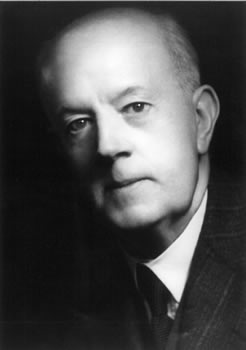
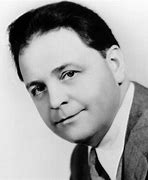
Next we watched – and listened – on screen to the music of Leroy Shield. Who? I

hear you say: he was the composer of the sound track of the Laurel and Hardy movies. So you are likely to be able to call to mind the jaunty theme to their films without knowing who wrote them. He was significant because it was the time of the ‘talkies’ which were hugely disruptive for the industry. Many actors and actresses never survived once people heard their voices. Some studios struggled with the technology especially matching the sound track to the images. Hal Roach and others overcame the problems and helped the comic team to their huge success

Also another familiar piece from those times was the theme to Charlie Chaplin’s film Modern Times which he composed. Chaplin was slow to adapt to sound – his humour was essentially visual – but did so to further enhance his reputation.

Vivaldi was played and no, not the Four Seasons beloved of Classic FM, but Nisi Dominus composed at the beginning of the 18th Century and a setting of Psalm 127. It is a highly regarded piece and shows why he was much admired by JS Bach.

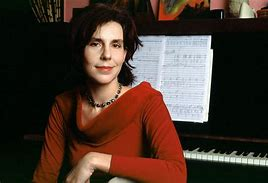
Hanna Kulenty (pictured) is Polish and it was good to feature a female composer. Born in

1961, she has an impressive range of compositions in a variety of genre to her name. Tonight we heard Music for Roy – intriguing and quite different in style to what had gone before.

Still on the subject of women, next was a performance of a movement from Shostakovich’s Cello Concerto No. 1 performed by the Argentinian cellist Sol Gabetta. We watched this on screen and her amazing talent was plain to see. She first started playing the violin at the age of 4 and switched to the larger instrument a year or two later.

Next some jazz by Steve Reich and something completely different. I Sixteenths is typical of his style and can be heard on this clip.

Anouard Brahem is not a name known to many but is a Tunisian player of the oud, a Middle Eastern instrument similar in many ways to the Lute from which the name derived. It differs in having no frets and a shorter neck than a lute. We heard Dances with Waves which started with a bass clarinet solo and then joined by a solo oud piece.

Tchaikovsky: well everyone’s heard of him. But they were unlikely to have heard this recording which was made a century ago and has now been digitised. We forget that stereo recordings were effectively unknown in the ’20s but the vigour and brightness of this exciting piece – oh, didn’t I say, it was an excerpt from his 4th Symphony.

Altogether an fascinating evening with jazz, film and TV scores, and other curiosities.

Peter Curbishley


Our next and last meeting is on Monday 12th May and is a presentation of the music of Edgar Bainton. We look forward to seeing you there. 7:30 as usual.

Tonight’s meeting

March 2025

Our next meeting will be tonight, Monday 24th March, when we shall welcome Peter Jarvis who will be reminiscing about his life in the orchestra pit as a clarinettist.

At the following meeting on 7th April Peter Curbishley will be discussing the somewhat overlooked French Composer Francis Poulenc.

I hope we can welcome you to one or both of these evenings.

PC

William Mathias

Excellent presentation on this largely forgotten composer

March 2025

One of the puzzles of musical life is why some composers seem to disappear from the repertoire. One thinks of Bruckner who enjoyed great popularity in his day at the end of the nineteenth century then was forgotten for many decades. He began to be appreciated again in the 60s. Bach no less suffered a long period of silence until Mendelssohn brought him out of the shadows.

Last evening we heard a range of compositions by the Welsh composer William Mathias. Unknown to several us, he composed a wide range of material including symphonies, concerti, choral and an opera. Lindsay Dannatt provided several examples from his compositions many of which were accomplished and of great interest. It is true that some have entered the repertory such as the Harp Concerto from which we heard an extract, the Piano Concerto No 3, likewise and the Organ Concerto.

Other works were extracts from Symphony No 1; the Horn Concerto and Divertimento for String Orchestra. Choral works included This World’s Joie and Songs of William Blake.

Mathias’ musical language embraced both instrumental and vocal forms with equal success, and he addressed a large and varied audience both in Britain and abroad. He was widely honoured in the academic word being awarded an Honorary DMus by Westminster Choir College, Princeton USA in 1987 and he was made CBE in the 1985 New Year’s Honours. He was honoured in Wales, his home country as well. He died in 1992 at a relatively young age.

Although some of the references to him, in Groves for example, refer to the influence of Bartok and Hindemith, he had a definite ‘voice’ and was not in any way derivative.

We were enormously grateful to Lindsay for bringing this composer to our attention and for an informed selection of his works.

Peter Curbishley

Next meeting: tonight

January 2025

Our first session of 2025 will be tonight, Monday 27th January 2025 when Peter Horwood will present “A Polish Panorama” – a summary and brief survey of Polish composers from medieval times to the 21st Century.

Following that on 10th February, we shall welcome Ute Schwarting to tell us about her personal journey with the music of Johannes Brahms.

We look forward to seeing you there.

Meeting tonight

The Society’s penultimate meeting takes place tonight, Monday 29th April, and is entitled The curse of the ninth. Some symphonic composers have reached nine but not quite managed, or finished, a tenth. Alan Forshaw examines the myth that of why nine composers couldn’t or wouldn’t write a tenth symphony.

Starts at 7:30 as usual.

Second half starts

Second half of the programme starts on Monday 29th January

January 2024

Last night: review shortly.

The second half of the Society’s season starts on Monday 29th at 7:30 as usual with a presentation by Chris Cope posing the question ‘is there more to Gustav Holst than the Planets?’ Holst was a reticent man and the fame which followed the success of the Planets was not altogether welcome. Much of his music was unknown but there has been something of a revival since the ’80s and hopefully we will hear more during Chris’s presentation.

[This event may appear in the Salisbury Journal’s What’s On page and even though it was posted with the correct date, the confirmation was returned with Friday shown and I have been unable to change it. To confirm: the meeting is on Monday 29th].

PC

New season has got underway

Next meeting on 6 November 2023

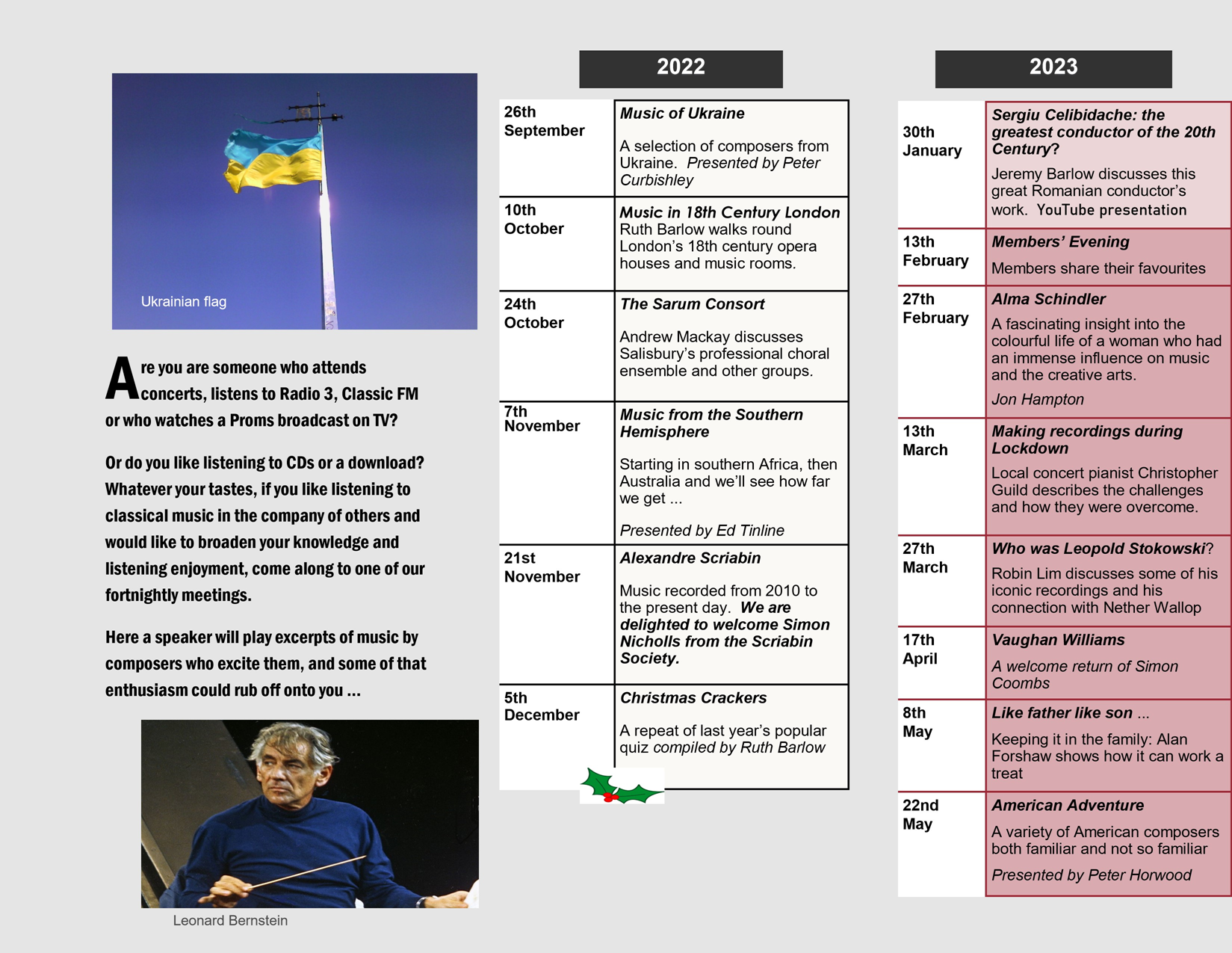
The Society’s new season started in September and we have an interesting programme again this year. We have a wide ranging series of evenings including music by Puccini, Gustav Holst, the best of the 20th Century and on why so few composers managed a tenth symphony. We also have two members’ evenings and a Christmas quiz.

You can download the programme here or printed copies will be in the Library, Oxfam (upstairs) and the Tourism Information Centre next week.

The Society meets once a fortnight on a Monday evening starting at 7:30 and we aim to finish at 10 pm. It meets in the Guides’ Centre in St Ann Street although access is from the rear off Friary Lane. Parking is free and it is accessible for people with mobility difficulties.

If you want to speak on the phone then contact Ruth on T: 01722 782387 or M: 07759 785760

New season about to start!

NOTE: please note that the first meeting does not take place tomorrow, 12th September as printed in Music in Salisbury. We had to change our programme at the last minute due to unforeseen circumstances. The first meeting is on 26th. We are sorry for this sudden change.

The new season gets underway soon and the programme is printed and will soon be in various locations around town. A pdf version is below. It is a varied and extremely interesting programme so we look forward to seeing you again on Monday 26th September for a presentation of music from Ukraine. We look forward to seeing you again or welcoming new members.

New programme

The new programme for 2022 – 23 is available and the print version can be found in the Library, TIC, and the Oxfam music Room. We have some outside speakers including someone from the Scriabin Society and old friends returning with new topics.

There will be a coupon in the programme entitling you to a free evening* for those who are curious about what we do. Keep an eye on this site – better still put it into your favourites – and we look forward to seeing you when we kick off again in the autumn.

*can only be used once

Next Meeting

Our next meeting is tonight, Monday 28th March when Robin will be presenting: “Women composers who won the Prix de Rome”.

I hope you will be able to attend.

Note that we have a range of CDs for sale at a £l each or less as well as a selection of books for sale including biographies of Mahler and Ben Britten as well as other books on musical topics. All at bargain prices!