October 2025
This week’s meeting of the Society was an exploration of the work of
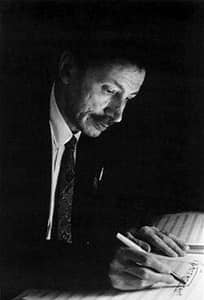
Hovhaness a composer probably unknown to many. The presenter was Peter Horwood who had done a lot of research to illuminate his works and music. Peter kindly gave us his notes and these are presented below.
Hovhaness was an extremely prolific composer and addition to symphonies composed 10 operas, 3 oratorios, a great mass of orchestral, chamber, vocal and instrumental pieces – 434 opus numbers plus a considerable number of unnumbered compositions. There is well over 500 known pieces. A man of considerable energy he was also married 6 times! The first extract was:
Symphony 22 Op 236 ‘City of Light’ 1st movement excerpt
That excerpt from Symphony 22, ‘City of Light’ demonstrates some key features of Hovhaness’s mature style – a luminous (maybe even numinous (spiritual) tone/quality, long breathed melodies, block chords, modal harmony, and exotic sounds (bells, percussion effects in clusters etc).
Written in 1971, this symphony is one of no less than 67!
Certainly, the music appeared to flow unceasingly from him. Inevitably with such a large output there are variations in quality, but the best, as I hope you will hear is fully worthy of our attention and appreciation.
John Cage, a friend and longtime advocate of the composer said his music was like ‘inward singing’, ‘his melodies are often long and arching, clear and consonant, generally modal and run the gamut from western diatonicism to rhythmically complex Indian Ragas – with many cultural variations woven in. Echoes of Renaissance choral polyphony and Baroque instrumental part writing course through much of his music.’
This alchemy/mix of Western and Eastern, Ancient and modern, produces a very individual and recognisable voice. Sometimes one particular influence may take precedent, let’s hear a couple of examples, firstly two bagatelles for string quartet:
Bagatelles for string quartet Op 30 1, 2
Now lets hear a short piano piece called
Piano piece mystic flute –
This piece was a favourite of the composer Rachmaninov who used it as an encore when he was on tour.
I think you will agree that there is a distinct middle or far eastern sound to these pieces.
Born in 1911 in Massachusetts to a Scottish mother and Armenian father the composer showed amazingly precocious talent, from the age of 4!
As a boy, he acquired a love of mountains through long walks and apparent metaphysical experiences in the hills of New England. Such landscapes were the frequent subjects of his paintings and drawings. Mountains always remained important to him, determining the locales in which he chose to live, such as Lucerne in Switzerland and Seattle on the Pacific Coast, and would prove to be a lifelong inspiration
Hovhaness explained ‘Mountains are symbols of man’s attempt to know God. They are symbolic meeting places between the mundane and spiritual worlds.’
This not an unusual conception. Mountains have figured prominently in many spiritual and religious situations.
Studied piano and then composition at The New England Conservatory, with amongst others Frederick Converse, a noted but relatively conservative composer.
In the 1930’s gained a basic living through teaching and performing. He also composed prolifically throughout this decade. In 1935, prompted by his great love of the music of Sibelius, Hovhaness and his then-pregnant first wife (artist Martha Mott) visited Finland to meet Sibelius. A friendship was struck up, and the Finnish master later became godfather to their child, a daughter, who in homage was named Jean Christina.
Surviving examples of work from this stime include the Mystic Flute piece just heard and this following piece, Song of The Sea:
Song of the Sea – part 1
This is relatively conventional, but Hovhaness was due to radically change his style. He was strongly affected by meeting Uday Shankar (Ravi’s brother) and North Indian musician Vishnu Shirali when they performed in Boston in 1936, a time when Indian music was scarcely known in the West.
In 1942, Hovhaness won a scholarship at Tanglewood to study in Bohuslav Martinu’s Master Class. This period turned sour when he also came into contact with Bernstein, Copland and their impressionable circle in the composition class. Already something of an outcast amongst this clique (not being Jewish, homosexual, or Paris-trained), he left this situation immediately
At this artistic crisis point, Hovhaness found strength from friendships with two Boston artists, Hyman Bloom (who later on became rather famous) and Hermon di Giovanno. In 1943 di Giovanno, a Greek painter and mystic, supposedly guided Hovhaness into the ancient worlds of Greece, Egypt, Armenia and India. Hovhaness described di Giovanno as the “spiritual teacher who opened the gate to the spiritual dimension”. He was a pivotal influence in that he encouraged Hovhaness to seek out his paternal Armenian heritage and be true to himself in his pursuits.
In addition, during 1940’s Hovhaness sustained his living by being appointed organist at St James’s Armenian Church in Waterstone, Massachusetts.
This 1940’s were looked upon as his ‘Armenian period’ where he found authenticity and spiritual inspiration and Hovhaness destroyed most of his earlier music in order to make a ‘fresh start’.
This change of direction is exemplified in the 1944 concerto for piano and strings, Lousadzak (means ‘Coming of Light’) where the soloist’s part is an exquisitely filigreed giant melody, monophonic throughout, which imitates Armenian and Turkish stringed instruments. In this seminal work Hovhaness introduced his aleatory technique, initially called ‘spirit murmur’. Here, performers individually repeats a designated melodic phrase over and over without synchronicity to the rest of that section’s players. The invention of this so-called ad libitum technique has mistakenly been attributed to Polish composer Witold Lutoslawski, because some 17 years later he first employed it in his 1961 orchestral work Jeux Venitiens.
This piece was premiered at the composers memorable New York debut and marked a step change in his standing.
Piano concerto ‘Lousadzak’ (1944) excerpt
Composer and newspaper critic Lou Harrison recalled it thus:
“’I remember the premiere of that work in Town Hall, and the enormous excitement that Alan’s sudden appearance in New York produced. The intermission that followed [Lousadzak] was the closest I’ve ever been to one of those renowned artistic riots. In the lobby, the Chromaticists and the Americanists were carrying on at high decibels. What had touched it off of course, was that here came a man from Boston whose obviously beautiful and fine music had nothing to do with either camp, and was in fact its own very wonderful thing to begin with. My guest John Cage and I were very excited, and I dashed off to the lamented Herald Tribune and wrote a rave review while John went back to the Green Room to meet Alan”.
Lou Harrison had moved to New York to be employed as music critic and his association with John Cage, Virgil Thomson and now Alan Hovhaness, formed a lifelong connection and mutual support.
At first sight what seems an unlikely combination of individuals to befriend each other made sense in that there was a mutual attraction to seek alternative musical formats and cultures, rather than follow western ‘conventional modernism’.
Composer writer and teacher Lou Harrison was a cultural polymath, who worked across a number of areas, not just music. His own music combines serial and aleatory procedures, used quarter tones, emulates ancient polyphony and gamelan rhythms, – using extraordinary devices for producing unusual sounds. As well as a leading reviewer and writer he had an intense interest in eastern music, especially Balinese gamelan music. This is reflected in this next piece:
LOU HARRISON – Concerto in Slendro
Slendro refers to an Indonesian five tone mode with no semitones.
During the 1950’s and 60’s Hovhaness was awarded a series of Rockefeller and Fullbright scholarships to travel and study Indian, Korean and Japanese music. The composer wrote and conducted pieces in these countries and undertook study in Korean Ah-ak (ancient court music), Japanese Bunraku and Gagaku (traditional ceremonial music) and also music applied to Noh theatre)
This period of study and related composition is known as his oriental period.
Hovhaness composed for a wide range of instrumental and vocal forces so let’s now hear an example of a cantata, written in 1968 for soloists, choir and orchestra. We will hear the introductory section – (lyrics)
Lady of Light – cantata – Op 227 – ‘Great is the Power of Love’
Hovhaness, along with his chosen colleagues, was always looking to expand his compositional tonal palette, or means of expression. It is difficult in any epoch to accredit change or innovation to any specific person or events; things happen through the chemistry of interaction and creative association. This next piano piece uses innovative performance techniques, realised at the time that John Cage was working in a similar vein.
Pastorale No. 1 for piano
In 1966/67, Hovhaness had been Composer in Residence with the Seattle Symphony. In the early 1970s Hovhaness moved permanently to Seattle, Washington. His recent links with the Seattle Symphony Orchestra had unwittingly brought about a love affair with the landscape: “I like the mountains very much. I don’t have to go to Switzerland, I expect to stay here.”
Also, in the early 1970s, the music itself was in demand for live performance. The 1975 Hovhaness royalty statement from publisher C.F. Peters Corp. was 17 pages long. Nearly all of his 240 compositions had sold that year, from 1 copy of the Accordion Concerto to 5,620 copies of the 4-page choral piece From the Ends of the Earth. Let’s now hear that piece:
From the end of the Earth – choral
We have previously mentioned the composers use of ‘long breathed’ or giant melodies. Commissioned in 1967 by the Detroit Symphony Orchestra the tone poem Fra Angelico portrays the work of the Italian artist who painted in an Eastern spirit, of celestial musicians descending heaven to earth, accompanied by celestial trumpets.
Fra Angelico – excerpt
John Cage was born in Los Angeles in 1912. From an early age he showed and particular interest in dance and percussive music, as well as developing techniques to alter the tone and character of instruments ‘prepared piano’. From the 1940’s lived in New York where he pursued his interests in composition and music by chance –originating the first ‘musical happening’, random performance by throwing coin etc and developing aleatory techniques. Also, like Hovhaness he had an intense interest in Eastern philosophy and Buddhism. He met Lou Harrison when he was organising concert events in the San Francisco Bay area. Having much in common in their search for new sounds and unusual musical formats, especially for potential percussion instruments they spent much time rummaging the junk yards and import stores for brake drums, dustbin lids, flower pots etc!
This is a piece that they jointly composed for percussion quartet, each writing two parts.
LOU HARRISON/JOHN CAGE – Double music
Hovhaness, from his youthful enthusiasm of studying Bach, probably more fugues than any other western 20th century composer. We will hear and example of a double fugue taken from perhaps his most famous work, Symphony no.2, ‘Mysterious Mountain’ , played here by one of Hovhaness’s fervent advocates, Fritz Reiner conducting the Chicago Symphony Orchestra in 1958.
Symphony 2 ‘Mysterious Mountain’ 2nd movement – double fugue
From the 1970s (and thereafter) the composer retreated from overtly oriental/Eastern sounding devices. If anything, Hovhaness veered towards a more Western neo-romantic approach, but still within the realms of rhapsodic melody and mystical expression. Noteworthy is the expansion of harmony from purely modal (as in the 1960s) to fully chromatic, including whole-tone and diminished chords
We will conclude this presentation with two works that represent the mature or final style statements of the respective composers.
We have noted that John Cage was a close friend and lifelong advocate of Alan Hovhaness. From their initial meeting each composer took a number of creative routes before finally establishing a mature style. We will hear a work from John Cage that is part of his ‘number’ works completed in the last two years of his life. These works have been described as ‘products of a profound and brilliantly imaginative musical mind.’ 42 was composed in 1990 for a High School choir in Oregon (the text is built on letters of that state) in the style of a harmony textbook, one can visualise the whole notes on four staves.
JOHN CAGE – 42 Choral
In May 1981, Henry Hinrichsen, president of C.F. Peters, approached Hovhaness with a one-off commission for a symphony on the theme of Mount St. Helens, the famous volcano that had erupted in 1980. Both the Seattle Symphony and the San Jose Symphony wanted to give the work’s premiere, which was eventually decided by the composer on the flip of a coin.
Between 1980 and 1989 Hovhaness penned some 80 works, including almost 20 symphonies. 1986 alone witnessed the creation of six symphonies.
Symphony is somewhat misleading term as these are not classically structured, goal orientated works, as a lot of contemporary symphonies, but rather a series of movements, almost baroque in nature, that together express a collective feeling or impression.
We will hear the finale that describes a volcanic eruption and concludes with a song of awe to creation.
Symphony No. 50 ‘Mount St Helens’ op 360 – Finale
Copyright©Peter Horwood 2025
I hope you will agree this is a serious piece of work on this composer and the Society was grateful to Peter for bringing this largely unknown composer to our attention.
PC



 Salisbury Recorded Music Society