
Nino Rota

April 2024

There are few who do not know the instantly recognisable theme to The Godfather, the composer of which is less well known. Nino Rota, real name Rinaldi, born in 1911, composed this and over a hundred other film scores as well as much other music during the course of a prolific career.

Last evening, Robin Lim gave an excellent presentation of this composer’s life. He was a prodigy and, aged 11, while the rest of us were reading Enid Blyton or looking at our stamp collections, he was composing an oratorio which was performed in Milan. Aged 14, following his father’s death and with the help of the Italian conductor, Arturo Toscanini, he went to the Curtis Institute in America to study composing and conducting.

Apart from The Godfather, another film score which received critical acclaim was for the Glass Mountain. The film itself was not a success but the music – of which we heard and saw an extract – was recognisable.

We heard a movement from the Clarinet Sonata composed in 1945 and also from a symphony. The sonata was very moving but the Symphony might need another hearing to appreciate it more. He composed four symphonies but they have been somewhat overshadowed by his film and operatic scores.

The overture to the opera I Cappello di Paglia di Firenze was lively and tuneful. For the film The Leopard by Visconti, he adapted the music from an unfinished symphony and we watched an excerpt featuring a waltz.

We could not of course escape hearing his famous composition but this was not the familiar version but one played on a harp.

He has sometimes been described as a musical chameleon – perhaps not always flatteringly – as his style is sometimes a little derivative of other composers.

In any event, it was a fascinating evening and we certainly learned more of this prolific composer.

And talking of unfinished symphonies. the next meeting on 29th April is ‘The curse of the ninth’ looking at those composers who never quite manage ten symphonies.

Peter Curbishley

Robin has kindly sent the full playlist:

1. Cello Concerto (1925) excerpt                                                                                          

2. Symphony No. 1 (1936 – 39) – 1st movement (Allegro con moto)                                                       

3. Clarinet Sonata (1945) – 1st movement (Allegretto scorrevole)                                         

4. “The Glass Mountain” (Henry Cass,1949) – Opera sequence                                                            

5. Sinfonia on a Love Song (1947, 1st Perf 1972) – 1st movement                                                         

6. “Obsession” (Edward Dmytryk, 1949) – Opening titles                                          

7. “The Stranger’s Hand” (Mario Soldati, 1954) – Opening titles and scene

INTERVAL

8. Overture to The Florentine Straw Hat, operetta (1st perf 1955)                                                                           

9.  “La Dolce Vita” (Federico Fellini, 1959) – Opening Titles                                                     

10. “La Dolce Vita” – Blues                                                       

11. Concerto Soiree for piano and orchestra (1958) – 1st Movement (Walzer-fantasia)                                               

12. “The Leopard” (Luchino Visconti, 1963) – Opening Titles                                                                   

13. Sinfonia on a Love Song – 3rd movement                                                    

14. “The Leopard” – Ball scene                                                                                               

15. “The Godfather” (Francis Ford Coppola, 1972)  – Love Theme – transcribed by Rota for solo harp

16. Le Moliere Imaginaire , Ballet (1976) excerpts         
New season gets underway

The Society was able to meet for the first time in many months at our normal venue off St Ann Street in Salisbury. Covid arrangements meant we could not offer refreshments unfortunately. Being back in person was good however.

The topic for the evening was the legend of Orpheus and the birth of opera. We tend now to think of opera in terms of major theatrical productions by Verdi, Wagner or Mozart etc replete with arias, an overture and full orchestra. It did not start out that way.

The presenter, Jeremy Barlow, introduced the evening with a discussion of the legend of Orpheus. This is a Greek myth and there are several versions but essentially, his wife, Euridice, is bitten by a snake and descends to Hades. Orpheus descends into Hades in an effort to see her again. Orpheus had been given a Lyre by Apollo and taught him to play which he did so well that few could resist his playing, even animals. Jeremy showed a number of artist’s representation of the myth and how the things like the instrument Orpheus played changed as those like the lyre went out of use.

Opera started he explained with things called intermedio which were short intervals between straight plays. These were put on during special court events in Italy such as feasts and weddings. After around 1600, operas as we now know them really began.

Monteverdi was not the first but is remembered because his music is still performed today. Various extracts from these earlier operas were played. Many composers through history have based their work on this legend.

A most interesting evening and the use of the monitor meant it was a new departure for the Society. Jeremy was able to mix legend with history and weave in musical examples to show the early development of the genre. We will almost certainly be using these methods in future and during lockdown, we were able to use YouTube to great effect.


The next meeting, on 27 September, will be ‘committee member’s choices’. We hope to see some returning members then. The full programme can be read here.

PC

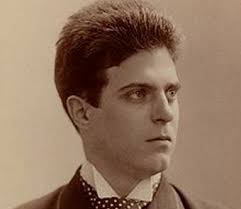
Pietro Mascagni

The last meeting of the Society took place on Monday 20 April.  It focused on the Italian composer Pietro Mascagni.  He was the son of a baker in Lavorno and studied at the Milan Academy. He lived from 1863 to 1945 and in the 1930s and during World War II worked reluctantly, and with difficulty, under Mussolini’s fascist regime.  He wrote 15 operas and one operetta.

mascagniIn England we tend to remember him only for his one-act opera Cavalleria Rusticana, the piece that made him famous overnight and gave him financial security for the rest of his life.  At its first performance it received no less than 60 curtain calls.  In his native Italy and elsewhere in Europe his works are better remembered and the presenter Ron Seaman played us some examples.  He was seen as the heir to Verdi but as time went on, it was Puccini who wore that mantle.  Among the pieces played were Mein ester Walzer, my first waltz; the Apotheosis of the Stork; and the ballet music for Fiori del Brabante.  We also heard extracts from Cavalleria including the final scene; Intermezzo and the Easter Hymn.  We also heard extracts from his last opera Nerone.

He is a composer who made it big early in his life and yet did not quite follow it up as he matured.  Listening to the range of his work it was perhaps surprising that he never composed film scores as some of his compositions, which had strong melodic lines, could have been adapted.

It was interesting to hear some works not often performed to gain a wider perspective of this composer.

Continue reading “Pietro Mascagni”