
Christopher Guild plays piano music from Scottish composers
October 2024
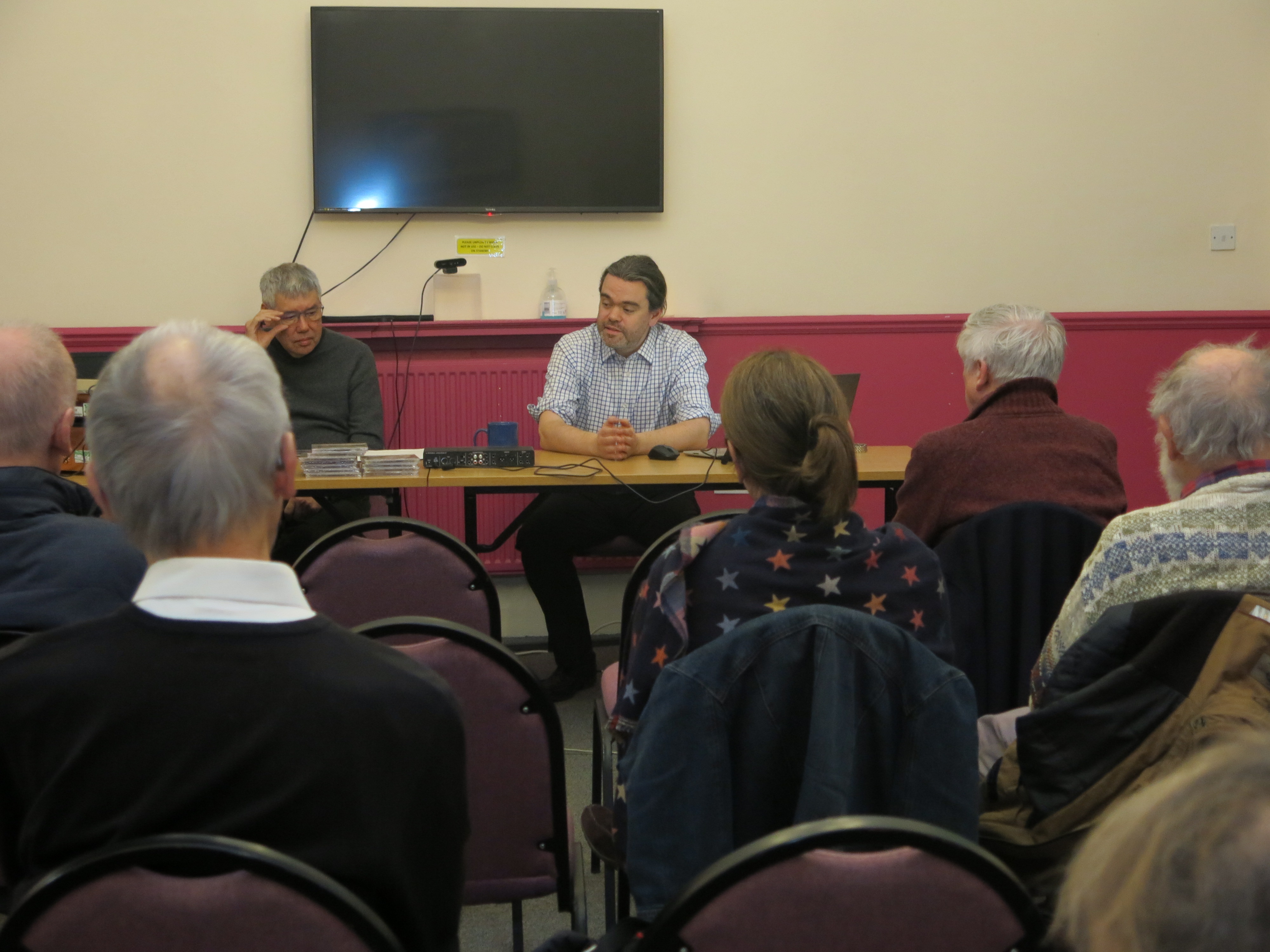
The Society was delighted to welcome back Christopher Guild who played a selection of largely unfamiliar piano music by Scottish composers. Many will remember his previous visit where he discussed the problems of producing recordings during the Covid lockdown.
One wonders whether the course of Scottish music might have taken a different turn if a certain Alexander Grieg had decided to stay in Scotland. Instead, he went to Norway and married a Norwegian girl who gave birth to a certain Edvard Greig – note the change in spelling – who put Norwegian music on the map. Just think what might have been …
Christopher is an accomplished pianist and has played at the Wigmore Hall and at St John Smith Square. He has also appeared on Radio 3. He has made a number of recordings and some of these were played this evening. Indeed, the Society was the first to hear one recording, a ‘world first’ in St Ann St, Salisbury no less.
A key influence is a form of music called ‘Pibroch’ an exact definition of which is a little challenging unless your Gaelic grammar is up to scratch and you have downed a few glasses of Scotland’s finest. A not altogether accurate summary is an extended compositional form for pipes – which effectively means bagpipes – with a number of variations. It is in contrast to shorter forms such as dances and reels.
We started with Eric Chisholm’s Piano Concerto No 1. Scottish born, he was highly regarded by fellow musicians and a number of his compositions were published and recorded. He is sometimes compared to Bartók, whom he encouraged to come to Scotland, and it was indeed possible to hear his influence in the piece. He was keen to encourage contemporary music.
This was followed by pieces by Francis George Scott and David Charles Johnson. We heard the latter’s Prelude No 6 which included an impressive fugue based on a Scottish folk song.
William Wordsworth, distantly related to the poet, had a somewhat troubled compositional history and was not always in favour. He was born in Surrey and moved to Scotland. We heard his Valediction.
Ronald Center, from Aberdeen, did not have a big compositional output – one symphony and a quantity of chamber music and solo piano works. The last composer was another Ronald, Ronald Stevenson who was born in Blackburn but spent most of his life in Scotland. Christopher introduced us to his work nine years ago. Much influenced by Grainger, he composed many works and was a teacher working in South Africa and New York. There is a society: https://ronaldstevensonsociety.org.uk
It was a pleasure to have an evening presented by someone with knowledge and enthusiasm for his subject. Here was a varied collection of pieces by a range of composers some, sadly, seldom heard. The Chair of the Society said it was an ‘ear opening’ evening.
The next meeting is on 21 October and is a members’ evening. Please let Robin know what your favourite piece is.
 Salisbury Recorded Music Society