Catherine Wilmers’ fascinating presentation
March 2026
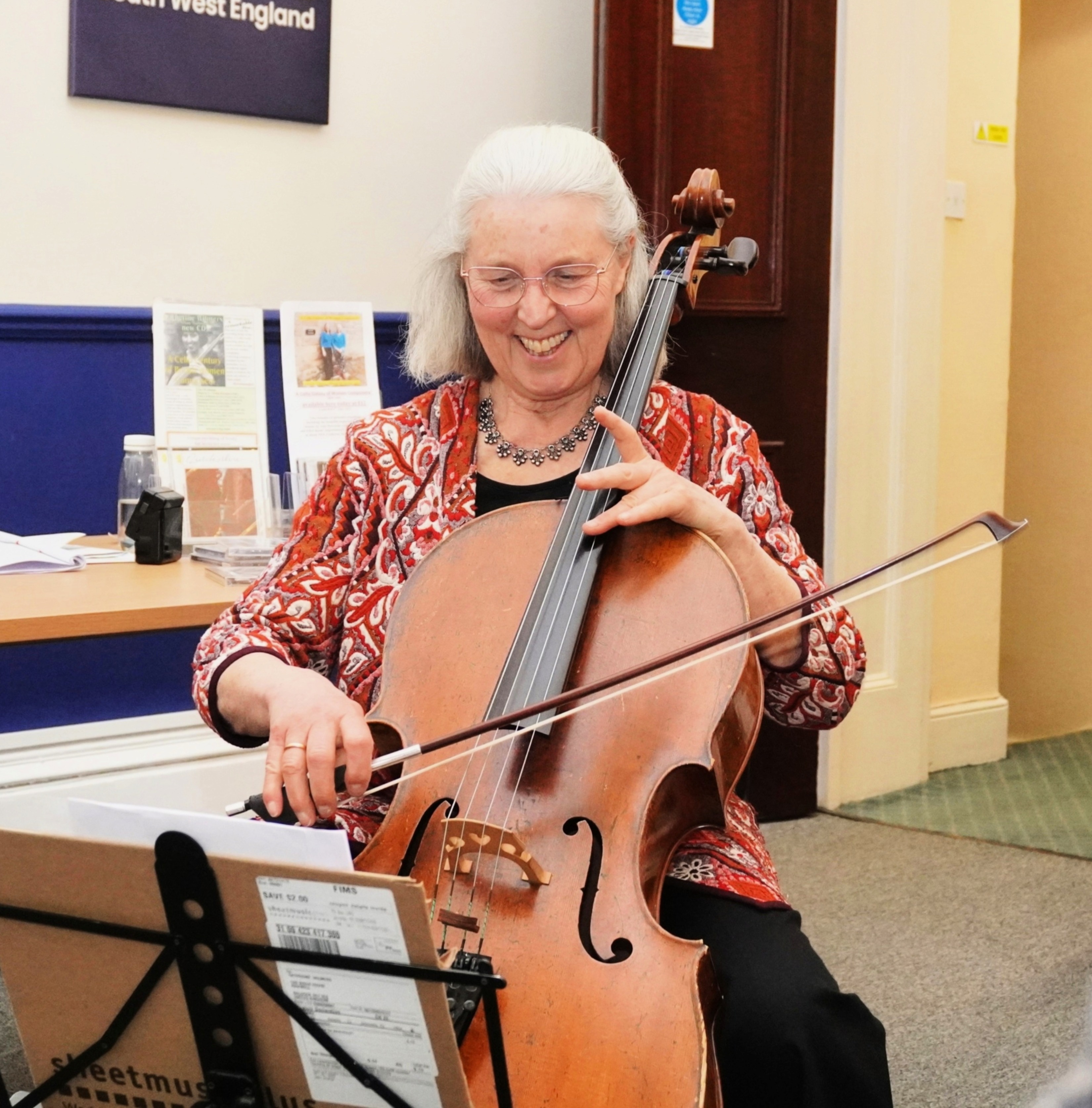
Female composers get a raw deal and few of their compositions get an airing in a musical world which until recently was very male dominated and to an extent, is still so. The Society was delighted to welcome Catherine Wilmers to give a presentation of a selection of such works and not only that, but works for the cello. She brought a cello along with her and played two of the pieces in a live performance.
Catherine (pictured) has a distinguished history having studied at the Royal Academy of Music and subsequently in Vienna. For a quarter of a century she played for the London Philharmonic Orchestra only the second woman to do so in the cello section. She has made many recordings.
Such was the prejudice against women composers that many published using only initials instead of their full name. This actually makes it harder for subsequent generations since finding out if ‘A’ Smith for example is Alexander Smith or Alexandra Smith is difficult. Detective work is often needed therefore.
Fanny Mendelssohn is well known but some of her works were published under her husband’s name. Is that plagiarism I wonder? Since a husband at that time owned his wife’s property then probably not – I digress. We heard her Fantasy in G minor written when she was 24 a quite brilliant work. Despite being a brilliant player she was not allowed to perform.
Some women did make it into the public realm one being Susan Spain-Dunk who conducted at the Proms at the time of Henry Wood only the second woman to do so.
Another interesting vignette of history was May Muckle who was the first to play the cello not ‘side-saddle’ no doubt because it was considered ‘unseemly’ to do so. We heard her Hamadryad.
The conductor Hans von Bülow was another man of that era who opposed female emancipation saying ‘women’s emancipation is hateful to me’. He did do a lot however, to promote the careers of composers like Brahms and Wagner. At that time was another famous female composer Dame Ethyl Smyth who was imprisoned for her campaigning for suffrage and was a friend of Emmeline Pankhurst . We heard an extract from her Sonata in A minor.
Altogether we listened to 14 pieces* from a range of women some of whom are sadly almost forgotten. We were extremely grateful for her presentation, the live performance of two pieces and the range of background material and anecdotes she had been able to find out about many of women she highlighted.
Peter Curbishley
Next meeting in 3 weeks on 13 April and is on black musicians in the period 1500 – 1800.
*I can scan the full list for anyone who would like it.
 Salisbury Recorded Music Society